Head and Neck Oncology Group, Chang Gung Memorial Hospital and Chang Gung University, Taoyuan, Taiwan.
PLoS One. 2012;7(7):e40767. doi: 10.1371/journal.pone.0040767. Epub 2012 Jul 12.
Human papillomavirus (HPV) is an oncogenic virus causing oropharyngeal cancers and resulting in a favorable outcome after the treatment. The role of HPV in oral cavity squamous cell carcinoma (OSCC) remains ambiguous.
This study aimed to examine the effect of HPV infection on disease control among patients with OSCC following radical surgery with radiation-based adjuvant therapy.
We prospectively followed 173 patients with advanced OSCC (96% were stage III/IV) who had undergone radical surgery and adjuvant therapy between 2004 and 2006. They were followed between surgery and death or up to 60 months. Surgical specimens were examined using a PCR-based HPV blot test. The primary endpoints were the risk of relapse and the time to relapse; the secondary endpoints were disease-free survival, disease-specific survival, and overall survival.
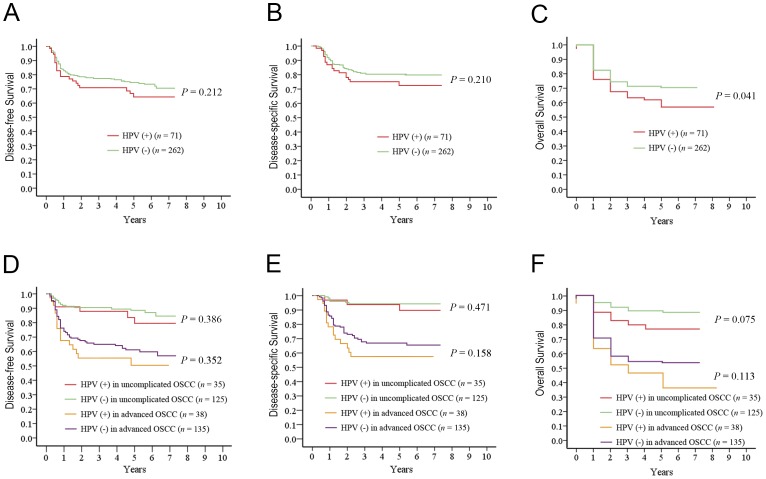
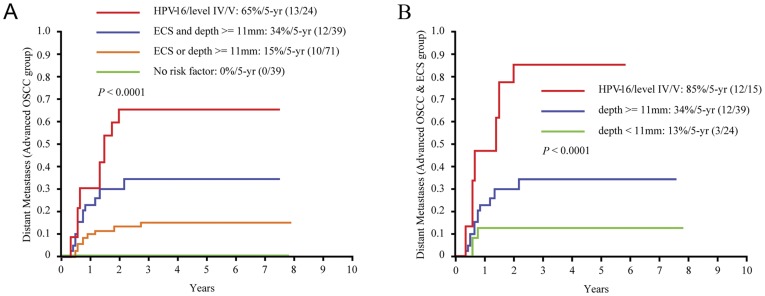
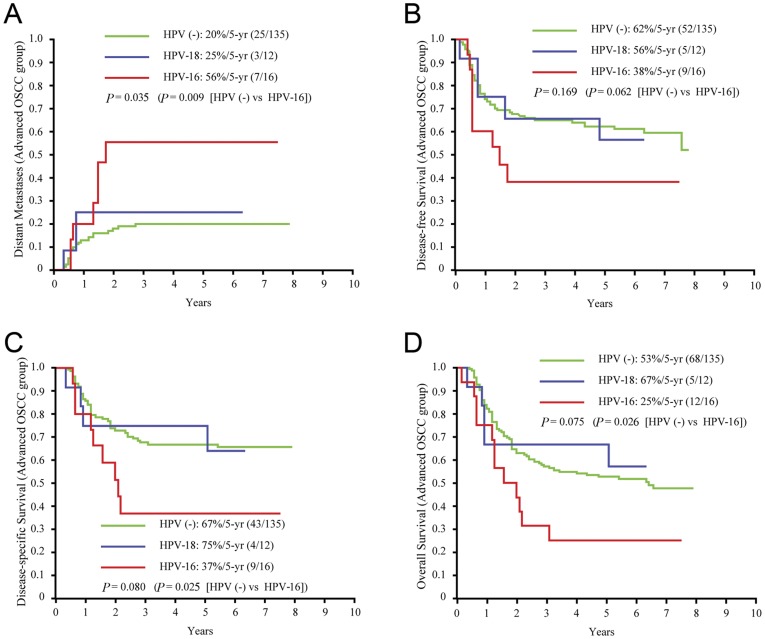
The prevalence of HPV-positive OSCC was 22%; HPV-16 (9%) and HPV-18 (7%) were the genotypes most commonly encountered. Solitary HPV-16 infection was a poor predictor of 5-year distant metastases (hazard ratio, 3.4; 95% confidence interval, 1.4-8.0; P = 0.005), disease-free survival (P = 0.037), disease-specific survival (P = 0.006), and overall survival (P = 0.010), whereas HPV-18 infection had no impact on 5-year outcomes. The rate of 5-year distant metastases was significantly higher in the HPV-16 or level IV/V metastasis group compared with both the extracapsular spread or tumor depth ≥ 11-mm group and patients without risk factors (P<0.001).
HPV infections in advanced OSCC patients are not uncommon and clinically relevant. Compared with HPV-16-negative advanced OSCC patients, those with a single HPV-16 infection are at higher risk of distant metastases and poor survival despite undergoing radiation-based adjuvant therapy and require a more aggressive adjuvant treatment and a more thorough follow-up.
人乳头瘤病毒(HPV)是一种致癌病毒,可导致口咽癌,且经治疗后预后良好。HPV 在口腔鳞状细胞癌(OSCC)中的作用仍存在争议。
本研究旨在探讨 HPV 感染对接受根治性手术加基于放疗的辅助治疗的 OSCC 患者疾病控制的影响。
我们前瞻性随访了 173 例接受根治性手术加辅助治疗的晚期 OSCC 患者(96%为 III/IV 期),这些患者于 2004 年至 2006 年期间接受了治疗。从手术到死亡或最长 60 个月的时间内对他们进行了随访。使用基于 PCR 的 HPV 印迹试验检测手术标本。主要终点为复发风险和复发时间;次要终点为无病生存、疾病特异性生存和总生存。
HPV 阳性 OSCC 的患病率为 22%;最常见的 HPV 基因型为 HPV-16(9%)和 HPV-18(7%)。单一 HPV-16 感染是 5 年远处转移(危险比,3.4;95%置信区间,1.4-8.0;P = 0.005)、无病生存(P = 0.037)、疾病特异性生存(P = 0.006)和总生存(P = 0.010)的不良预测因子,而 HPV-18 感染对 5 年结局无影响。与包膜外扩散或肿瘤深度≥11mm 组和无危险因素的患者相比,HPV-16 或 IV/V 级转移组的 5 年远处转移率显著更高(P<0.001)。
高级别 OSCC 患者中 HPV 感染并不少见,且具有临床意义。与 HPV-16 阴性的高级别 OSCC 患者相比,即使接受基于放疗的辅助治疗,单一 HPV-16 感染的患者发生远处转移和预后不良的风险更高,需要更积极的辅助治疗和更彻底的随访。