Adediran O, Akintunde A A, Edo A E, Opadijo O G, Araoye A M
Department of Internal Medicine, Ladoke Akintola University of Technology, P.M.B 4000, Ogbomoso, Oyo State, Nigeria.
J Cardiovasc Dis Res. 2012 Jul;3(3):191-6. doi: 10.4103/0975-3583.98890.
Metabolic syndrome (MetS) is an important cause of morbidity and mortality. Nigeria is currently undergoing rapid epidemiological transition. The objective was to study whether urbanization is associated with increased prevalence of MetS between native rural Abuja settlers and genetically related urban dwellers.
It was a cross-sectional study. Three hundred and forty-two urban native Abuja settlers and 325 rural dwellers were used for the study. Fasting blood lipid, glucose, waist circumference, blood pressure, and body mass index were determined. MetS was defined according to three standard criteria. SPSS 16.0 was used for statistical analysis. P<0.05 was used as statistically significant.
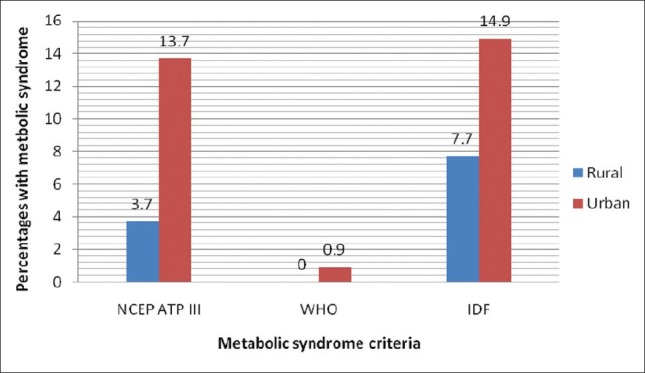
Obesity, hypertriglyceridemia, and hypertension were commoner among urban dwellers than rural dwellers. MetS was associated more with the female gender. Urbanization significantly increases the frequency of MetS using the three standard definitions. The prevalence of MetS using International Diabetes Federation, World Health Organization, and National Cholesterol Education Program Adult Treatment Panel III among rural versus urban dwellers were 7.7% vs. 14.9%, P<0.05; 0% vs. 0.9%, P>0.05; and 3.7% vs. 13.7%, P<0.05, respectively.
This study shows that MetS is a major health condition among rural and urban Nigerians and that urbanization significantly increases the prevalence of MetS. This can be explained on the basis of higher prevalence of dyslipidemia, obesity, and hypertension in urban setting, possibly as a result of stress, diet, and reduction in physical activity. Effective preventive strategy is therefore required to stem the increased risk associated with urbanization to reduce the cardiovascular risk associated with MetS among Nigerians.
代谢综合征(MetS)是发病和死亡的重要原因。尼日利亚目前正在经历快速的流行病学转变。目的是研究城市化是否与阿布贾本地农村定居者和有基因关联的城市居民中MetS患病率的增加有关。
这是一项横断面研究。该研究使用了342名阿布贾城市本地定居者和325名农村居民。测定了空腹血脂、血糖、腰围、血压和体重指数。根据三个标准对MetS进行定义。使用SPSS 16.0进行统计分析。P<0.05被用作具有统计学意义。
肥胖、高甘油三酯血症和高血压在城市居民中比农村居民更常见。MetS与女性的关联更大。使用三种标准定义,城市化显著增加了MetS的发生率。农村居民与城市居民相比,采用国际糖尿病联盟、世界卫生组织和美国国家胆固醇教育计划成人治疗小组第三次报告标准时,MetS的患病率分别为7.7%对14.9%,P<0.05;0%对0.9%,P>0.05;3.7%对13.7%,P<0.05。
本研究表明,MetS是尼日利亚农村和城市居民中的主要健康问题,城市化显著增加了MetS的患病率。这可以基于城市环境中血脂异常、肥胖和高血压的较高患病率来解释,这可能是由于压力、饮食和体力活动减少所致。因此,需要有效的预防策略来遏制与城市化相关的风险增加,以降低尼日利亚人患与MetS相关的心血管疾病的风险。