Department of Computational Biology/Center for Advanced Studies, St. Petersburg State Polytechnical University, St. Petersburg, Russia.
PLoS Comput Biol. 2012;8(8):e1002635. doi: 10.1371/journal.pcbi.1002635. Epub 2012 Aug 23.
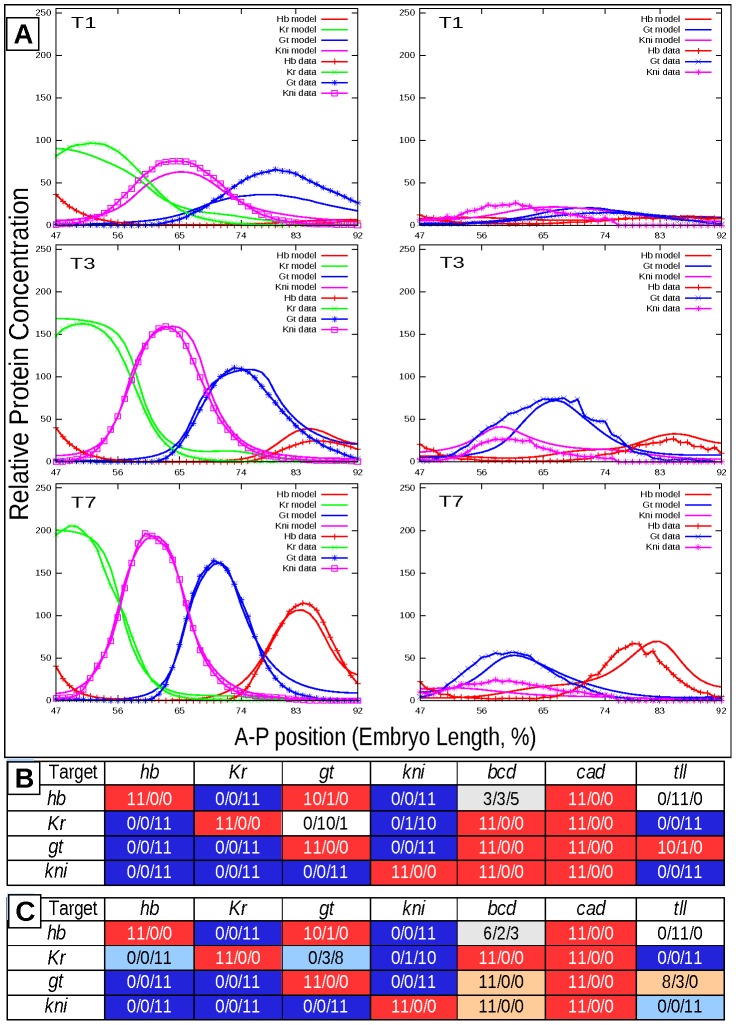
The segmentation gene network in Drosophila embryo solves the fundamental problem of embryonic patterning: how to establish a periodic pattern of gene expression, which determines both the positions and the identities of body segments. The gap gene network constitutes the first zygotic regulatory tier in this process. Here we have applied the systems-level approach to investigate the regulatory effect of gap gene Kruppel (Kr) on segmentation gene expression. We acquired a large dataset on the expression of gap genes in Kr null mutants and demonstrated that the expression levels of these genes are significantly reduced in the second half of cycle 14A. To explain this novel biological result we applied the gene circuit method which extracts regulatory information from spatial gene expression data. Previous attempts to use this formalism to correctly and quantitatively reproduce gap gene expression in mutants for a trunk gap gene failed, therefore here we constructed a revised model and showed that it correctly reproduces the expression patterns of gap genes in Kr null mutants. We found that the remarkable alteration of gap gene expression patterns in Kr mutants can be explained by the dynamic decrease of activating effect of Cad on a target gene and exclusion of Kr gene from the complex network of gap gene interactions, that makes it possible for other interactions, in particular, between hb and gt, to come into effect. The successful modeling of the quantitative aspects of gap gene expression in mutant for the trunk gap gene Kr is a significant achievement of this work. This result also clearly indicates that the oversimplified representation of transcriptional regulation in the previous models is one of the reasons for unsuccessful attempts of mutant simulations.
如何建立基因表达的周期性模式,这决定了身体部位的位置和身份。间隙基因网络构成了这个过程中的第一个合子调控层。在这里,我们应用系统级方法研究了间隙基因 Kruppel(Kr)对分段基因表达的调控作用。我们获得了大量关于 Kr 缺失突变体中间隙基因表达的数据集,并证明这些基因在第 14A 周期的后半部分的表达水平显著降低。为了解释这一新的生物学结果,我们应用了基因电路方法,该方法从空间基因表达数据中提取调控信息。以前尝试使用这种形式主义来正确和定量地再现突变体中主干间隙基因的表达是失败的,因此,我们在这里构建了一个修正模型,并表明它正确地再现了 Kr 缺失突变体中间隙基因的表达模式。我们发现,Kr 突变体中间隙基因表达模式的显著改变可以通过 Cad 对靶基因的激活作用的动态降低以及 Kr 基因从间隙基因相互作用的复杂网络中的排除来解释,这使得其他相互作用,特别是 hb 和 gt 之间的相互作用,能够发挥作用。成功地对主干间隙基因 Kr 的突变体的定量方面的间隙基因表达进行建模是这项工作的一个重要成就。这一结果还清楚地表明,在以前的模型中,转录调控的过分简化表示是模拟突变体失败的原因之一。