Evolutionary Theory Group, Max-Planck-Institute for Evolutionary Biology, Plön, Germany.
PLoS Comput Biol. 2012;8(8):e1002652. doi: 10.1371/journal.pcbi.1002652. Epub 2012 Aug 23.
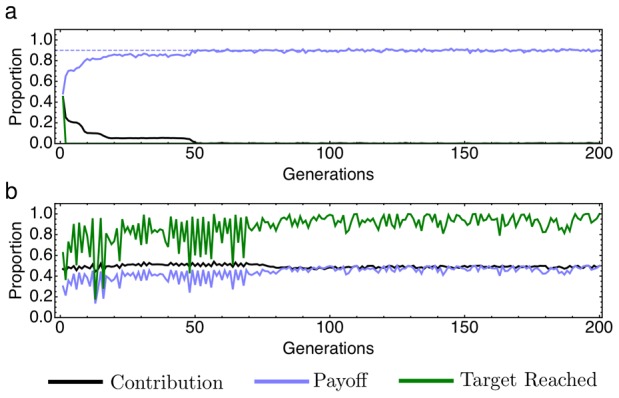
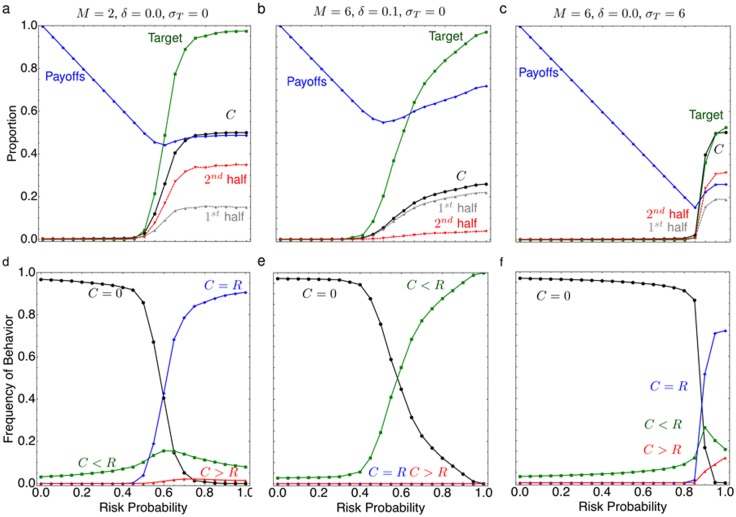
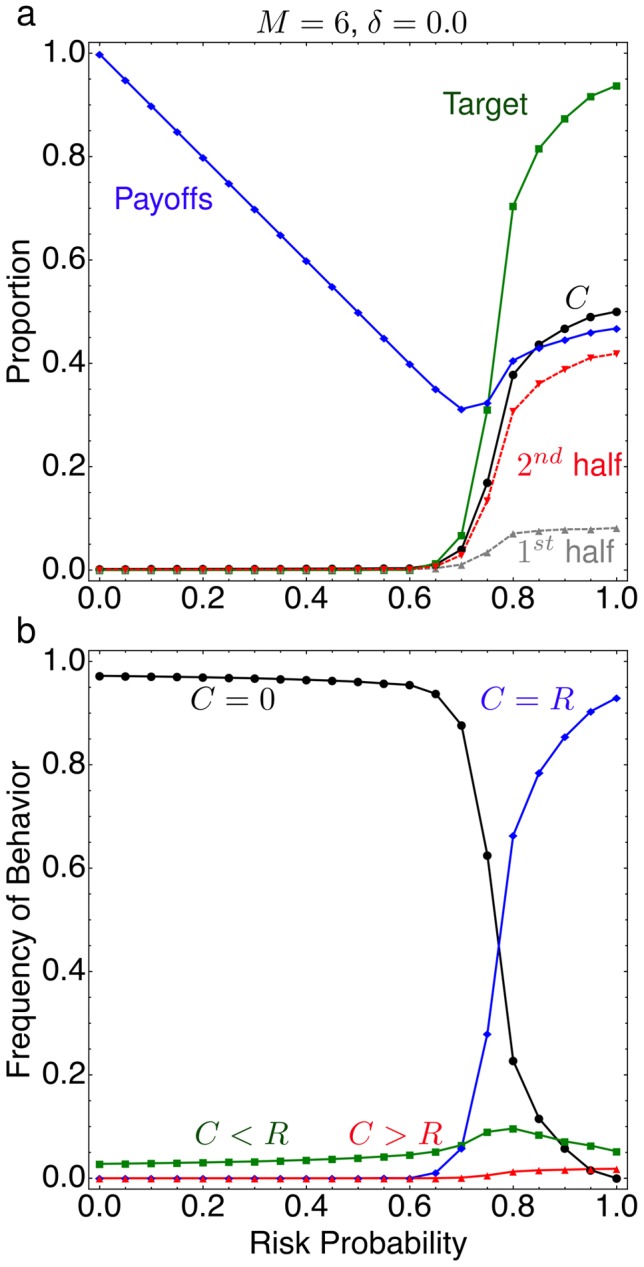
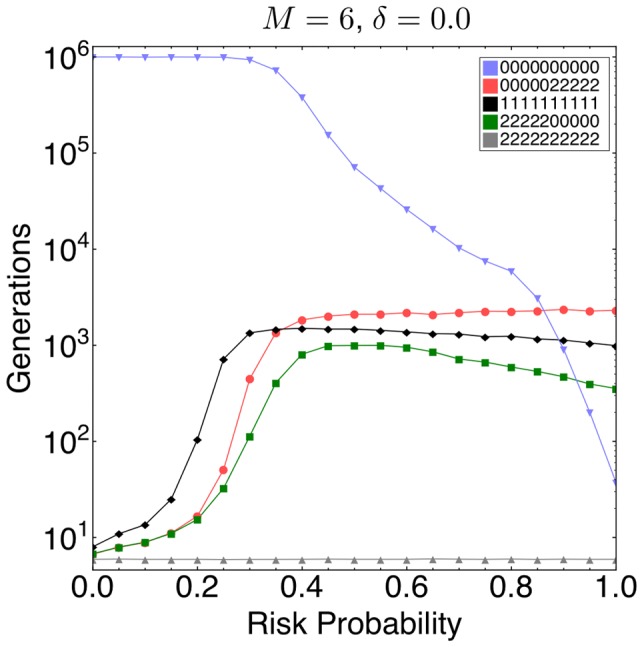
A collective-risk social dilemma arises when a group must cooperate to reach a common target in order to avoid the risk of collective loss while each individual is tempted to free-ride on the contributions of others. In contrast to the prisoners' dilemma or public goods games, the collective-risk dilemma encompasses the risk that all individuals lose everything. These characteristics have potential relevance for dangerous climate change and other risky social dilemmas. Cooperation is costly to the individual and it only benefits all individuals if the common target is reached. An individual thus invests without guarantee that the investment is worthwhile for anyone. If there are several subsequent stages of investment, it is not clear when individuals should contribute. For example, they could invest early, thereby signaling their willingness to cooperate in the future, constantly invest their fair share, or wait and compensate missing contributions. To investigate the strategic behavior in such situations, we have simulated the evolutionary dynamics of such collective-risk dilemmas in a finite population. Contributions depend individually on the stage of the game and on the sum of contributions made so far. Every individual takes part in many games and successful behaviors spread in the population. It turns out that constant contributors, such as constant fair sharers, quickly lose out against those who initially do not contribute, but compensate this in later stages of the game. In particular for high risks, such late contributors are favored.
当一个群体必须合作以达到共同目标,以避免集体损失的风险,而每个个体都受到他人贡献的诱惑时,就会出现集体风险社会困境。与囚徒困境或公共物品博弈不同,集体风险困境包含了所有个体失去一切的风险。这些特征可能与危险的气候变化和其他具有风险的社会困境有关。合作对个体来说是有代价的,只有当共同目标实现时,才对所有个体有利。因此,个体在没有保证投资对任何人都有价值的情况下进行投资。如果有几个后续的投资阶段,就不清楚个体应该在什么时候进行投资。例如,他们可以尽早投资,从而表明他们未来合作的意愿,始终投资他们公平的份额,或者等待并补偿缺失的贡献。为了研究这种情况下的策略行为,我们在有限的群体中模拟了这种集体风险困境的进化动态。贡献取决于个体在游戏阶段的情况以及迄今为止的总贡献。每个个体都参与许多游戏,成功的行为在群体中传播。结果表明,恒定的贡献者,如恒定的公平分担者,很快就会输给那些最初不贡献但在游戏后期会补偿的人。特别是对于高风险,这种晚期贡献者更受欢迎。