Psychology, School of Natural Sciences, University of Stirling, Stirling, United Kingdom.
PLoS One. 2012;7(8):e43807. doi: 10.1371/journal.pone.0043807. Epub 2012 Aug 23.
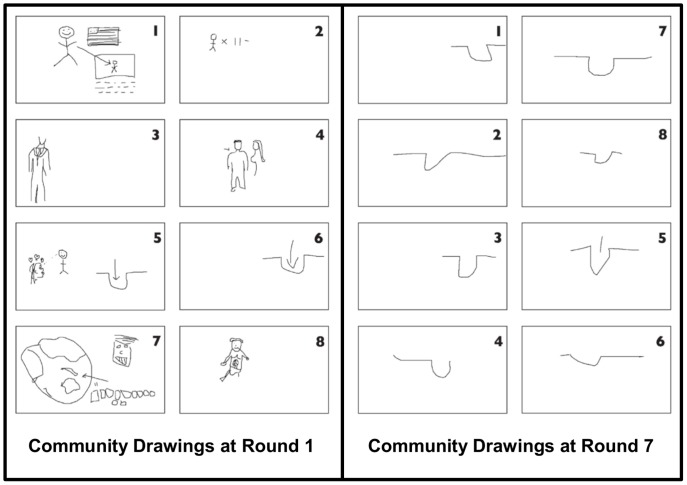
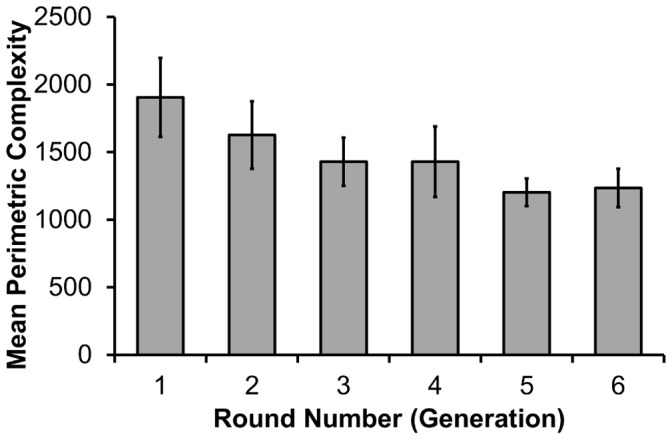
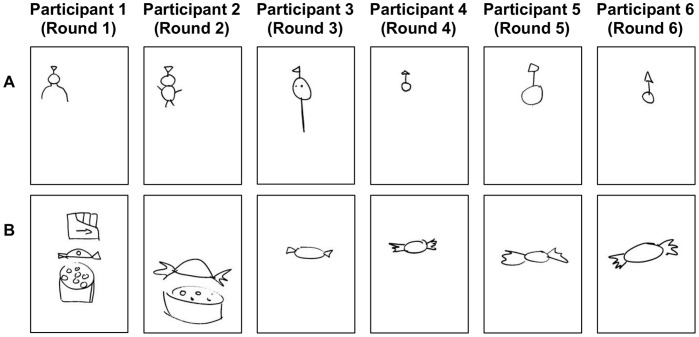
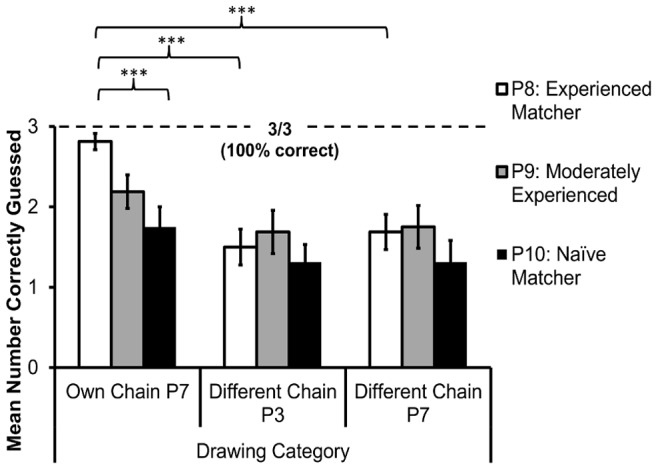
Previous studies have shown that iconic graphical signs can evolve into symbols through repeated usage within dyads and interacting communities. Here we investigate the evolution of graphical signs over chains of participants. In these chains (or "replacement microsocieties"), membership of an interacting group changed repeatedly such that the most experienced members were continually replaced by naïve participants. Signs rapidly became symbolic, such that they were mutually incomprehensible across experienced members of different chains, and new entrants needed to learn conventionalised meanings. An objective measure of graphical complexity (perimetric complexity) showed that the signs used within the microsocieties were becoming progressively simplified over successive usage. This is the first study to show that the signs that evolve in graphical communication experiments can be transmitted to, and spontaneously adopted by, naïve participants. This provides critical support for the view that human communicative symbols could have evolved culturally from iconic representations.
先前的研究表明,在对偶和相互作用的群体中,具有标志性的图形符号可以通过重复使用而演变为符号。在这里,我们研究了图形符号在参与者链中的演变。在这些链(或“替换微社会”)中,相互作用的群体的成员不断变化,以至于最有经验的成员不断被新手参与者所取代。符号迅速变得具有象征性,以至于它们在不同链的有经验的成员之间无法相互理解,新进入者需要学习约定俗成的含义。图形复杂性的客观度量(周长复杂性)表明,在微社会中使用的符号在连续使用过程中变得越来越简单。这是第一项表明在图形交流实验中演变的符号可以传播给并被新手参与者自发采用的研究。这为人类交际符号可能从标志性表示中通过文化进化而来的观点提供了关键支持。