
肌萎缩侧索硬化症-额颞叶痴呆连续体中的灰质和白质变化。
Grey and white matter changes across the amyotrophic lateral sclerosis-frontotemporal dementia continuum.
机构信息
Neuroscience Research Australia, Sydney, Australia.
出版信息
PLoS One. 2012;7(8):e43993. doi: 10.1371/journal.pone.0043993. Epub 2012 Aug 29.
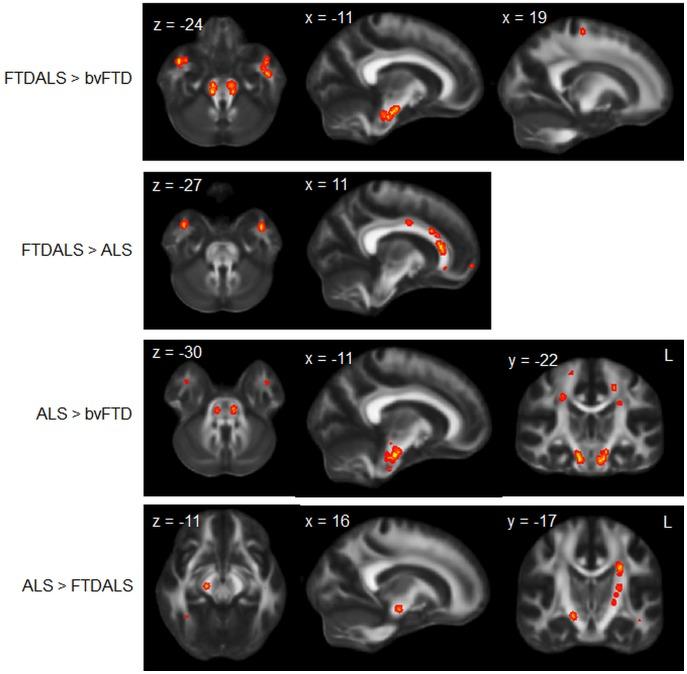
There is increasing evidence that amyotrophic lateral sclerosis (ALS) and frontotemporal dementia (FTD) lie on a clinical, pathological and genetic continuum with patients of one disease exhibiting features of the other. Nevertheless, to date, the underlying grey matter and white matter changes across the ALS-FTD disease continuum have not been explored. In this study fifty-three participants with ALS (n = 10), ALS-FTD (n = 10) and behavioural variant FTD (bvFTD; n = 15) as well as controls (n = 18), underwent detailed clinical assessment plus structural imaging using voxel-based morphometry (VBM) and diffusion tensor imaging (DTI) analysis of magnetic resonance brain imaging to examine grey and white matter differences and commonalities across the continuum. Importantly, patient groups were matched for age, education, gender and disease duration. VBM and DTI results showed that changes in the ALS group were confined mainly to the motor cortex and anterior cingulate as well as their underlying white matter tracts. ALS-FTD and bvFTD showed widespread grey matter and white matter changes involving frontal and temporal lobes. Extensive prefrontal cortex changes emerged as a marker for bvFTD compared to other subtypes, while ALS-FTD could be distinguished from ALS by additional temporal lobe grey and white matter changes. Finally, ALS could be mainly distinguished from the other two groups by corticospinal tract degeneration. The present study shows for the first time that FTD and ALS overlap in anterior cingulate, motor cortex and related white matter tract changes across the whole continuum. Nevertheless, frontal and temporal atrophy as well as corticospinal tract degeneration emerged as marker for subtype classification, which will inform future diagnosis and target disease management across the continuum.
越来越多的证据表明,肌萎缩侧索硬化症(ALS)和额颞叶痴呆(FTD)在临床、病理和遗传上存在连续性,一种疾病的患者表现出另一种疾病的特征。尽管如此,迄今为止,ALS-FTD 疾病连续体中的潜在灰质和白质变化尚未得到探索。在这项研究中,53 名参与者包括 ALS(n=10)、ALS-FTD(n=10)和行为变异型额颞叶痴呆(bvFTD;n=15)以及对照组(n=18),他们接受了详细的临床评估以及结构成像,包括基于体素的形态学(VBM)和磁共振脑成像的弥散张量成像(DTI)分析,以检查连续体中的灰质和白质差异和共性。重要的是,患者组在年龄、教育程度、性别和疾病持续时间方面相匹配。VBM 和 DTI 结果表明,ALS 组的变化主要局限于运动皮层和前扣带回及其下的白质束。ALS-FTD 和 bvFTD 显示出广泛的灰质和白质变化,涉及额叶和颞叶。与其他亚型相比,广泛的前额叶皮层变化成为 bvFTD 的标志物,而 ALS-FTD 可以通过额外的颞叶灰质和白质变化与 ALS 区分开来。最后,皮质脊髓束变性可将 ALS 主要与其他两组区分开来。本研究首次表明,FTD 和 ALS 在整个连续体中存在前扣带回、运动皮层和相关白质束变化的重叠。然而,额叶和颞叶萎缩以及皮质脊髓束变性作为亚型分类的标志物出现,这将为连续体中的未来诊断和靶向疾病管理提供信息。



 Zotero 插件