Department of Genome Sciences, University of Washington, Seattle, WA 98195, USA.
Cell. 2012 Sep 14;150(6):1274-86. doi: 10.1016/j.cell.2012.04.040. Epub 2012 Sep 5.
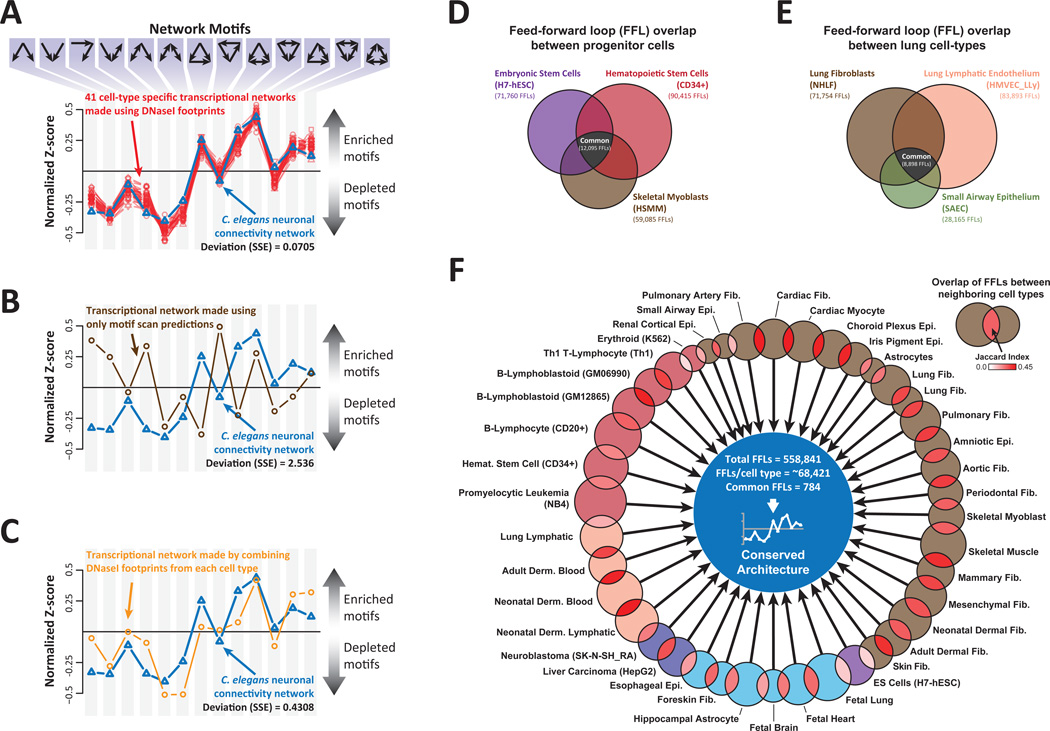
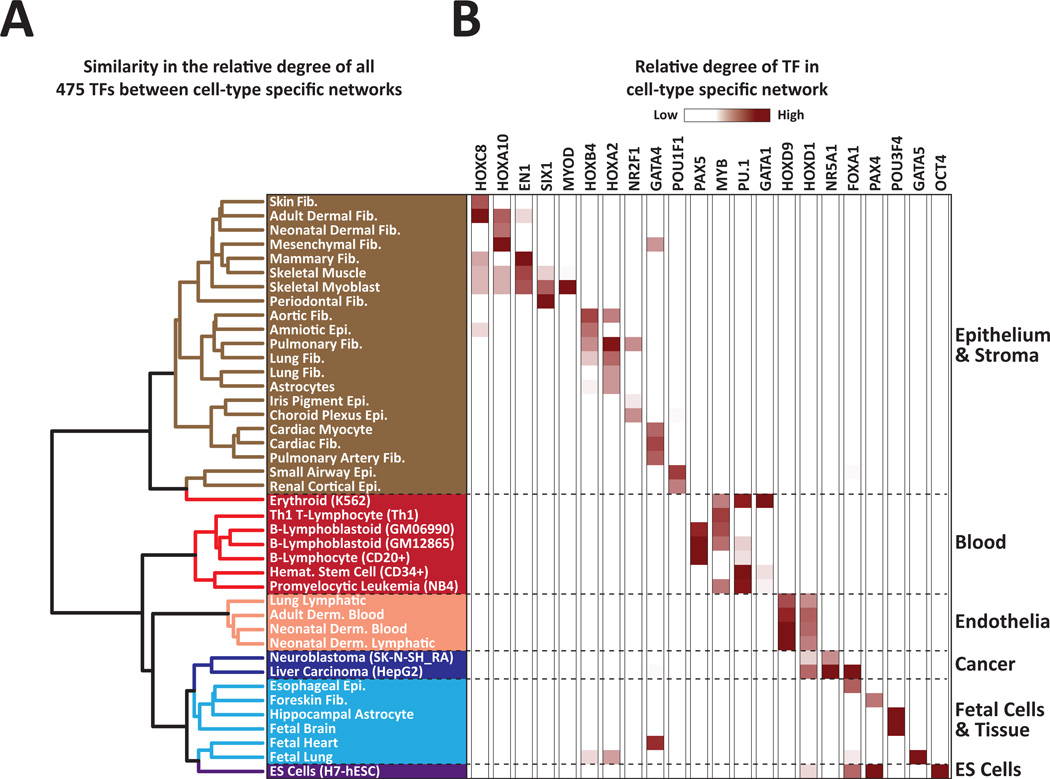
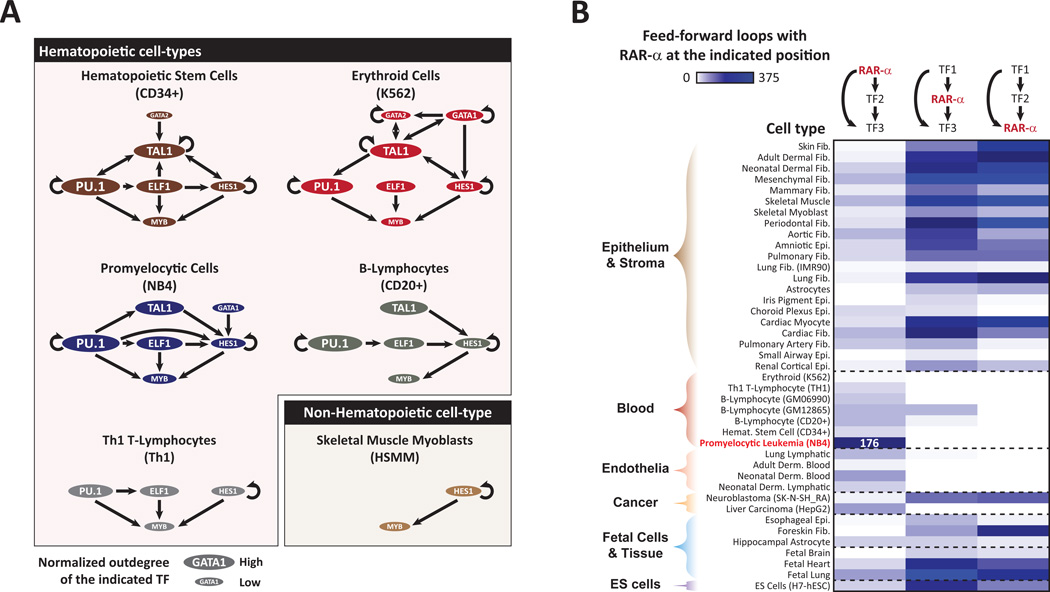
The combinatorial cross-regulation of hundreds of sequence-specific transcription factors (TFs) defines a regulatory network that underlies cellular identity and function. Here we use genome-wide maps of in vivo DNaseI footprints to assemble an extensive core human regulatory network comprising connections among 475 sequence-specific TFs and to analyze the dynamics of these connections across 41 diverse cell and tissue types. We find that human TF networks are highly cell selective and are driven by cohorts of factors that include regulators with previously unrecognized roles in control of cellular identity. Moreover, we identify many widely expressed factors that impact transcriptional regulatory networks in a cell-selective manner. Strikingly, in spite of their inherent diversity, all cell-type regulatory networks independently converge on a common architecture that closely resembles the topology of living neuronal networks. Together, our results provide an extensive description of the circuitry, dynamics, and organizing principles of the human TF regulatory network.
数百个序列特异性转录因子 (TFs) 的组合交叉调控定义了一个调控网络,该网络是细胞身份和功能的基础。在这里,我们使用体内 DNaseI 足迹的全基因组图谱来组装一个广泛的核心人类调控网络,该网络包括 475 个序列特异性 TFs 之间的连接,并分析这些连接在 41 种不同细胞和组织类型中的动态变化。我们发现,人类 TF 网络具有高度的细胞选择性,并且由一群因子驱动,其中包括以前在控制细胞身份方面作用未知的调节剂。此外,我们鉴定了许多广泛表达的因子,它们以细胞选择性的方式影响转录调控网络。引人注目的是,尽管它们具有内在的多样性,但所有细胞类型的调控网络都独立地汇聚到一个共同的架构上,该架构与活神经元网络的拓扑结构非常相似。总之,我们的研究结果提供了对人类 TF 调控网络的电路、动态和组织原则的广泛描述。