Department of Public Health, Ministry of Health, Thimphu, Bhutan.
BMC Pediatr. 2012 Sep 19;12:151. doi: 10.1186/1471-2431-12-151.
There are few reports on the nutritional status of Bhutanese children. The objective of this paper is to summarize results from the 2008 National Nutrition Survey and to describe progress achieved during the last two decades.
A cross-sectional survey of 2376 children aged 6 to 59 months was conducted during November-December 2008 to provide national and regional estimates. A multi-stage cluster sampling method was applied and 40 gewogs/thromdes were selected from each region (Western, Central, Eastern). Guidelines on how to measure length/height and weight followed WHO standardized procedures. Data were analysed for consistency and validation using the software WHO Anthro and the WHO SPSS macro. Underweight, stunting, overweight, wasting and thinness were defined based on the WHO Child Growth Standards. Data from 1986-88 and 1999 national surveys were reanalysed using the WHO standards to describe trends in nutritional status.
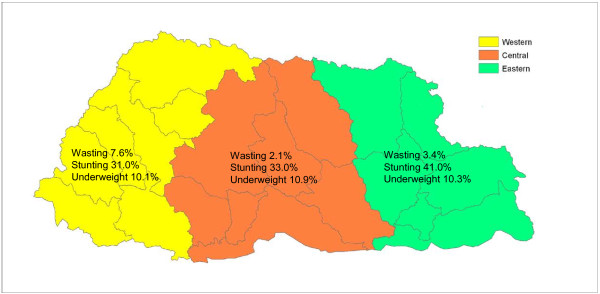
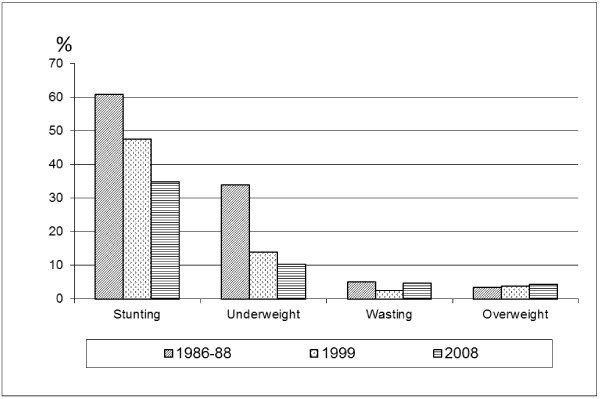
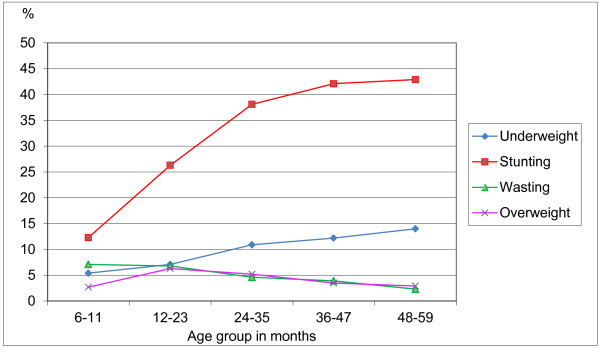
Nationally, 34.9% Bhutanese preschool children are stunted and 10.4% are underweight. Wasting is 4.7%, with severe wasting close to 2% in rural areas, while overweight affects 4.4% of preschool children. While underweight rates are similar across regions, wasting is substantially more prevalent in the Western region and stunting in the Eastern region. Stunting shows a steep rise during the first two years of life, as high as 40%, and levels off thereafter, while wasting is greatest among children aged 6-24 months and subsequently decreases. The prevalence of stunting fell from 60.9% in 1986-88 to 34.9% in 2008, and underweight declined from 34.0% to 10.4% during same period. The percentage of wasted children dropped from 5.2% in 1986-88 to 2.5% in 1999 but then increased to 4.7% in 2008.
There have been major improvements in the nutritional status of Bhutanese children over the past two decades, however, linear growth retardation remains a significant concern. Early identification of growth faltering is essential for improving the effectiveness of public health programs to prevent stunting. Similarly, wasting rates indicate the need for a system to identify children with severe malnutrition in the isolated communities so that they can receive appropriate care.
关于不丹儿童的营养状况,鲜有报告。本文旨在总结 2008 年国家营养调查结果,并描述过去二十年取得的进展。
2008 年 11 月至 12 月期间,采用横断面调查方法对 2376 名 6 至 59 月龄儿童进行了调查,以提供全国和地区估计值。采用多阶段聚类抽样方法,从每个地区(西部、中部和东部)选择 40 个 gewogs/thromdes。采用世卫组织标准化程序测量身长/身高和体重。使用 WHO Anthro 软件和世卫组织 SPSS 宏对数据进行一致性和验证分析。根据世卫组织儿童生长标准,将消瘦、发育迟缓、超重、消瘦和消瘦定义为。对 1986-88 年和 1999 年全国调查的数据进行了重新分析,使用世卫组织标准描述营养状况的趋势。
全国有 34.9%的学龄前儿童发育迟缓,10.4%体重不足。消瘦率为 4.7%,农村地区接近 2%的儿童严重消瘦,而超重影响 4.4%的学龄前儿童。虽然各地区的消瘦率相似,但西部地区消瘦更为普遍,东部地区发育迟缓更为普遍。发育迟缓在生命的头两年急剧上升,高达 40%,此后趋于平稳,而消瘦在 6-24 月龄儿童中最为常见,随后逐渐减少。1986-88 年,发育迟缓率从 60.9%下降到 2008 年的 34.9%,同期体重不足率从 34.0%下降到 10.4%。消瘦儿童的比例从 1986-88 年的 5.2%下降到 1999 年的 2.5%,但随后在 2008 年上升到 4.7%。
在过去的二十年里,不丹儿童的营养状况有了很大的改善,然而,线性生长迟缓仍然是一个重大问题。早期发现生长迟缓对于提高公共卫生计划的有效性至关重要,以防止发育迟缓。同样,消瘦率表明需要建立一个系统,以查明偏远社区中患有严重营养不良的儿童,以便他们能够得到适当的护理。