Hull York Medical School, Department of Health Sciences, University of York, York, UK.
BMC Health Serv Res. 2012 Sep 27;12:342. doi: 10.1186/1472-6963-12-342.
Older adults receive most of their end-of-life care in the community, but there are few published data to guide researchers on recruitment to studies in primary care. The aim of this study was to compare recruitment of patients and bereaved carers from general practices in areas with different research network support, and identify challenges in obtaining samples representative of those in need of end-of-life care.
Comparative analysis of recruitment from general practices to two face-to-face interview studies concerned with 1) carers' perceptions of transitions between settings for decedents aged over 75 years and 2) the experiences of older patients living with cancer at the end-of-life.
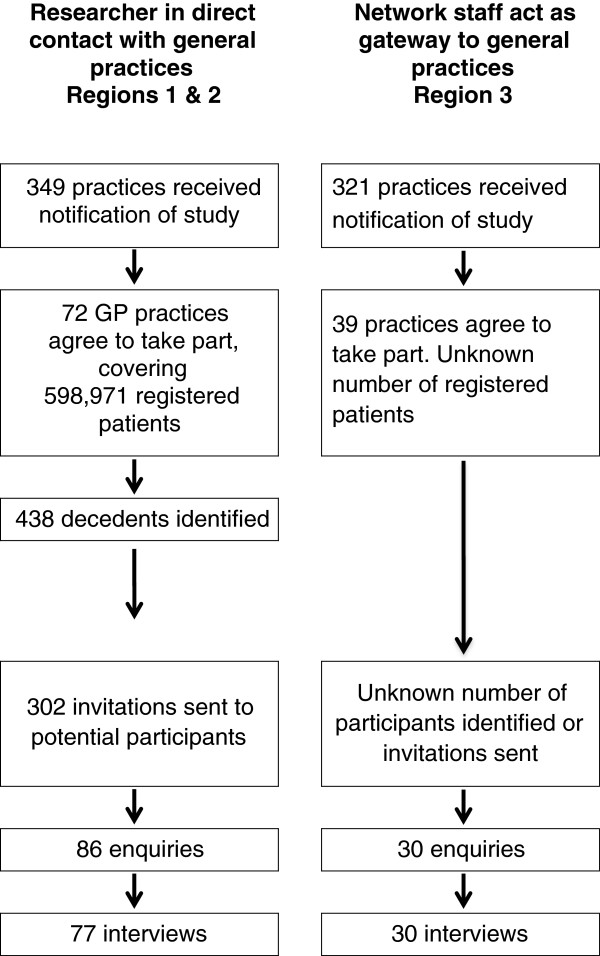
33 (15% of invitees) patients and 118 (25%) carers were interviewed. Carers from disadvantaged areas were under-represented. Recruitment was higher when researchers, rather than research network staff, were in direct contact with general practices. Most practices recruited no more than one carer, despite a seven fold difference in the number of registered patients. The proportion identified as eligible for patient interviews varied by a factor of 38 between practices. Forty-four Primary Care Trusts granted approval to interview carers; two refused. One gave no reason; a second did not believe that general practitioners would be able to identify carers.
Obtaining a representative sample of patients or carers in end-of-life research is a resource intensive challenge. Review of the regulatory and organisational barriers to end-of-life researchers in primary care is required. Research support networks provide invaluable assistance, but researchers should ensure that they are alert to the ways in which they may influence study recruitment.
老年人的大部分临终关怀都在社区中进行,但很少有发表的数据可以指导研究人员在初级保健中进行研究。本研究的目的是比较在不同研究网络支持下的社区医疗实践中招募患者和丧亲护理者的情况,并确定在获得代表性样本方面的挑战,这些样本代表了需要临终关怀的人群。
对两项面对面访谈研究的社区医疗实践招募情况进行比较分析,这两项研究分别涉及:1)护理人员对 75 岁以上死者从一个环境到另一个环境的过渡的看法;2)生命末期患有癌症的老年患者的经历。
共访谈了 33 名(邀请人数的 15%)患者和 118 名(25%)护理者。来自劣势地区的护理者代表性不足。当研究人员而不是研究网络工作人员直接与社区医疗实践联系时,招募率更高。尽管登记患者数量相差七倍,但大多数实践招募的护理者人数都不超过一名。被确定为适合接受患者访谈的比例在实践之间差异高达 38 倍。44 个初级保健信托机构批准了对护理者的访谈;两家拒绝了。一家没有给出理由;另一家则认为普通医生无法识别护理者。
在临终关怀研究中获得患者或护理者的代表性样本是一项资源密集型的挑战。需要审查初级保健中临终关怀研究人员的监管和组织障碍。研究支持网络提供了非常有价值的帮助,但研究人员应该确保他们意识到自己可能会影响研究招募的方式。