Department of Earth and Environmental Engineering, Department of Chemical Engineering, Columbia University-New York, New York, New York, United States of America.
PLoS One. 2012;7(9):e44846. doi: 10.1371/journal.pone.0044846. Epub 2012 Sep 19.
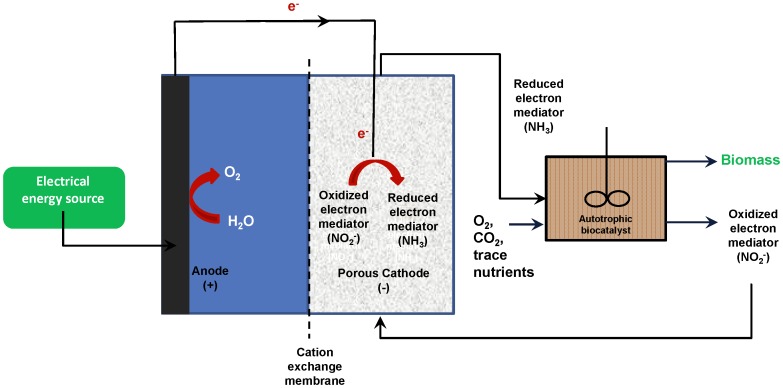
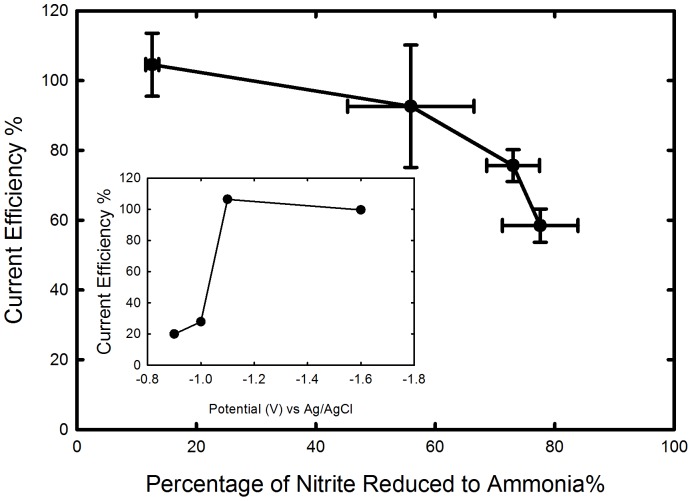
The storage of renewable electrical energy within chemical bonds of biofuels and other chemicals is a route to decreasing petroleum usage. A critical challenge is the efficient transfer of electrons into a biological host that can covert this energy into high energy organic compounds. In this paper, we describe an approach whereby biomass is grown using energy obtained from a soluble mediator that is regenerated electrochemically. The net result is a separate-stage reverse microbial fuel cell (rMFC) that fixes CO₂ into biomass using electrical energy. We selected ammonia as a low cost, abundant, safe, and soluble redox mediator that facilitated energy transfer to biomass. Nitrosomonas europaea, a chemolithoautotroph, was used as the biocatalyst due to its inherent capability to utilize ammonia as its sole energy source for growth. An electrochemical reactor was designed for the regeneration of ammonia from nitrite, and current efficiencies of 100% were achieved. Calculations indicated that overall bioproduction efficiency could approach 2.7±0.2% under optimal electrolysis conditions. The application of chemolithoautotrophy for industrial bioproduction has been largely unexplored, and results suggest that this and related rMFC platforms may enable biofuel and related biochemical production.
将可再生电能存储在生物燃料和其他化学物质的化学键中是减少石油使用的一种途径。一个关键的挑战是将电子高效地转移到可以将这种能量转化为高能有机化合物的生物宿主中。在本文中,我们描述了一种方法,即用从可溶介体中获得的能量来生长生物质,而介体可通过电化学再生。最终的结果是一个独立的反向微生物燃料电池(rMFC),它使用电能将 CO₂固定到生物质中。我们选择氨作为一种低成本、丰富、安全且可溶的氧化还原介体,以促进能量向生物质的转移。由于其将氨作为唯一生长能源的固有能力,我们选择了硝化单胞菌(Nitrosomonas europaea)作为生物催化剂。为了从亚硝酸盐中再生氨,设计了一个电化学反应器,并实现了 100%的电流效率。计算表明,在最佳电解条件下,整体生物生产效率可接近 2.7±0.2%。化能自养在工业生物生产中的应用在很大程度上尚未得到探索,结果表明,这种和相关的 rMFC 平台可能使生物燃料和相关的生化生产成为可能。