Department of Mechanical Engineering, Stanford University, Stanford, CA, 94305, USA.
Nanoscale Res Lett. 2012 Oct 6;7(1):554. doi: 10.1186/1556-276X-7-554.
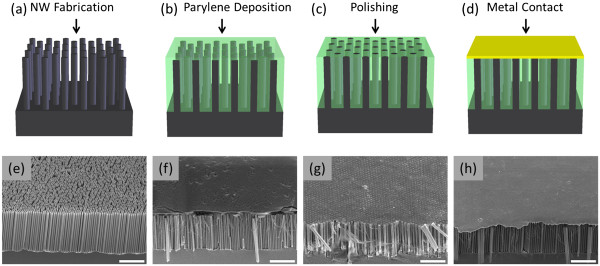
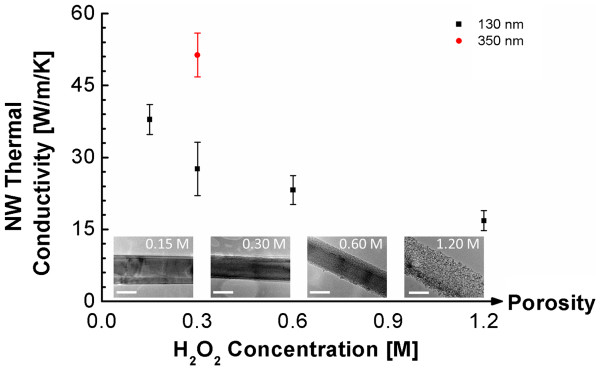
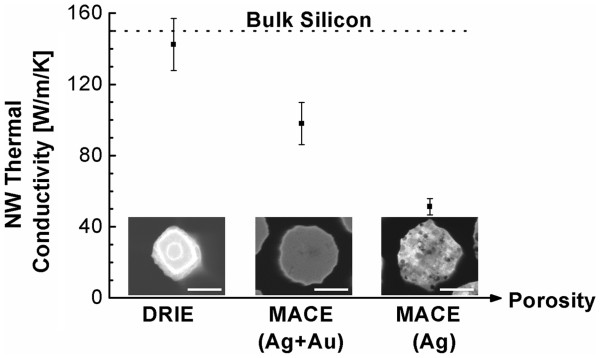
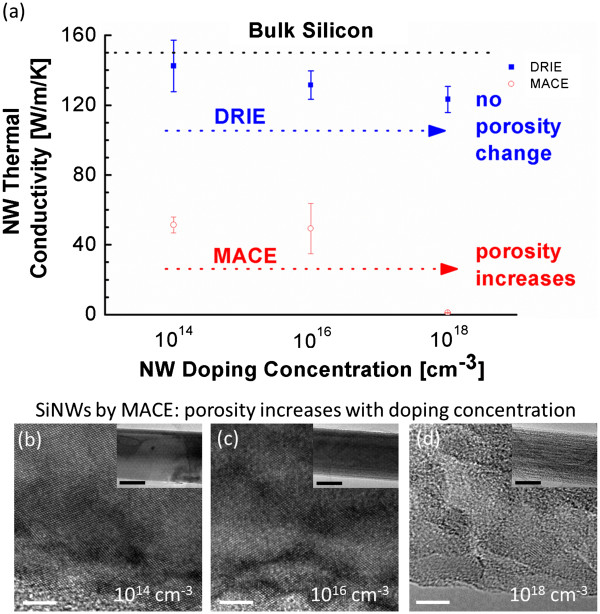
The nanoscale features in silicon nanowires (SiNWs) can suppress phonon propagation and strongly reduce their thermal conductivities compared to the bulk value. This work measures the thermal conductivity along the axial direction of SiNW arrays with varying nanowire diameters, doping concentrations, surface roughness, and internal porosities using nanosecond transient thermoreflectance. For SiNWs with diameters larger than the phonon mean free path, porosity substantially reduces the thermal conductivity, yielding thermal conductivities as low as 1 W/m/K in highly porous SiNWs. However, when the SiNW diameter is below the phonon mean free path, both the internal porosity and the diameter significantly contribute to phonon scattering and lead to reduced thermal conductivity of the SiNWs.
硅纳米线(SiNWs)中的纳米级特征可以抑制声子传播,并与体材料值相比强烈降低其热导率。本工作使用纳秒瞬态热反射法测量了具有不同纳米线直径、掺杂浓度、表面粗糙度和内部孔隙率的 SiNW 阵列沿轴向的热导率。对于直径大于声子平均自由程的 SiNW,孔隙率会大大降低热导率,在高多孔 SiNW 中热导率可低至 1 W/m/K。然而,当 SiNW 的直径低于声子平均自由程时,内部孔隙率和直径都会显著导致声子散射,并导致 SiNW 的热导率降低。