Department of Psychiatry, University of Alberta Edmonton, AB, Canada.
Front Syst Neurosci. 2012 Sep 28;6:69. doi: 10.3389/fnsys.2012.00069. eCollection 2012.
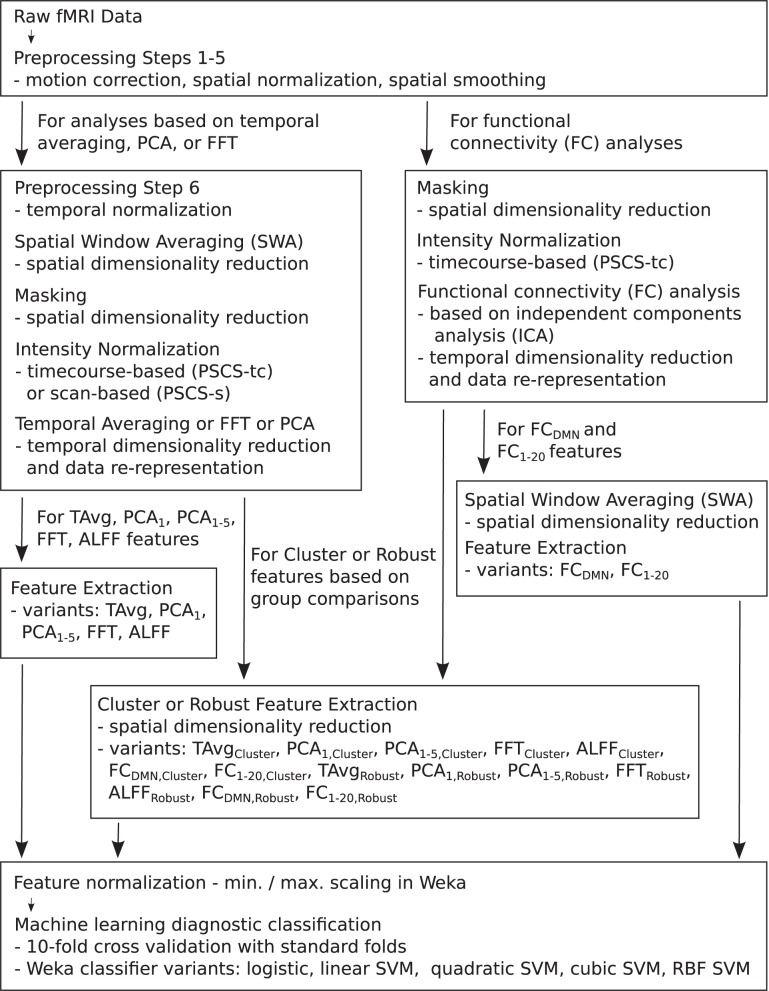
Neuroimaging-based diagnostics could potentially assist clinicians to make more accurate diagnoses resulting in faster, more effective treatment. We participated in the 2011 ADHD-200 Global Competition which involved analyzing a large dataset of 973 participants including Attention deficit hyperactivity disorder (ADHD) patients and healthy controls. Each participant's data included a resting state functional magnetic resonance imaging (fMRI) scan as well as personal characteristic and diagnostic data. The goal was to learn a machine learning classifier that used a participant's resting state fMRI scan to diagnose (classify) that individual into one of three categories: healthy control, ADHD combined (ADHD-C) type, or ADHD inattentive (ADHD-I) type. We used participants' personal characteristic data (site of data collection, age, gender, handedness, performance IQ, verbal IQ, and full scale IQ), without any fMRI data, as input to a logistic classifier to generate diagnostic predictions. Surprisingly, this approach achieved the highest diagnostic accuracy (62.52%) as well as the highest score (124 of 195) of any of the 21 teams participating in the competition. These results demonstrate the importance of accounting for differences in age, gender, and other personal characteristics in imaging diagnostics research. We discuss further implications of these results for fMRI-based diagnosis as well as fMRI-based clinical research. We also document our tests with a variety of imaging-based diagnostic methods, none of which performed as well as the logistic classifier using only personal characteristic data.
基于神经影像学的诊断方法可能有助于临床医生做出更准确的诊断,从而实现更快、更有效的治疗。我们参与了 2011 年 ADHD-200 全球竞赛,该竞赛涉及分析包括注意力缺陷多动障碍 (ADHD) 患者和健康对照者在内的 973 名参与者的大型数据集。每位参与者的数据包括静息态功能磁共振成像 (fMRI) 扫描以及个人特征和诊断数据。目标是学习一种机器学习分类器,该分类器使用参与者的静息态 fMRI 扫描将个体诊断 (分类) 为以下三种类型之一:健康对照者、ADHD 混合型 (ADHD-C) 或 ADHD 注意力不集中型 (ADHD-I)。我们使用参与者的个人特征数据(数据采集地点、年龄、性别、惯用手、表现智商、言语智商和全量表智商),而不使用任何 fMRI 数据作为逻辑分类器的输入,以生成诊断预测。令人惊讶的是,这种方法的诊断准确率(62.52%)最高,在参加竞赛的 21 个团队中得分(195 分中的 124 分)最高。这些结果表明,在影像诊断研究中,考虑年龄、性别和其他个人特征差异的重要性。我们进一步讨论了这些结果对 fMRI 诊断以及 fMRI 临床研究的影响。我们还记录了我们使用各种基于影像的诊断方法的测试结果,没有一种方法的表现优于仅使用个人特征数据的逻辑分类器。