Department of Biological and Diagnostic Sciences, College of Veterinary Medicine, The University of Tennessee, 2407 River Drive, Knoxville, TN 37996, USA.
Int J Health Geogr. 2012 Oct 13;11(1):45. doi: 10.1186/1476-072X-11-45.
Socioeconomic factors play a complex role in determining the risk of campylobacteriosis. Understanding the spatial interplay between these factors and disease risk can guide disease control programs. Historically, Poisson and negative binomial models have been used to investigate determinants of geographic disparities in risk. Spatial regression models, which allow modeling of spatial effects, have been used to improve these modeling efforts. Geographically weighted regression (GWR) takes this a step further by estimating local regression coefficients, thereby allowing estimations of associations that vary in space. These recent approaches increase our understanding of how geography influences the associations between determinants and disease. Therefore the objectives of this study were to: (i) identify socioeconomic determinants of the geographic disparities of campylobacteriosis risk (ii) investigate if regression coefficients for the associations between socioeconomic factors and campylobacteriosis risk demonstrate spatial variability and (iii) compare the performance of four modeling approaches: negative binomial, spatial lag, global and local Poisson GWR.
Negative binomial, spatial lag, global and local Poisson GWR modeling techniques were used to investigate associations between socioeconomic factors and geographic disparities in campylobacteriosis risk. The best fitting models were identified and compared.
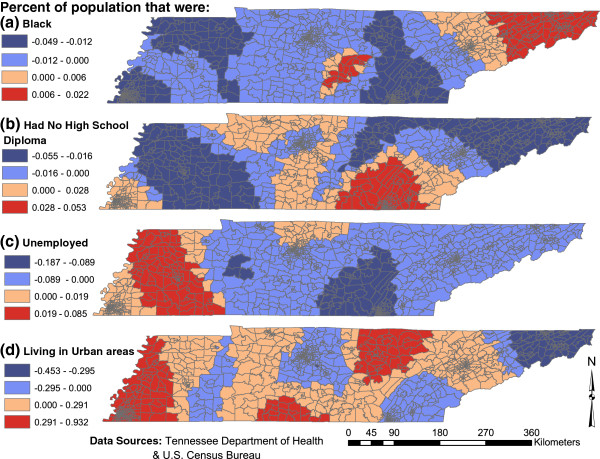
Two competing four variable models (Models 1 & 2) were identified. Significant variables included race, unemployment rate, education attainment, urbanicity, and divorce rate. Local Poisson GWR had the best fit and showed evidence of spatially varying regression coefficients.
The international significance of this work is that it highlights the inadequacy of global regression strategies that estimate one parameter per independent variable, and therefore mask the true relationships between dependent and independent variables. Since local GWR estimate a regression coefficient for each location, it reveals the geographic differences in the associations. This implies that a factor may be an important determinant in some locations and not others. Incorporating this into health planning ensures that a needs-based, rather than a "one-size-fits-all", approach is used. Thus, adding local GWR to the epidemiologists' toolbox would allow them to assess how the impacts of different determinants vary by geography. This knowledge is critical for resource allocation in disease control programs.
社会经济因素在确定弯曲杆菌病的风险中起着复杂的作用。了解这些因素与疾病风险之间的空间相互作用可以指导疾病控制计划。历史上,泊松和负二项式模型已被用于调查风险的地理差异的决定因素。空间回归模型允许对空间效应进行建模,已被用于改进这些建模工作。地理加权回归(GWR)更进一步,估计局部回归系数,从而允许对空间变化的关联进行估计。这些新方法提高了我们对地理如何影响决定因素与疾病之间关联的理解。因此,本研究的目的是:(i)确定弯曲杆菌病风险的地理差异的社会经济决定因素;(ii)调查社会经济因素与弯曲杆菌病风险之间的关联的回归系数是否表现出空间可变性;(iii)比较四种建模方法的性能:负二项式、空间滞后、全局和局部泊松 GWR。
使用负二项式、空间滞后、全局和局部泊松 GWR 建模技术来研究社会经济因素与弯曲杆菌病风险的地理差异之间的关联。确定了最佳拟合模型并进行了比较。
确定了两个竞争的四变量模型(模型 1 和 2)。显著变量包括种族、失业率、受教育程度、城市化程度和离婚率。局部泊松 GWR 拟合度最好,并且有空间变化回归系数的证据。
这项工作的国际意义在于,它强调了全球回归策略的不足,该策略估计每个独立变量一个参数,从而掩盖了因变量和自变量之间的真实关系。由于局部 GWR 为每个位置估计一个回归系数,因此它揭示了关联的地理差异。这意味着一个因素在某些位置可能是一个重要的决定因素,而在其他位置则不是。将其纳入卫生规划确保使用基于需求的方法,而不是“一刀切”的方法。因此,将局部 GWR 添加到流行病学家的工具包中,将使他们能够评估不同决定因素的影响在地理上的变化。这种知识对于疾病控制计划中的资源分配至关重要。