Developmental Psychology Unit, Saarland University Saarbrücken, Germany.
Front Psychol. 2012 Oct 29;3:445. doi: 10.3389/fpsyg.2012.00445. eCollection 2012.
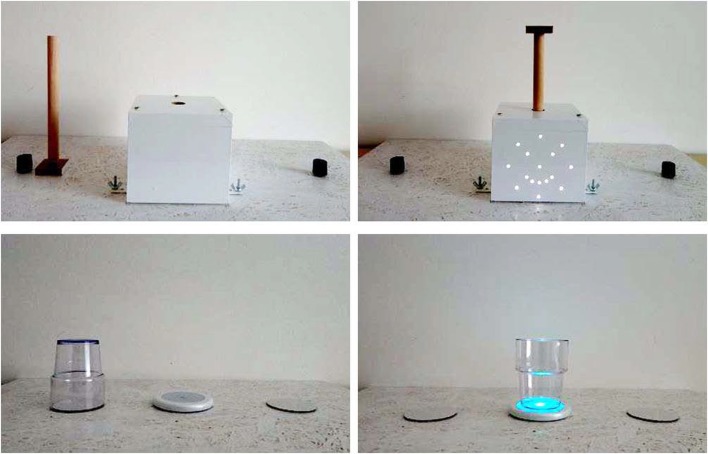
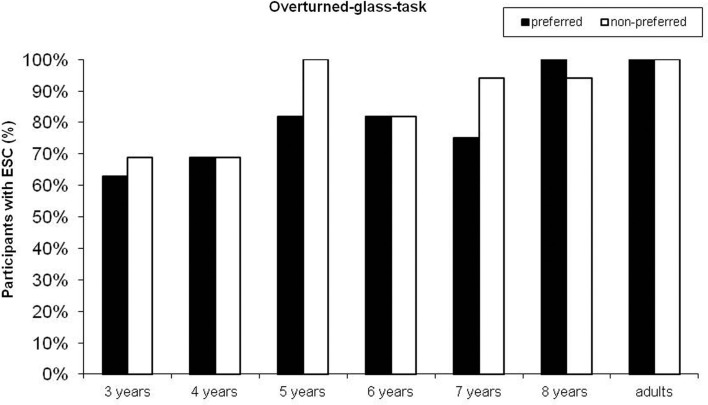
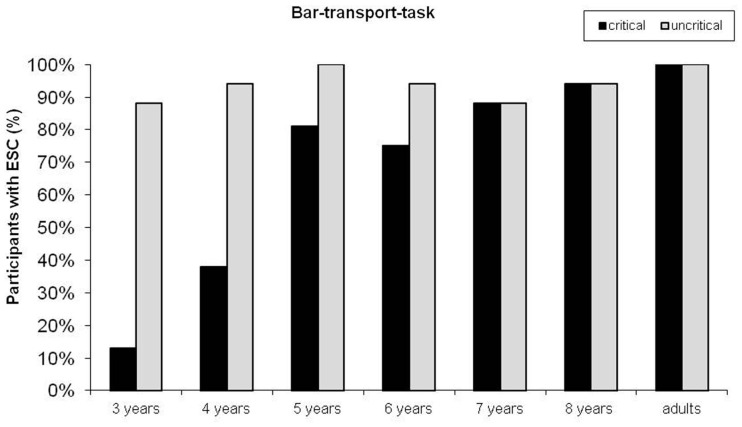
The aim of the study was to compare 3- to 8-year-old children's propensity to anticipate a comfortable hand posture at the end of a grasping movement (end-state comfort effect) between two different object manipulation tasks, the bar-transport task, and the overturned-glass task. In the bar-transport task, participants were asked to insert a vertically positioned bar into a small opening of a box. In the overturned-glass task, participants were asked to put an overturned-glass right-side-up on a coaster. Half of the participants experienced action effects (lights) as a consequence of their movements (AE groups), while the other half of the participants did not (No-AE groups). While there was no difference between the AE and No-AE groups, end-state comfort performance differed across age as well as between tasks. Results revealed a significant increase in end-state comfort performance in the bar-transport task from 13% in the 3-year-olds to 94% in the 8-year-olds. Interestingly, the number of children grasping the bar according to end-state comfort doubled from 3 to 4 years and from 4 to 5 years of age. In the overturned-glass task an increase in end-state comfort performance from already 63% in the 3-year-olds to 100% in the 8-year-olds was significant as well. When comparing end-state comfort performance across tasks, results showed that 3- and 4-year-old children were better at manipulating the glass as compared to manipulating the bar, most probably, because children are more familiar with manipulating glasses. Together, these results suggest that preschool years are an important period for the development of motor planning in which the familiarity with the object involved in the task plays a significant role in children's ability to plan their movements according to end-state comfort.
本研究旨在比较 3-8 岁儿童在两种不同的物体操作任务(棒传输任务和翻倒玻璃杯任务)中对抓握动作结束时舒适手姿的预期倾向(结束状态舒适效应)。在棒传输任务中,参与者被要求将垂直放置的棒插入盒子的小开口中。在翻倒玻璃杯任务中,参与者被要求将翻倒的玻璃杯正放在杯垫上。一半的参与者体验到动作效果(灯光)作为其动作的后果(AE 组),而另一半参与者则没有(无 AE 组)。虽然 AE 组和无 AE 组之间没有差异,但结束状态舒适表现因年龄和任务而异。结果表明,在棒传输任务中,结束状态舒适表现从 3 岁儿童的 13%显著增加到 8 岁儿童的 94%。有趣的是,根据结束状态舒适抓握棒的儿童数量从 3 岁到 4 岁增加了一倍,从 4 岁到 5 岁也增加了一倍。在翻倒玻璃杯任务中,结束状态舒适表现从 3 岁儿童的 63%显著增加到 8 岁儿童的 100%。当比较跨任务的结束状态舒适表现时,结果表明 3 岁和 4 岁的儿童在操纵玻璃杯方面比操纵棒更好,这很可能是因为儿童更熟悉操纵玻璃杯。总的来说,这些结果表明,学前阶段是运动规划发展的重要时期,在此期间,儿童对任务中涉及的物体的熟悉程度在他们根据结束状态舒适来规划动作的能力中起着重要作用。