Institute of Psychology, Leiden University, Leiden, The Netherlands.
PLoS One. 2012;7(11):e48046. doi: 10.1371/journal.pone.0048046. Epub 2012 Nov 2.
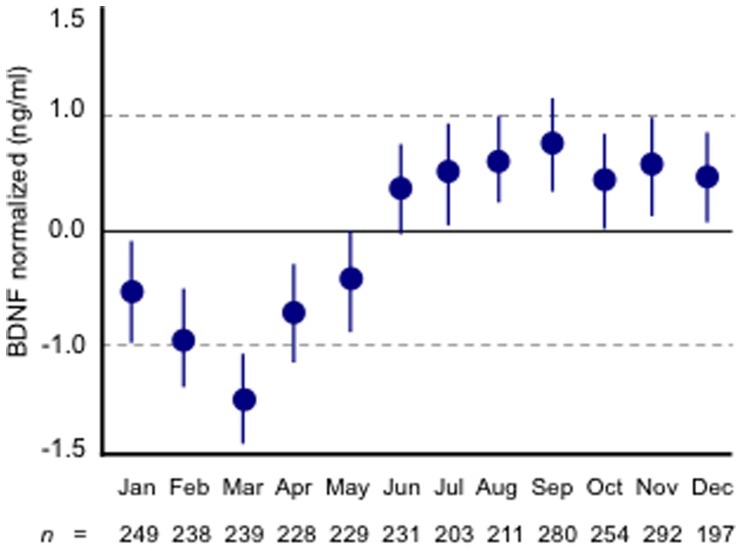
Earlier findings show seasonality in processes and behaviors such as brain plasticity and depression that in part are regulated by Brain-Derived Neurotrophic Factor (BDNF). Based on this we investigated seasonal variation in serum BDNF concentrations in 2,851 persons who took part in the Netherlands Study of Depression and Anxiety (NESDA). Analyses by month of sampling (monthly n's >196) showed pronounced seasonal variation in serum BDNF concentrations (P<.0001) with increasing concentrations in the spring-summer period (standardized regression weight (ß) = 0.19, P<.0001) and decreasing concentrations in the autumn-winter period (ß = -0.17, P<.0001). Effect sizes [Cohen's d] ranged from 0.27 to 0.66 for monthly significant differences. We found similar seasonal variation for both sexes and for persons with a DSM-IV depression diagnosis and healthy control subjects. In explorative analyses we found that the number of sunshine hours (a major trigger to entrain seasonality) in the week of blood withdrawal and the 10 weeks prior to this event positively correlated with serum BDNF concentrations (Pearson's correlation coefficients ranged: 0.05-0.18) and this could partly explain the observed monthly variation. These results provide strong evidence that serum BDNF concentrations systematically vary over the year. This finding is important for our understanding of those factors that regulate BDNF expression and may provide novel avenues to understand seasonal dependent changes in behavior and illness such as depression. Finally, the findings reported here should be taken into account when designing and interpreting studies on BDNF.
早期的研究结果表明,大脑可塑性和抑郁症等过程和行为具有季节性,而这些过程和行为在一定程度上受到脑源性神经营养因子 (BDNF) 的调节。基于这一点,我们调查了 2851 名参加荷兰抑郁和焦虑研究 (NESDA) 的人的血清 BDNF 浓度的季节性变化。按采样月份(每月 n 值>196)进行分析表明,血清 BDNF 浓度存在明显的季节性变化(P<.0001),春夏季浓度逐渐升高(标准化回归权重(β)=0.19,P<.0001),秋冬季浓度逐渐降低(β=-0.17,P<.0001)。每月差异的效应大小[Cohen's d]范围为 0.27 至 0.66。我们发现,两性以及 DSM-IV 抑郁症诊断和健康对照者均存在类似的季节性变化。在探索性分析中,我们发现采血周和前 10 周的日照小时数(引发季节性的主要因素)与血清 BDNF 浓度呈正相关(Pearson 相关系数范围:0.05-0.18),这可以部分解释观察到的月度变化。这些结果有力地证明了血清 BDNF 浓度会随年份而系统性变化。这一发现对于我们理解调节 BDNF 表达的因素非常重要,并可能为理解行为和疾病(如抑郁症)的季节性变化提供新的途径。最后,在设计和解释 BDNF 相关研究时,应考虑到这里报告的发现。