
双相抑郁默认模式网络内的局部一致性:一项静息态功能磁共振成像研究。
Regional homogeneity within the default mode network in bipolar depression: a resting-state functional magnetic resonance imaging study.
机构信息
Department of Radiology, Beijing Anding Hospital, Capital Medical University, Beijing, China.
出版信息
PLoS One. 2012;7(11):e48181. doi: 10.1371/journal.pone.0048181. Epub 2012 Nov 2.
AIM
We sought to use a regional homogeneity (ReHo) approach as an index in resting-state functional magnetic resonance imaging (fMRI) to investigate the features of spontaneous brain activity within the default mode network (DMN) in patients suffering from bipolar depression (BD).
METHODS
Twenty-six patients with BD and 26 gender-, age-, and education-matched healthy subjects participated in the resting-state fMRI scans. We compared the differences in ReHo between the two groups within the DMN and investigated the relationships between sex, age, years of education, disease duration, the Hamilton Rating Scale for Depression (HAMD) total score, and ReHo in regions with significant group differences.
RESULTS
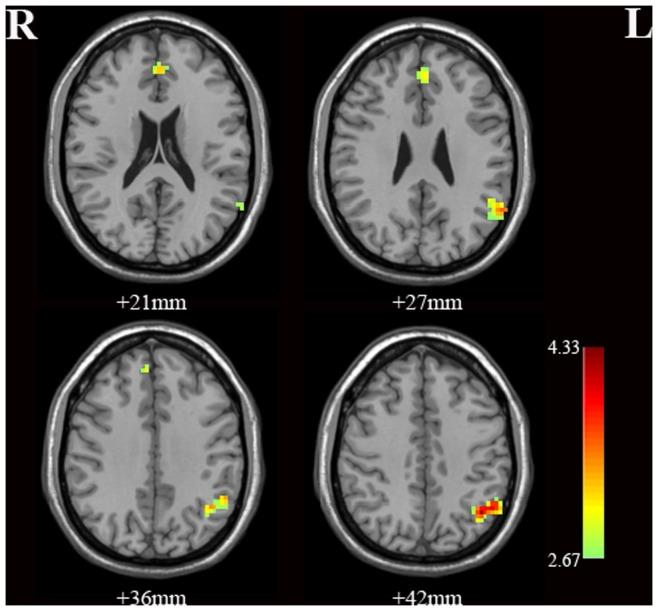
Our results revealed that bipolar depressed patients had increased ReHo in the left medial frontal gyrus and left inferior parietal lobe compared to healthy controls. No correlations were found between regional ReHo values and sex, age, and clinical features within the BD group.
CONCLUSIONS
Our findings indicate that abnormal brain activity is mainly distributed within prefrontal-limbic circuits, which are believed to be involved in the pathophysiological mechanisms underlying bipolar depression.
目的
我们试图使用基于区域同质性(ReHo)的方法作为静息态功能磁共振成像(fMRI)的指标,来研究双相抑郁(BD)患者默认模式网络(DMN)内自发性脑活动的特征。
方法
26 名 BD 患者和 26 名性别、年龄和教育程度相匹配的健康受试者参与了静息态 fMRI 扫描。我们比较了两组 DMN 内的 ReHo 差异,并探讨了性别、年龄、受教育年限、病程、汉密尔顿抑郁量表(HAMD)总分与具有显著组间差异的区域 ReHo 之间的关系。
结果
我们的结果表明,与健康对照组相比,双相抑郁患者的左侧额内侧回和左侧顶下小叶的 ReHo 增加。BD 组中,区域 ReHo 值与性别、年龄和临床特征之间无相关性。
结论
我们的发现表明,异常脑活动主要分布在前额-边缘回路内,这被认为与双相抑郁的病理生理机制有关。

 Zotero 插件