Office of Biotechnology, Genomics and Population Health, Public Health Agency of Canada, 180 Queen Street West, 11th Floor, Toronto, ON M5V 3L7, Canada.
Nutr Metab (Lond). 2012 Nov 16;9(1):102. doi: 10.1186/1743-7075-9-102.
Inflammation and oxidative stress are associated with the development of numerous chronic diseases. Circulating ascorbic acid, α-tocopherol, and 25-hydroxyvitamin D (25(OH)D) may help reduce concentrations of pro-inflammatory cytokines through their antioxidant and anti-inflammatory properties. These micronutrients may act synergistically, and they may have different anti-inflammatory effects, but previous studies have assessed the link between each of these micronutrients and inflammation in isolation without controlling for the other micronutrients. Our objective was to examine the association between circulating concentrations of ascorbic acid, α-tocopherol, and 25(OH) D and a panel of pro-inflammatory cytokines in an ethnically diverse population of young adults.
Participants (n = 1,007) from the Toronto Nutrigenomics and Health study provided fasting blood samples for biomarker measurements and were subsequently categorized into tertiles for each micronutrient based on their circulating concentrations. We conducted Pearson's correlation analyses across all micronutrients and cytokines. The associations between individual micronutrients and cytokines were examined using analysis of covariance with age, sex, waist circumference, ethnicity, physical activity, season of blood collection, total cholesterol, hormonal contraceptive use among women, and the other two micronutrients as covariates.
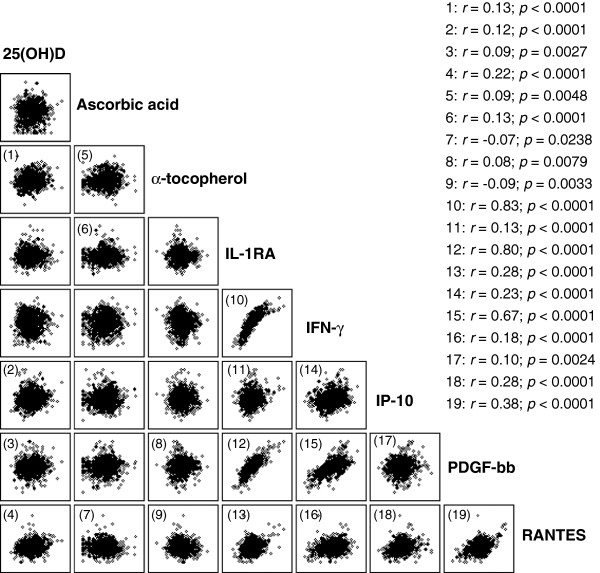
We observed weak micronutrient-cytokine correlations, moderate correlations between certain cytokines, and strong correlations between specific cytokines, particularly interleukin 1- receptor antagonist (IL-1RA), interferon-γ (IFN-γ), and platelet-derived growth factor BB (PDGF-bb). After full covariate adjustment, circulating α-tocopherol was inversely associated with IFN-γ and regulated upon activation normal T-cell expressed and secreted (RANTES). We observed an unexpected positive association between ascorbic acid and IFN-γ. 25(OH)D was not associated with altered concentrations of any inflammatory biomarkers.
These findings suggest that α-tocopherol, but not ascorbic acid or 25(OH)D, is inversely associated with inflammation in healthy young adults.
炎症和氧化应激与许多慢性疾病的发展有关。循环中的抗坏血酸、α-生育酚和 25-羟维生素 D(25(OH)D)可能通过其抗氧化和抗炎特性帮助降低促炎细胞因子的浓度。这些微量营养素可能协同作用,它们可能具有不同的抗炎作用,但以前的研究仅评估了每种微量营养素与炎症之间的联系,而没有控制其他微量营养素。我们的目的是在一个种族多样化的年轻成年人人群中,检查循环抗坏血酸、α-生育酚和 25(OH)D 浓度与一系列促炎细胞因子之间的关联。
来自多伦多营养基因组学和健康研究的参与者(n=1007)提供了用于生物标志物测量的空腹血液样本,并根据其循环浓度分为每个微量营养素的三分位数。我们对所有微量营养素和细胞因子进行了 Pearson 相关性分析。使用协方差分析,在调整年龄、性别、腰围、种族、体力活动、采血季节、总胆固醇、女性激素避孕药使用和其他两种微量营养素后,检查了个别微量营养素和细胞因子之间的关联。
我们观察到微量营养素-细胞因子相关性较弱,某些细胞因子之间相关性中等,特定细胞因子之间相关性较强,尤其是白细胞介素 1 受体拮抗剂(IL-1RA)、干扰素-γ(IFN-γ)和血小板衍生生长因子 BB(PDGF-bb)。在充分调整协变量后,循环α-生育酚与 IFN-γ和激活正常 T 细胞表达和分泌调节剂(RANTES)呈负相关。我们观察到抗坏血酸与 IFN-γ之间出人意料的正相关。25(OH)D 与任何炎症生物标志物的浓度改变均无关。
这些发现表明,α-生育酚,但不是抗坏血酸或 25(OH)D,与健康年轻成年人的炎症呈负相关。