Health Economics Group, Norwich Medical School, University of East Anglia, Norwich, UK.
Am J Prev Med. 2012 Dec;43(6):e45-57. doi: 10.1016/j.amepre.2012.09.001.
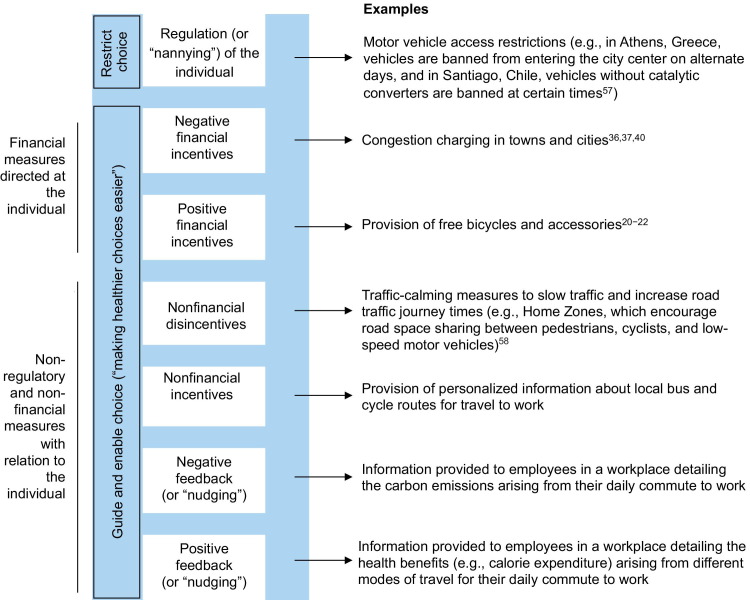
Financial incentives, including taxes and subsidies, can be used to encourage behavior change. They are common in transport policy for tackling externalities associated with use of motor vehicles, and in public health for influencing alcohol consumption and smoking behaviors. Financial incentives also offer policymakers a compromise between "nudging," which may be insufficient for changing habitual behavior, and regulations that restrict individual choice.
The literature review identified studies published between January 1997 and January 2012 of financial incentives relating to any mode of travel in which the impact on active travel, physical activity, or obesity levels was reported. It encompassed macroenvironmental schemes, such as gasoline taxes, and microenvironmental schemes, such as employer-subsidized bicycles. Five relevant reviews and 20 primary studies (of which nine were not included in the reviews) were identified.
The results show that more-robust evidence is required if policymakers are to maximize the health impact of fiscal policy relating to transport schemes of this kind.
Drawing on a literature review and insights from the SLOTH (sleep, leisure, occupation, transportation, and home-based activities) time-budget model, this paper argues that financial incentives may have a larger role in promoting walking and cycling than is acknowledged generally.
财政激励措施,包括税收和补贴,可以用来鼓励行为改变。它们在交通政策中常用于解决与机动车使用相关的外部性问题,在公共卫生政策中常用于影响饮酒和吸烟行为。财政激励措施还为政策制定者提供了一种介于“推动”(可能不足以改变习惯性行为)和限制个人选择的法规之间的妥协方案。
文献综述确定了在 1997 年 1 月至 2012 年 1 月期间发表的与任何交通方式相关的财政激励措施的研究,这些研究报告了对积极出行、身体活动或肥胖水平的影响。它包括宏观环境计划,如汽油税,以及微观环境计划,如雇主补贴的自行车。确定了五项相关综述和 20 项主要研究(其中 9 项未包括在综述中)。
结果表明,如果政策制定者要最大限度地提高与这类交通计划相关的财政政策对健康的影响,就需要更有力的证据。
本文通过文献综述和 SLOTH(睡眠、休闲、职业、交通和家庭活动)时间预算模型的见解,认为财政激励措施在促进步行和骑自行车方面可能比普遍认为的更有作用。