Department of Pulmonary Medicine, Erasmus Medical Center, Postbox 2040, 3000 CA, Rotterdam, The Netherlands.
BMC Cancer. 2012 Dec 5;12:580. doi: 10.1186/1471-2407-12-580.
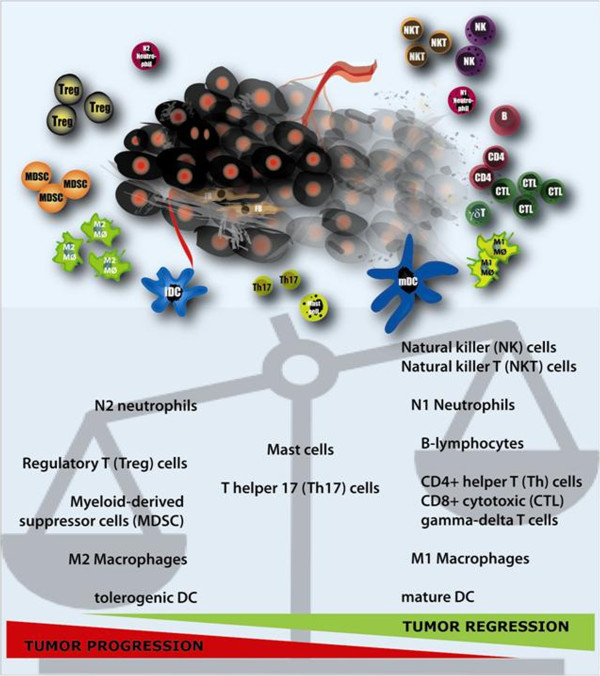
Cancer research has devoted most of its energy over the past decades on unraveling the control mechanisms within tumor cells that govern its behavior. From this we know that the onset of cancer is the result of cumulative genetic mutations and epigenetic alterations in tumor cells leading to an unregulated cell cycle, unlimited replicative potential and the possibility for tissue invasion and metastasis. Until recently it was often thought that tumors are more or less undetected or tolerated by the patient's immune system causing the neoplastic cells to divide and spread without resistance. However, it is without any doubt that the tumor environment contains a wide variety of recruited host immune cells. These tumor infiltrating immune cells influence anti-tumor responses in opposing ways and emerges as a critical regulator of tumor growth. Here we provide a summary of the relevant immunological cell types and their complex and dynamic roles within an established tumor microenvironment. For this, we focus on both the systemic compartment as well as the local presence within the tumor microenvironment of late-stage non-small cell lung cancer (NSCLC), admitting that this multifaceted cellular composition will be different from earlier stages of the disease, between NSCLC patients. Understanding the paradoxical role that the immune system plays in cancer and increasing options for their modulation may alter the odds in favor of a more effective anti-tumor immune response. We predict that the future standard of care of lung cancer will involve patient-tailor-made combination therapies that associate (traditional) chemotherapeutic drugs and biologicals with immune modulating agents and in this way complement the therapeutic armamentarium for this disease.
在过去的几十年里,癌症研究主要致力于揭示肿瘤细胞内控制其行为的调控机制。由此我们知道,癌症的发生是肿瘤细胞中累积的遗传突变和表观遗传改变导致细胞周期失控、无限复制潜力以及组织侵袭和转移的可能性的结果。直到最近,人们通常认为肿瘤或多或少被患者的免疫系统检测不到或耐受,导致肿瘤细胞不受抵抗地分裂和扩散。然而,毫无疑问,肿瘤微环境中含有各种各样被招募的宿主免疫细胞。这些肿瘤浸润免疫细胞以相反的方式影响抗肿瘤反应,并成为肿瘤生长的关键调节剂。在这里,我们总结了相关的免疫细胞类型及其在已建立的肿瘤微环境中的复杂和动态作用。为此,我们既关注全身隔室,也关注晚期非小细胞肺癌(NSCLC)肿瘤微环境中的局部存在,承认这种多方面的细胞组成将不同于疾病的早期阶段,也不同于不同的 NSCLC 患者。了解免疫系统在癌症中所扮演的矛盾角色,并增加对其调节的选择,可能会改变有利于更有效的抗肿瘤免疫反应的可能性。我们预测,未来肺癌的治疗标准将涉及为患者量身定制的联合治疗方案,将(传统)化疗药物和生物制剂与免疫调节剂联合使用,从而补充这种疾病的治疗手段。