Department of Health Sciences, Furman University, Greenville, South Carolina, USA.
Diabetes Care. 2013 Apr;36(4):865-72. doi: 10.2337/dc12-0536. Epub 2012 Dec 5.
The influence on diabetes of the timing and duration of obesity across the high-risk period of adolescence to young adulthood has not been investigated in a population-based, ethnically diverse sample.
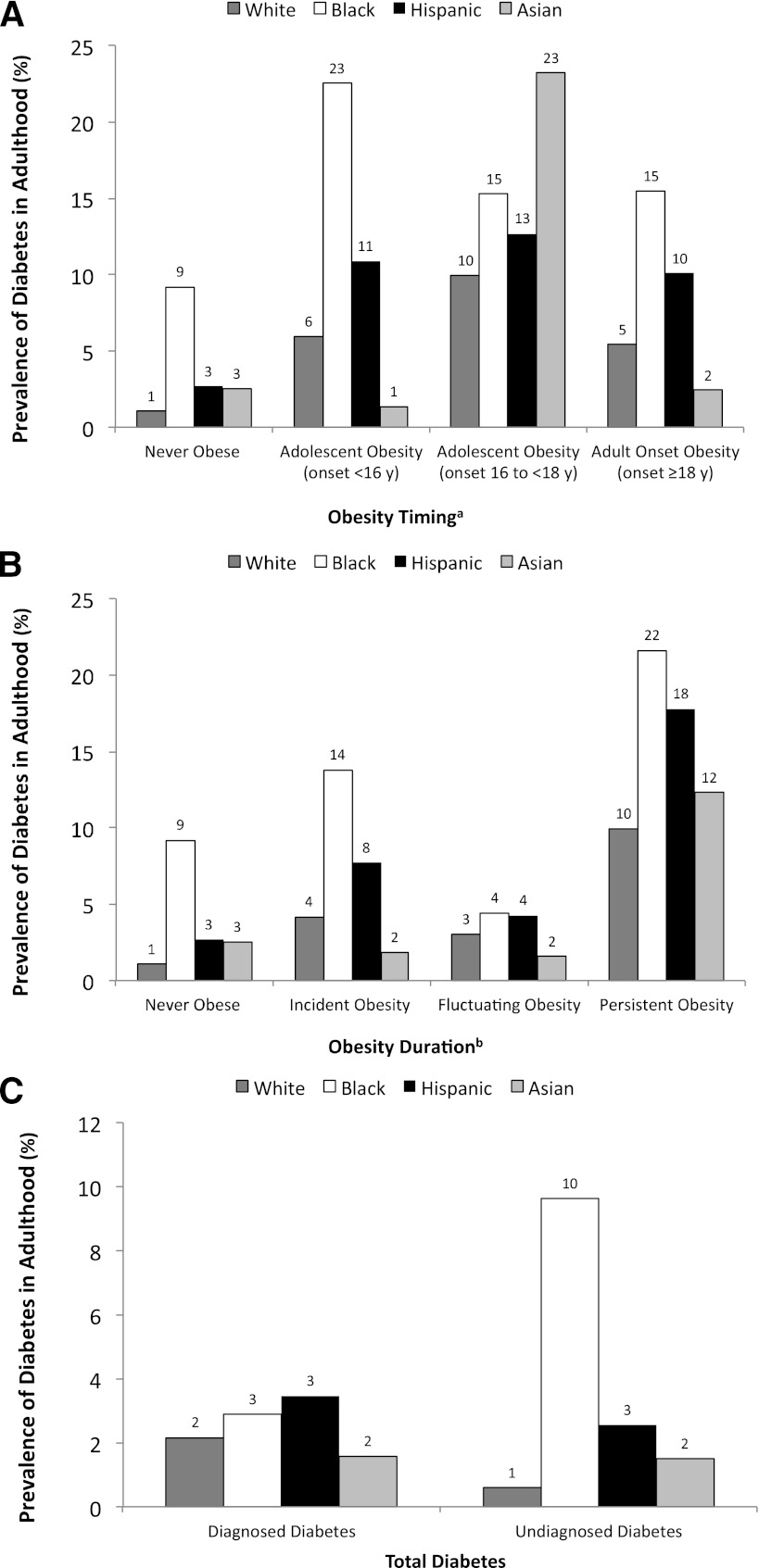
A cohort of 10,481 individuals aged 12-21 years enrolled in the U.S. National Longitudinal Study of Adolescent Health (1996) was followed over two visits during young adulthood (18-27 years, 2001-2002; 24-33 years, 2007-2009). Separate logistic regression models were used to examine the associations of diabetes (A1C ≥6.5% or diagnosis by a health care provider) in young adulthood with 1) obesity timing (never obese, onset <16 years, onset 16 to <18 years, onset ≥18 years) and 2) obesity duration over time (never obese, incident obesity, fluctuating obesity, and persistent obesity), testing differences by sex and race/ethnicity.
Among 24- to 33-year-old participants, 4.4% had diabetes (approximately half were undiagnosed), with a higher prevalence in blacks and Hispanics than whites. In multivariable analyses, women who became obese before age 16 were more likely to have diabetes than women who became obese at or after age 18 (odds ratio 2.77 [95% CI 1.39-5.52]), even after accounting for current BMI, waist circumference, and age at menarche. Persistent (vs. adult onset) obesity was associated with increased likelihood of diabetes in men (2.27 [1.41-3.64]) and women (2.08 [1.34-3.24]).
Diabetes risk is particularly high in individuals who were obese as adolescents relative to those with adult-onset obesity, thus highlighting the need for diabetes prevention efforts to address pediatric obesity.
在基于人群的、种族多样化的样本中,尚未研究肥胖在青春期到青年早期的高危期出现的时间和持续时间对糖尿病的影响。
美国国家青少年健康纵向研究(1996 年)招募了 10481 名年龄在 12-21 岁的个体,在成年早期(18-27 岁,2001-2002 年;24-33 岁,2007-2009 年)进行了两次随访。分别使用逻辑回归模型来研究青年时期的糖尿病(糖化血红蛋白≥6.5%或由医疗保健提供者诊断)与 1)肥胖出现的时间(从未肥胖、16 岁前发病、16-18 岁前发病、18 岁后发病)和 2)肥胖随时间的持续时间(从未肥胖、新发肥胖、波动肥胖和持续肥胖)之间的关联,检验性别和种族/族裔之间的差异。
在 24-33 岁的参与者中,有 4.4%患有糖尿病(约一半为未确诊),黑人及西班牙裔的患病率高于白人。在多变量分析中,与 18 岁或以后开始肥胖的女性相比,16 岁前开始肥胖的女性发生糖尿病的可能性更高(比值比 2.77 [95%CI 1.39-5.52]),即使考虑了当前的 BMI、腰围和初潮年龄。与成人发病肥胖相比,持续(成人发病)肥胖与男性(比值比 2.27 [1.41-3.64])和女性(比值比 2.08 [1.34-3.24])发生糖尿病的可能性增加有关。
与成人发病肥胖相比,青少年时期肥胖的个体发生糖尿病的风险特别高,这突出表明需要开展糖尿病预防工作来解决儿童肥胖问题。