Utah Center for Exploring Mind-Body Interactions, Pain Research Center, Department of Anesthesiology, School of Medicine, University of Utah, 615 Arapeen Drive, Salt Lake City, UT 84108, USA.
J Cancer Surviv. 2013 Jun;7(2):165-82. doi: 10.1007/s11764-012-0252-8. Epub 2013 Jan 22.
After completing treatment, cancer survivors may suffer from a multitude of physical and mental health impairments, resulting in compromised quality of life. This exploratory study investigated whether two mind-body interventions, i.e., Mind-Body Bridging (MBB) and Mindfulness Meditation (MM), could improve posttreatment cancer survivors' self-reported sleep disturbance and comorbid symptoms, as compared to sleep hygiene education (SHE) as an active control.
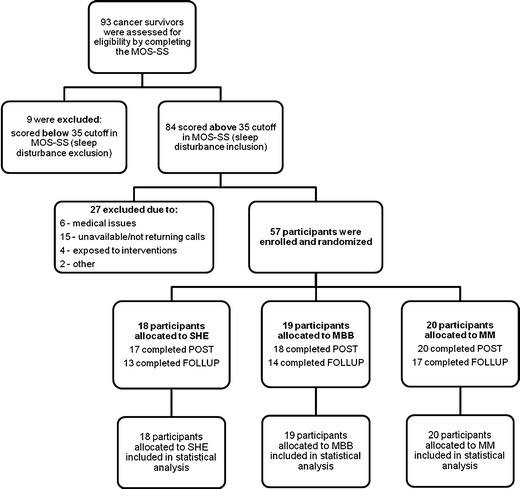
This randomized controlled trial examined 57 cancer survivors with clinically significant self-reported sleep disturbance, randomly assigned to receive MBB, MM, or SHE. All interventions were conducted in three sessions, once per week. Patient-reported outcomes were assessed via the Medical Outcomes Study Sleep Scale and other indicators of psychosocial functioning relevant to quality of life, stress, depression, mindfulness, self-compassion, and well-being.
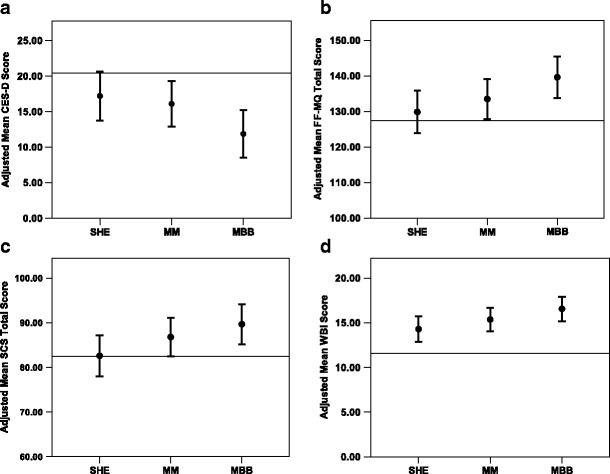
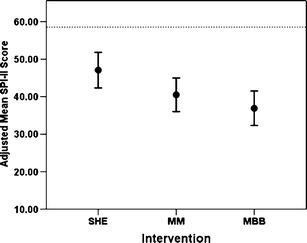
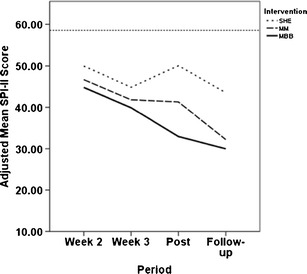
Mixed effects model analysis revealed that mean sleep disturbance symptoms in the MBB (p = .0029) and MM (p = .0499) groups were lower than in the SHE group, indicating that both mind-body interventions improved sleep. In addition, compared with the SHE group, the MBB group showed reductions in self-reported depression symptoms (p = .040) and improvements in overall levels of mindfulness (p = .018), self-compassion (p = .028), and well-being (p = .019) at postintervention.
This study provides preliminary evidence that brief sleep-focused MBB and MM are promising interventions for sleep disturbance in cancer survivors. Integrating MBB or MM into posttreatment supportive plans should enhance care of cancer survivors with sleep disturbance. Because MBB produced additional secondary benefits, MBB may serve as a promising multipurpose intervention for posttreatment cancer survivors suffering from sleep disturbance and other comorbid symptoms.
Two brief sleep-focused mind-body interventions investigated in the study were effective in reducing sleep disturbance and one of them further improved other psychosocial aspects of the cancer survivors' life. Management of sleep problems in survivors is a high priority issue that demands more attention in cancer survivorship.
癌症幸存者在完成治疗后可能会遭受多种身心健康损伤,导致生活质量受损。本探索性研究旨在比较身心桥接(MBB)和正念冥想(MM)两种身心干预措施与睡眠卫生教育(SHE)作为积极对照,是否能改善治疗后癌症幸存者的自我报告睡眠障碍和合并症状。
本随机对照试验纳入了 57 名自我报告有明显睡眠障碍的癌症幸存者,随机分配接受 MBB、MM 或 SHE。所有干预措施均每周进行一次,共三次。通过医疗结局研究睡眠量表和其他与生活质量相关的心理社会功能指标、压力、抑郁、正念、自我同情和幸福感来评估患者报告的结果。
混合效应模型分析显示,MBB(p=0.0029)和 MM 组(p=0.0499)的平均睡眠障碍症状均低于 SHE 组,表明两种身心干预均改善了睡眠。此外,与 SHE 组相比,MBB 组自我报告的抑郁症状(p=0.040)降低,整体正念水平(p=0.018)、自我同情(p=0.028)和幸福感(p=0.019)在干预后得到改善。
本研究初步证明了针对癌症幸存者睡眠障碍的简短、以睡眠为重点的 MBB 和 MM 是很有前途的干预措施。将 MBB 或 MM 纳入治疗后支持计划中,应能增强对有睡眠障碍的癌症幸存者的护理。由于 MBB 产生了额外的次要益处,MBB 可能成为治疗有睡眠障碍和其他合并症状的癌症幸存者的一种很有前途的多用途干预措施。
本研究中研究的两种针对睡眠障碍的简短身心干预措施对减轻睡眠障碍有效,其中一种进一步改善了癌症幸存者生活的其他心理社会方面。在癌症幸存者中,管理睡眠问题是一个高度优先的问题,需要在癌症康复阶段得到更多关注。