School of Medicine, Boston University, Boston, MA 02118, USA.
BMC Public Health. 2013 Jan 23;13:64. doi: 10.1186/1471-2458-13-64.
The Russian Federation (Russia) has one of the highest smoking rates in the world. The purpose of this study is to analyze past and current trends of the tobacco epidemic in the Russian Federation, review current tobacco control policy responses, and identify areas of opportunity for policy priorities.
We used a policy triangle as analytical framework to examine content, context, and processes of Russian tobacco control policy. The analysis was based on secondary data on supply and demand sides of the Russian tobacco epidemic, tobacco-related economic and health effects during Russia's economic transition, and compliance of Russian tobacco policy with international standards and regulations.
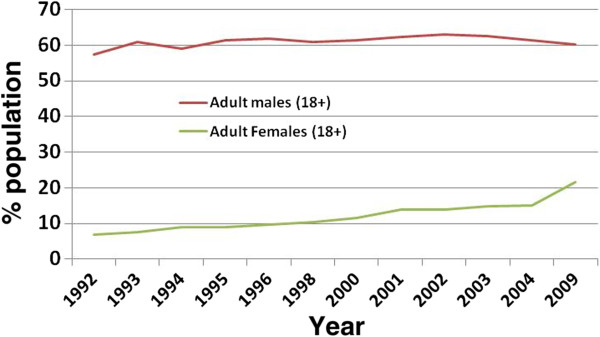
Tobacco-promoting strategies have specifically targeted women and youth. Russia's approval of a "National Tobacco Control Concept" and draft for a comprehensive tobacco control bill increasingly align national legislature with the WHO Framework Convention on Tobacco Control (FCTC). However, several structural and cultural factors represent substantial barriers to the policy process. The influence of transnational tobacco companies on policy processes in Russia has so far impeded a full implementation of the FCTC mandates.
Several strategies have been identified as having the potential to reduce the prevalence of tobacco use in Russia and decrease tobacco-related national health and economic burden: adjusting national tobacco policy by raising tobacco tax from the current lowest level in Europe to at least 70%; consequent enforcement of a complete smoking ban in public places; marketing restrictions; and smoking cessation interventions integrated into primary care. Russia's tobacco control efforts need to target women and youths specifically to efficiently counter industry efforts.
俄罗斯联邦(俄罗斯)是世界上吸烟率最高的国家之一。本研究旨在分析俄罗斯联邦烟草流行的过去和当前趋势,审查当前的烟草控制政策应对措施,并确定政策优先事项的机会领域。
我们使用政策三角作为分析框架,从内容、背景和俄罗斯烟草控制政策过程三个方面考察了俄罗斯烟草控制政策。分析的依据是俄罗斯烟草流行的供应和需求方面的二手数据、俄罗斯经济转型期间与烟草相关的经济和健康影响,以及俄罗斯烟草政策与国际标准和法规的一致性。
俄罗斯的烟草推广策略特别针对妇女和青年。俄罗斯批准了一项“国家烟草控制概念”和一份全面的烟草控制法案草案,使国家立法与世界卫生组织《烟草控制框架公约》(FCTC)更加一致。然而,一些结构和文化因素是政策进程的重大障碍。跨国烟草公司对俄罗斯政策进程的影响迄今为止阻碍了 FCTC 授权的全面实施。
已经确定了一些策略,有可能降低俄罗斯的烟草使用流行率,并减少与烟草相关的国家健康和经济负担:通过将目前在欧洲处于最低水平的烟草税提高到至少 70%,调整国家烟草政策;随后在公共场所实施全面禁烟;限制市场营销;并将戒烟干预措施纳入初级保健。俄罗斯的烟草控制工作需要特别针对妇女和青年,以有效应对行业的努力。