Bioelectromagnetics Laboratory, Zhejiang University School of Medicine, Hangzhou, China.
PLoS One. 2013;8(1):e54906. doi: 10.1371/journal.pone.0054906. Epub 2013 Jan 23.
Although IARC clarifies radiofrequency electromagnetic fields (RF-EMF) as possible human carcinogen, the debate on its health impact continues due to the inconsistent results. Genotoxic effect has been considered as a golden standard to determine if an environmental factor is a carcinogen, but the currently available data for RF-EMF remain controversial. As an environmental stimulus, the effect of RF-EMF on cellular DNA may be subtle. Therefore, more sensitive method and systematic research strategy are warranted to evaluate its genotoxicity.
To determine whether RF-EMF does induce DNA damage and if the effect is cell-type dependent by adopting a more sensitive method γH2AX foci formation; and to investigate the biological consequences if RF-EMF does increase γH2AX foci formation.
Six different types of cells were intermittently exposed to GSM 1800 MHz RF-EMF at a specific absorption rate of 3.0 W/kg for 1 h or 24 h, then subjected to immunostaining with anti-γH2AX antibody. The biological consequences in γH2AX-elevated cell type were further explored with comet and TUNEL assays, flow cytometry, and cell growth assay.
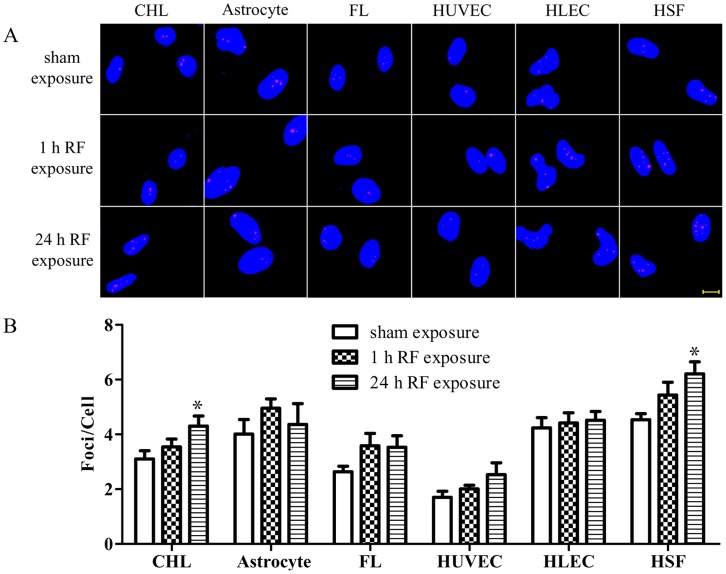
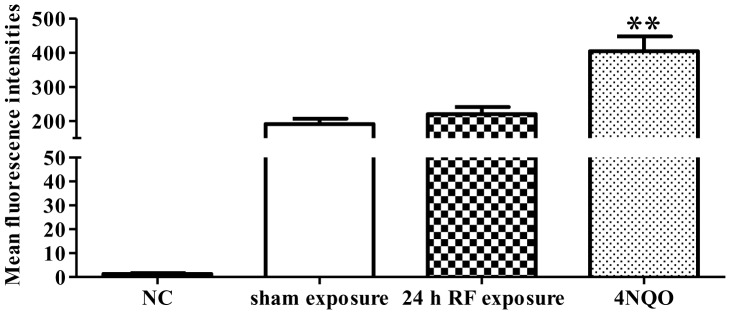
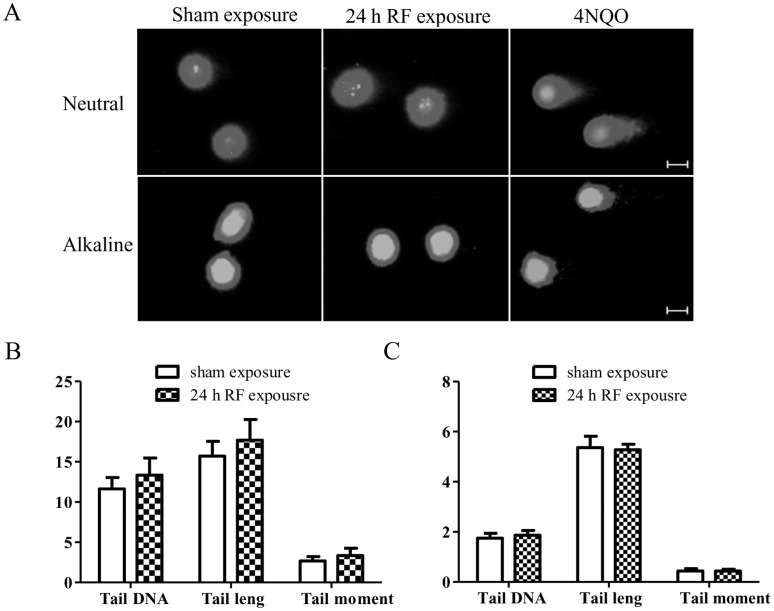
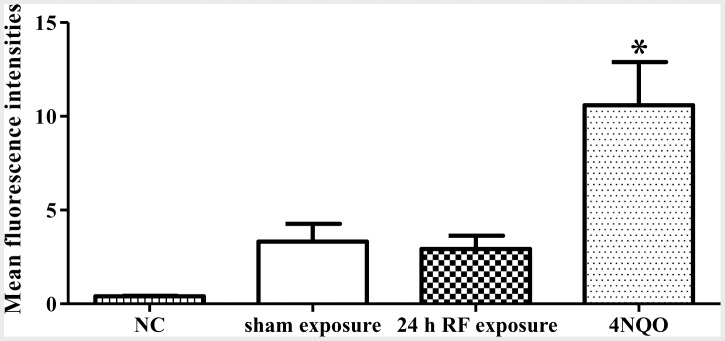
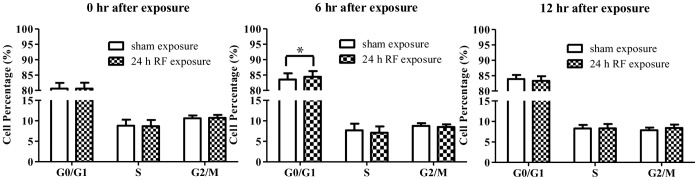
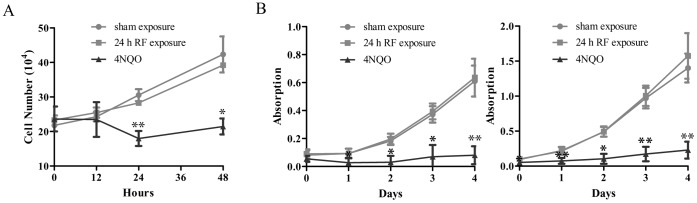
Exposure to RF-EMF for 24 h significantly induced γH2AX foci formation in Chinese hamster lung cells and Human skin fibroblasts (HSFs), but not the other cells. However, RF-EMF-elevated γH2AX foci formation in HSF cells did not result in detectable DNA fragmentation, sustainable cell cycle arrest, cell proliferation or viability change. RF-EMF exposure slightly but not significantly increased the cellular ROS level.
RF-EMF induces DNA damage in a cell type-dependent manner, but the elevated γH2AX foci formation in HSF cells does not result in significant cellular dysfunctions.
尽管国际癌症研究机构(IARC)将射频电磁场(RF-EMF)列为可能的人类致癌物,但由于结果不一致,其健康影响的争论仍在继续。遗传毒性已被认为是确定环境因素是否为致癌物的金标准,但目前关于 RF-EMF 的数据仍存在争议。作为一种环境刺激物,RF-EMF 对细胞 DNA 的影响可能很细微。因此,需要采用更敏感的方法和系统的研究策略来评估其遗传毒性。
通过采用更敏感的方法γH2AX 焦点形成来确定 RF-EMF 是否会引起 DNA 损伤,以及这种效应是否依赖于细胞类型;并研究如果 RF-EMF 确实增加了γH2AX 焦点形成,是否会产生生物学后果。
将六种不同类型的细胞间歇性地暴露于特定吸收率为 3.0 W/kg 的 GSM 1800 MHz RF-EMF 中 1 小时或 24 小时,然后用抗γH2AX 抗体进行免疫染色。通过彗星和 TUNEL 分析、流式细胞术和细胞生长分析进一步研究了在γH2AX 升高的细胞类型中的生物学后果。
暴露于 RF-EMF 24 小时后,明显诱导了中国仓鼠肺细胞和人皮肤成纤维细胞(HSFs)中的γH2AX 焦点形成,但其他细胞则没有。然而,RF-EMF 升高的 HSF 细胞中的γH2AX 焦点形成并未导致可检测的 DNA 片段化、可持续的细胞周期停滞、细胞增殖或活力变化。RF-EMF 暴露略微但无统计学意义地增加了细胞内 ROS 水平。
RF-EMF 以细胞类型依赖性方式诱导 DNA 损伤,但 HSF 细胞中升高的γH2AX 焦点形成不会导致明显的细胞功能障碍。