Do Thi Thanh Toan, Martens Pim, Luu Ngoc Hoat, Wright Pamela, Choisy Marc
Biostatistics and Medical Informatics Department, Institute of Training for Preventive Medicine and Public Health, Hanoi Medical University, Hanoi, Vietnam.
BMC Public Health. 2014 Oct 16;14:1078. doi: 10.1186/1471-2458-14-1078.
Dengue fever (DF) has been emerging in Hanoi over the last decade. Both DF epidemiology and climate in Hanoi are strongly seasonal. This study aims at characterizing the seasonality of DF in Hanoi and its links to climatic variables as DF incidence increases from year to year.
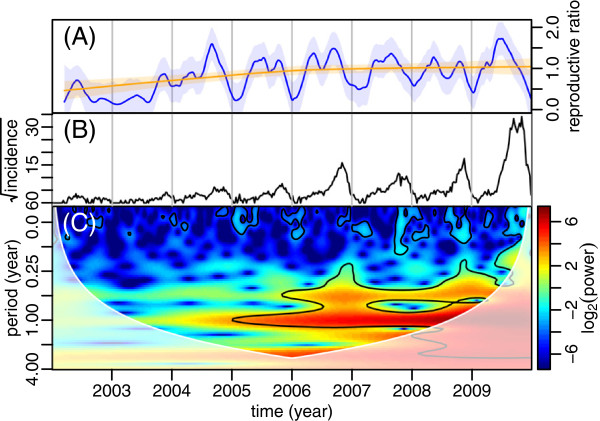
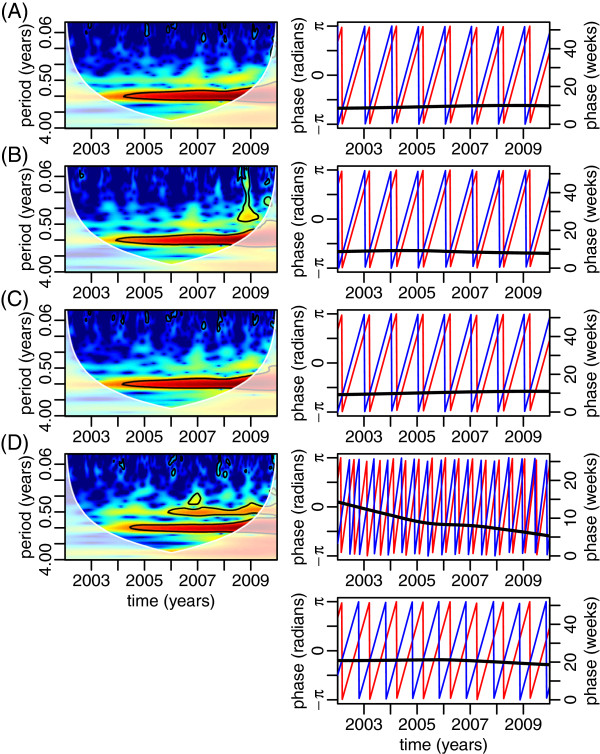
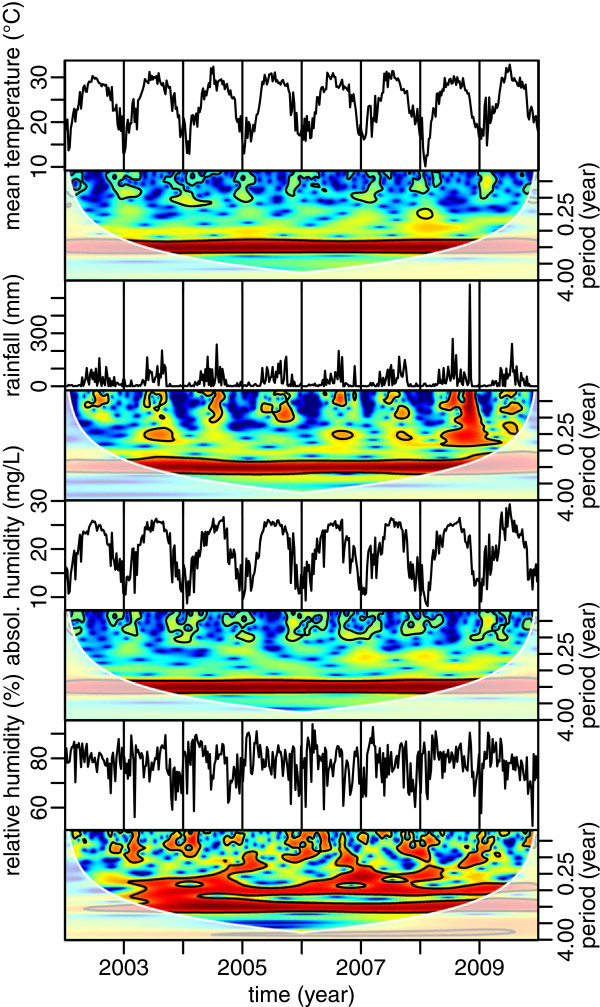
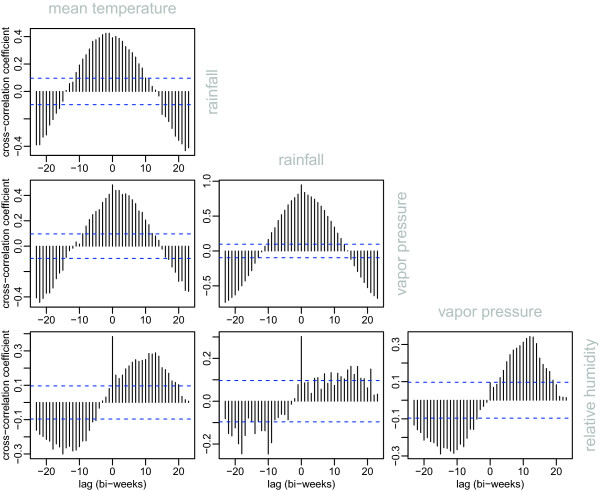
Clinical suspected cases of DF from the 14 central districts of Hanoi were obtained from the Ministry of Health over a 8-year period (2002-2009). Wavelet decompositions were used to characterize the main periodic cycles of DF and climatic variables as well as the mean phase angles of these cycles. Cross-wavelet spectra between DF and each climatic variables were also computed. DF reproductive ratio was calculated from Soper's formula and smoothed to highlight both its long-term trend and seasonality.
Temperature, rainfall, and vapor pressure show strong seasonality. DF and relative humidity show both strong seasonality and a sub-annual periodicity. DF reproductive ratio is increasing through time and displays two clear peaks per year, reflecting the sub-annual periodicity of DF incidence. Temperature, rainfall and vapor pressure lead DF incidence by a lag of 8-10 weeks, constant through time. Relative humidity leads DF by a constant lag of 18 weeks for the annual cycle and a lag decreasing from 14 to 5 weeks for the sub-annual cycle.
Results are interpreted in terms of mosquito population dynamics and immunological interactions between the different dengue serotypes in the human compartment. Given its important population size, its strong seasonality and its dengue emergence, Hanoi offers an ideal natural experiment to test hypotheses on dengue serotypes interactions, knowledge of prime importance for vaccine development.
在过去十年中,登革热在河内呈上升趋势。河内的登革热流行病学和气候都具有强烈的季节性。随着登革热发病率逐年上升,本研究旨在描述河内登革热的季节性特征及其与气候变量的关系。
从河内14个中心城区收集了8年期间(2002 - 2009年)临床疑似登革热病例的数据,数据来源于卫生部。采用小波分解来描述登革热和气候变量的主要周期以及这些周期的平均相位角。还计算了登革热与各气候变量之间的交叉小波谱。根据索珀公式计算登革热繁殖率,并进行平滑处理以突出其长期趋势和季节性。
温度、降雨量和水汽压呈现出强烈的季节性。登革热和相对湿度既表现出强烈的季节性,又呈现出亚年度周期性。登革热繁殖率随时间增加,每年有两个明显的峰值,反映了登革热发病率的亚年度周期性。温度、降雨量和水汽压导致登革热发病率滞后8 - 10周,且随时间保持不变。对于年度周期,相对湿度导致登革热发病滞后18周,对于亚年度周期,滞后时间从14周减少到5周。
从蚊虫种群动态以及人类群体中不同登革热血清型之间的免疫相互作用方面对结果进行了解释。鉴于其庞大的人口规模、强烈的季节性以及登革热的出现,河内提供了一个理想的自然实验,以检验关于登革热血清型相互作用的假设,这对于疫苗开发至关重要。