Laboratoire Psychologie de la Perception, Université Paris Descartes, Sorbonne Paris Cité Paris, France.
Front Neurosci. 2013 Jan 31;7:6. doi: 10.3389/fnins.2013.00006. eCollection 2013.
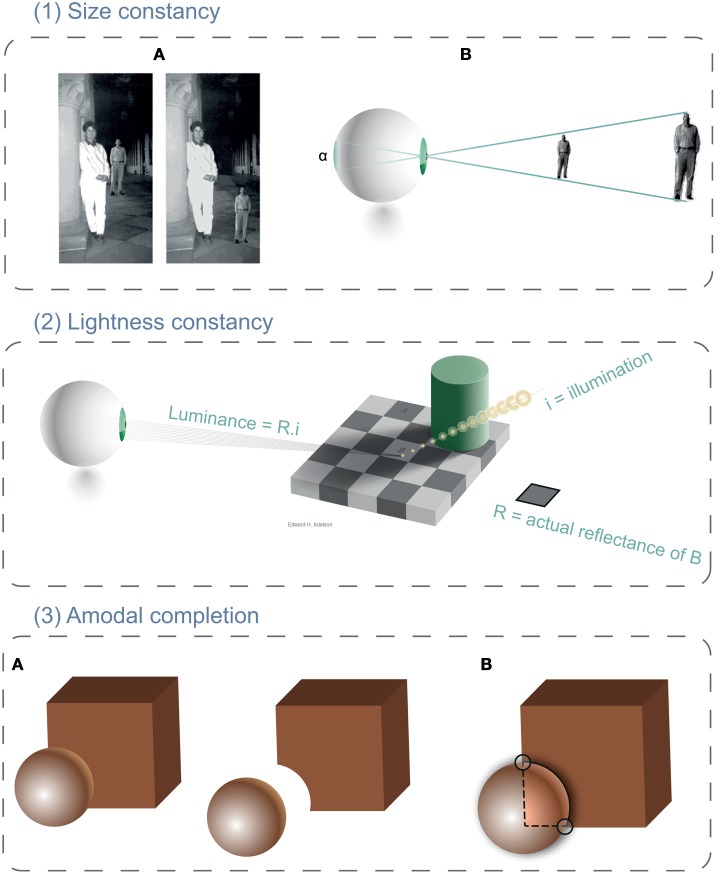
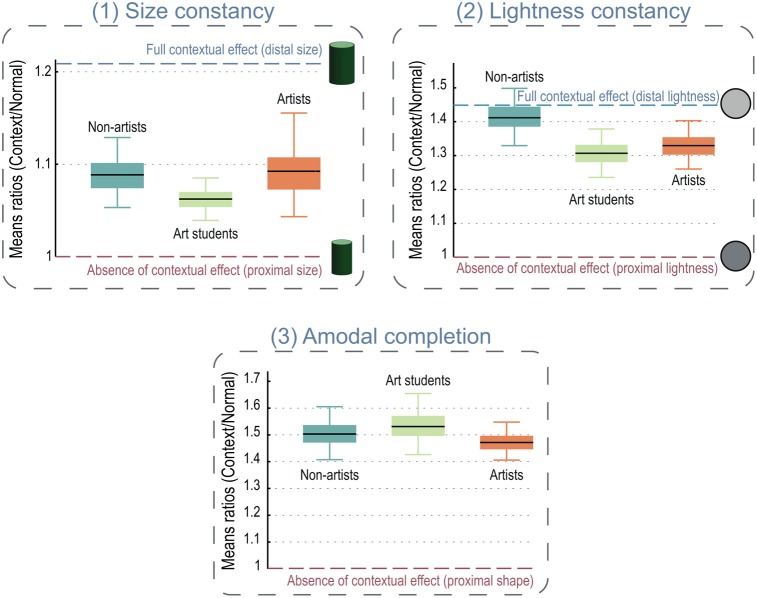
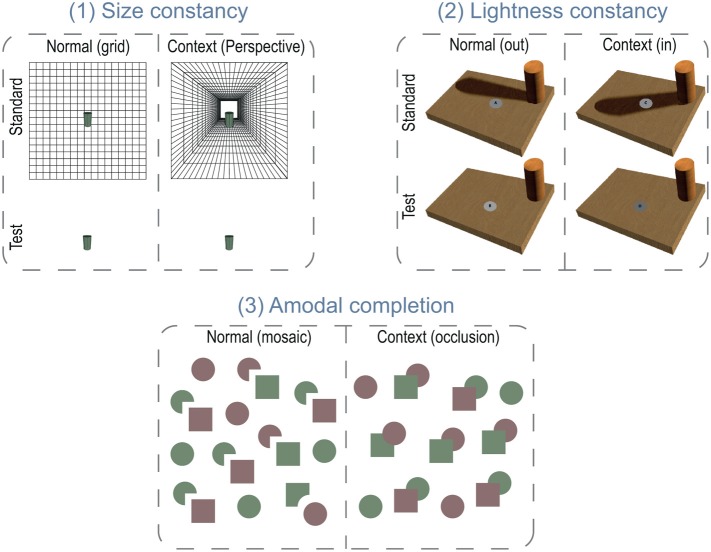
Figurative artists spend years practicing their skills, analyzing objects, and scenes in order to reproduce them accurately. In their drawings, they must depict distant objects as smaller and shadowed surfaces as darker, just as they are at the level of the retinal image. However, this retinal representation is not what we consciously see. Instead, the visual system corrects for distance, changes in ambient illumination and view-point so that our conscious percept of the world remains stable. Does extensive experience modify an artist's visual system so that he or she can access this retinal, veridical image better than a non-artist? We have conducted three experiments testing artists' perceptual abilities and comparing them to those of non-artists. The subjects first attempted to match the size or the luminance of a test stimulus to a standard that could be presented either on a perspective grid (size) or within a cast shadow. They were explicitly instructed to ignore these surrounding contexts and to judge the stimulus as if it were seen in isolation. Finally, in a third task, the subjects searched for an L-shape that either contacted or did not contact an adjacent circle. When in contact, the L-shape appeared as an occluded square behind a circle. This high-level completion camouflaged the L-shape unless subjects could access the raw image. However, in all these tasks, artists were as much affected by visual context as novices. We concluded that artists have no special abilities to access early, non-corrected visual representations and that better accuracy in artists' drawings cannot be attributed to the effects of expertise on early visual processes.
具象派艺术家花费数年时间练习技艺,分析物体和场景,以便能够精确地再现它们。在他们的画作中,他们必须按照视网膜图像的呈现方式,将远处的物体画得更小,将阴影部分画得更暗。然而,我们所看到的并非视网膜呈现的内容。相反,视觉系统会对距离、环境光照和视角的变化进行校正,从而使我们对世界的有意识感知保持稳定。大量的经验是否会改变艺术家的视觉系统,使他们能够比非艺术家更好地获取这种视网膜、真实的图像?我们进行了三项实验,测试了艺术家的感知能力,并将其与非艺术家的能力进行了比较。首先,受试者试图将测试刺激的大小或亮度与可以在透视网格(大小)或投影阴影内呈现的标准进行匹配。他们被明确指示忽略这些周围环境,将刺激视为孤立存在进行判断。最后,在第三个任务中,受试者搜索一个与相邻圆接触或不接触的 L 形。当接触时,L 形会在圆后面呈现为一个被遮挡的正方形。这种高级别的完成会掩盖 L 形,除非受试者能够访问原始图像。然而,在所有这些任务中,艺术家和新手一样受到视觉环境的影响。我们得出的结论是,艺术家没有特殊能力来获取早期未经校正的视觉表示,并且艺术家画作中更好的准确性不能归因于专业知识对早期视觉过程的影响。