Department of Epidemiology and the Welch Center for Prevention, Epidemiology and Clinical Research, Johns Hopkins Bloomberg School of Public Health, Baltimore, Maryland, USA.
Diabetes. 2013 Jun;62(6):2116-21. doi: 10.2337/db12-1528. Epub 2013 Feb 8.
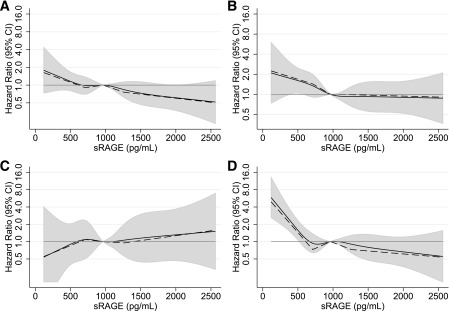
Advanced glycation end products (AGEs) and their receptors are strongly implicated in the development of diabetes complications. When stimulated by AGEs, the receptors for AGEs (RAGEs) induce inflammation and are thought to fuel disease progression. Soluble circulating RAGE (sRAGE) may counteract the detrimental effects of RAGE. We measured sRAGE in stored plasma from a random sample of 1,201 participants in the Atherosclerosis Risk in Communities (ARIC) Study who were aged 47-68 years, had normal kidney function, and had no history of cardiovascular disease. In cross-sectional analyses, black race, male sex, higher BMI, and higher C-reactive protein were independently associated with low sRAGE. The racial difference was striking, with blacks approximately three times more likely to have low sRAGE compared with whites even after adjustment. During ~18 years of follow-up, there were 192 incident coronary heart disease events, 53 ischemic strokes, 213 deaths, and 253 cases of diabetes (among the 1,057 persons without diabetes at baseline). In multivariable Cox models comparing risk in the first quartile with that in the fourth quartile of baseline sRAGE, low levels of sRAGE were significantly associated with risk of diabetes (hazard ratio 1.64 [95% CI 1.10-2.44]), coronary heart disease (1.82 [1.17-2.84]), and mortality (1.72 [1.11-2.64]) but not ischemic stroke (0.78 [0.34-1.79]). In conclusion, we found that low levels of sRAGE were a marker of future chronic disease risk and mortality in the community and may represent an inflammatory state. Racial differences in sRAGE deserve further examination.
晚期糖基化终产物 (AGEs) 及其受体强烈参与糖尿病并发症的发展。当受到 AGEs 的刺激时,AGEs 的受体 (RAGEs) 会引发炎症,并被认为推动疾病的进展。可溶性循环 RAGE (sRAGE) 可能会抵消 RAGE 的有害影响。我们测量了来自随机抽取的 1201 名参加动脉粥样硬化风险社区研究(ARIC)的参与者的储存血浆中的 sRAGE,这些参与者年龄在 47-68 岁之间,肾功能正常,且没有心血管疾病史。在横断面分析中,黑种人、男性、更高的 BMI 和更高的 C 反应蛋白与低 sRAGE 独立相关。种族差异非常显著,即使在调整后,黑人患低 sRAGE 的可能性是白人的三倍左右。在大约 18 年的随访期间,有 192 例冠心病事件、53 例缺血性中风、213 例死亡和 253 例糖尿病(在基线时没有糖尿病的 1057 人中)。在比较基线 sRAGE 第一四分位数与第四四分位数风险的多变量 Cox 模型中,低水平的 sRAGE 与糖尿病(风险比 1.64 [95%CI 1.10-2.44])、冠心病(1.82 [1.17-2.84])和死亡率(1.72 [1.11-2.64])的风险显著相关,但与缺血性中风(0.78 [0.34-1.79])无关。总之,我们发现低水平的 sRAGE 是社区中未来慢性疾病风险和死亡率的标志物,可能代表一种炎症状态。sRAGE 的种族差异值得进一步研究。