Department of Psychiatry, Douglas Institute, McGill University Verdun, QC, Canada.
Front Aging Neurosci. 2013 Feb 20;5:1. doi: 10.3389/fnagi.2013.00001. eCollection 2013.
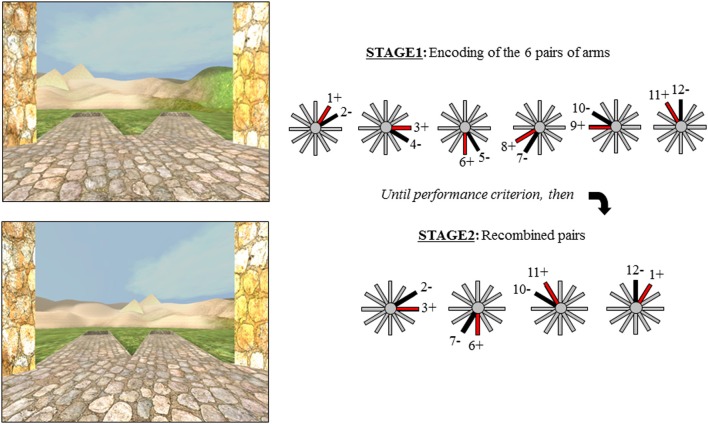
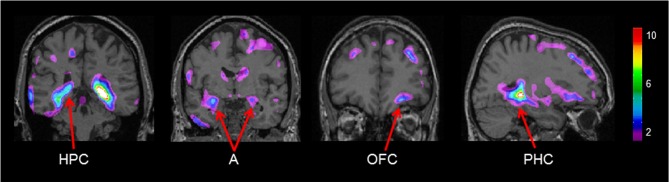
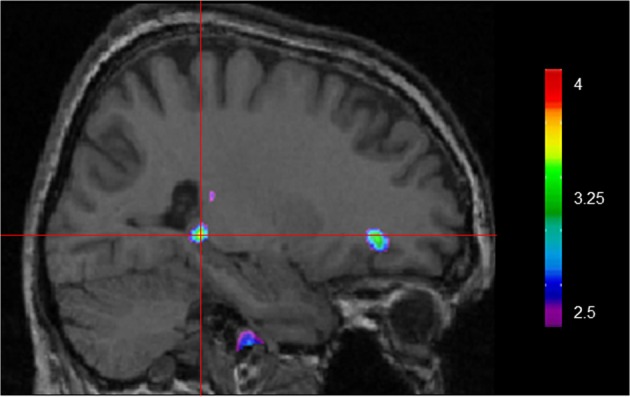
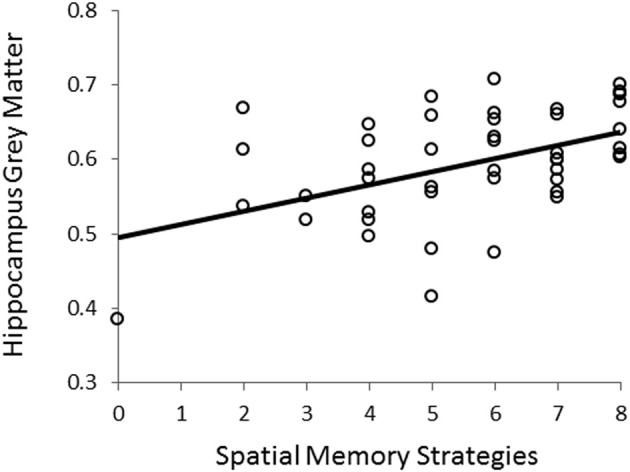
Healthy young adults use different strategies when navigating in a virtual maze. Spatial strategies involve using environmental landmarks while response strategies involve executing a series of movements from specific stimuli. Neuroimaging studies previously confirmed that people who use spatial strategies show increased activity and gray matter in the hippocampus, while those who use response strategies show increased activity and gray matter in caudate nucleus (Iaria et al., 2003; Bohbot et al., 2007). A growing number of studies report that cognitive decline that occurs with normal aging is correlated with a decrease in volume of the hippocampus. Here, we used voxel-based morphometry (VBM) to examine whether spatial strategies in aging are correlated with greater gray matter in the hippocampus, as found in our previous study with healthy young participants. Forty-five healthy older adults were tested on a virtual navigation task that allows spatial and response strategies. All participants learn the task to criterion after which a special "probe" trial that assesses spatial and response strategies is given. Results show that spontaneous spatial memory strategies, and not performance on the navigation task, positively correlate with gray matter in the hippocampus. Since numerous studies have shown that a decrease in the volume of the hippocampus correlates with cognitive deficits during normal aging and increases the risks of ensuing dementia, the current results suggest that older people who use their spatial memory strategies in their everyday lives may have increased gray matter in the hippocampus and enhance their probability of healthy and successful aging.
健康的年轻成年人在虚拟迷宫中导航时使用不同的策略。空间策略涉及使用环境地标,而反应策略涉及根据特定刺激执行一系列动作。神经影像学研究先前证实,使用空间策略的人会增加海马体的活动和灰质,而使用反应策略的人会增加尾状核的活动和灰质(Iaria 等人,2003 年;Bohbot 等人,2007 年)。越来越多的研究报告称,与正常衰老相关的认知能力下降与海马体体积的减少有关。在这里,我们使用基于体素的形态测量学(VBM)来检查随着年龄增长而出现的空间策略是否与海马体中的灰质增加有关,正如我们之前对健康年轻参与者的研究中所发现的那样。我们对 45 名健康的老年人进行了虚拟导航任务测试,该任务允许使用空间和反应策略。所有参与者在达到标准后都接受了特殊的“探针”试验,以评估空间和反应策略。结果表明,自发的空间记忆策略,而不是导航任务的表现,与海马体中的灰质呈正相关。由于许多研究表明,海马体体积的减少与正常衰老期间的认知缺陷相关,并增加了随后痴呆的风险,因此目前的结果表明,在日常生活中使用空间记忆策略的老年人可能会增加海马体中的灰质,并提高他们健康和成功衰老的可能性。