Sansom Institute for Health Research, Division of Health Sciences, University of South Australia, Adelaide, South Australia, Australia.
Nutr Diabetes. 2012 Aug 13;2(8):e40. doi: 10.1038/nutd.2012.11.
A high-protein (HP), low-fat weight-loss diet may be advantageous for improving cardiometabolic health outcomes and body composition. To date, only limited research has been conducted in male participants.
To evaluate the medium to long-term effects of two, low-fat, hypocaloric diets differing in carbohydrate:protein ratio on body composition and cardiometabolic health outcomes in overweight and obese males.
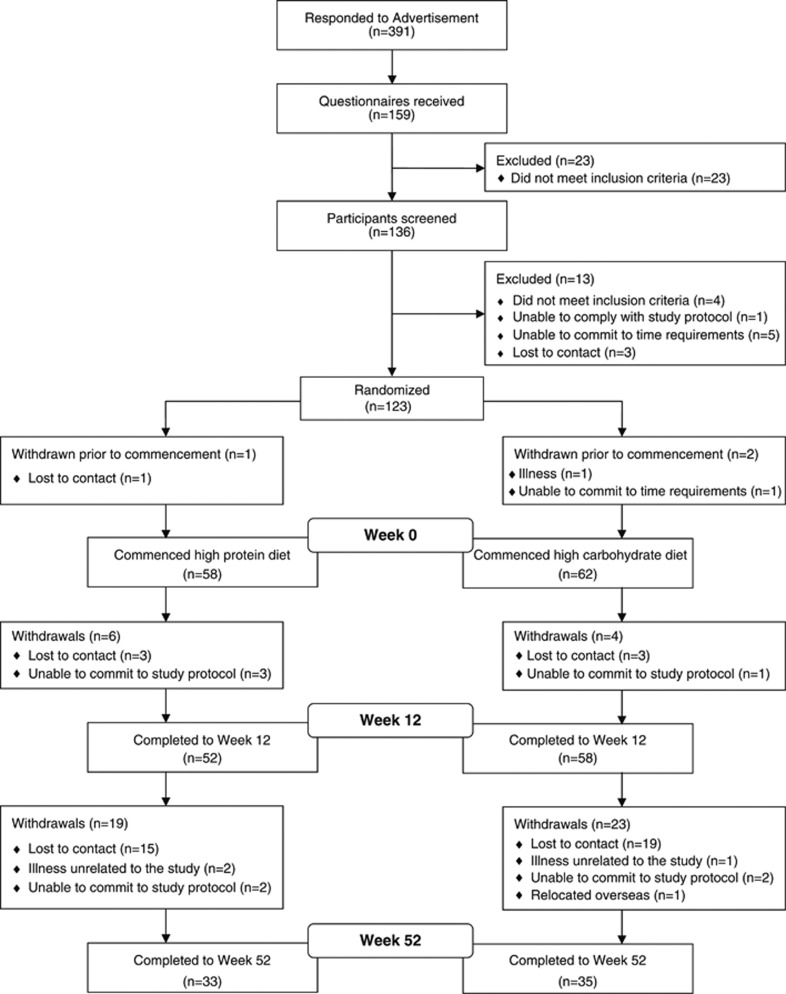
One hundred and twenty males (age 50.8±9.3 (s.d.) years, body mass index 33.0±3.9 kg m(-2)) were randomly assigned and consumed a low-fat, isocaloric, energy-restricted diet (7 MJ per day) with either HP (protein:carbohydrate:fat %energy, 35:40:25) or high carbohydrate (HC; 17:58:25). Body weight, body composition and cardiometabolic risk factors were assessed at baseline and after 12 and 52 weeks.
Sixty-eight participants completed the study (HP, n=33; HC, n=35). At 1 year both the groups experienced similar reductions in body weight (HP, -12.3±8.0 kg (-12%); HC, -10.9±8.6 kg (-11%); P=0.83 time × group interaction) and fat mass (-9.9±6.0 kg (-27%) vs -7.3±5.8 kg (-22%); P=0.11). Participants who consumed the HP diet lost less fat-free mass (-2.6±3.7 kg (-4%) vs -3.8±4.7 kg (-6%); P<0.01). Both groups experienced similar increases in high-density lipoprotein cholesterol (8%) and reductions in total cholesterol (-7%), low-density lipoprotein cholesterol (-9%), triglycerides (-24%), glucose (-3%), insulin (-38%), blood pressure (-7/-12%) and C-reactive protein (-29%), (P0.14).
In overweight and obese men, both a HP and HC diet reduced body weight and improved cardiometabolic risk factors. Consumption of a HP diet was more effective for improving body composition compared with an HC diet.
高蛋白(HP)、低脂肪减肥饮食可能有利于改善心血管代谢健康结果和身体成分。迄今为止,只有有限的研究在男性参与者中进行。
评估两种低脂肪、低热量的碳水化合物:蛋白质比例不同的饮食对超重和肥胖男性身体成分和心血管代谢健康结果的中到长期影响。
120 名男性(年龄 50.8±9.3(标准差)岁,体重指数 33.0±3.9kg/m²)被随机分配并食用低脂肪、等热量、能量限制饮食(每天 7MJ),其中 HP(蛋白质:碳水化合物:脂肪%能量,35:40:25)或高碳水化合物(HC;17:58:25)。在基线和 12 周和 52 周后评估体重、身体成分和心血管代谢危险因素。
68 名参与者完成了研究(HP,n=33;HC,n=35)。在 1 年内,两组体重均出现相似的减轻(HP,-12.3±8.0kg(-12%);HC,-10.9±8.6kg(-11%);P=0.83 时间×组交互)和脂肪量减少(-9.9±6.0kg(-27%)比-7.3±5.8kg(-22%);P=0.11)。摄入 HP 饮食的参与者体脂减少较少(-2.6±3.7kg(-4%)比-3.8±4.7kg(-6%);P<0.01)。两组高密度脂蛋白胆固醇均增加(8%),总胆固醇降低(-7%),低密度脂蛋白胆固醇降低(-9%),甘油三酯降低(-24%),血糖降低(-3%),胰岛素降低(-38%),血压降低(-7/-12%)和 C 反应蛋白降低(-29%)(P0.14)。
在超重和肥胖男性中,HP 和 HC 饮食均可减轻体重并改善心血管代谢危险因素。与 HC 饮食相比,HP 饮食在改善身体成分方面更有效。