Department of Neurology, Radboud University Nijmegen Medical Centre, Nijmegen Centre for Evidence Based Practice, Nijmegen, Netherlands.
BMJ. 2013 Mar 1;346:f576. doi: 10.1136/bmj.f576.
To evaluate whether a multifaceted behavioural change programme increases physical activities in patients with Parkinson's disease.
Multicentre randomised controlled trial.
32 community hospitals in the Netherlands, collaborating in a nationwide network (ParkinsonNet).
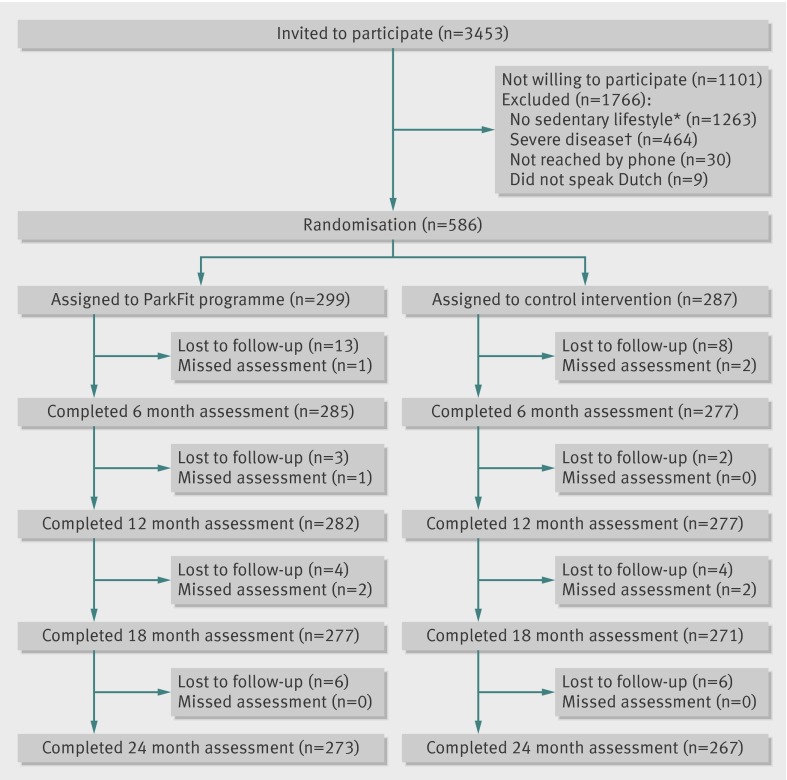
586 sedentary patients with idiopathic Parkinson's disease aged between 40 and 75 years with mild to moderate disease severity (Hoehn and Yahr stage ≤ 3).
Patients were randomly assigned to the ParkFit programme or a matched general physiotherapy intervention. ParkFit is a multifaceted behavioural change programme, designed specifically to achieve an enduring increase in the level of physical activity (coaches using motivational strategies; ambulatory feedback).
The primary endpoint was the level of physical activity, measured every six months with a standardised seven day recall (LASA physical activity questionnaire-LAPAQ). Secondary endpoints included two other measures of physical activity (activity diary and ambulatory activity monitor), quality of life (Parkinson's disease questionnaire-PDQ-39), and fitness (six minute walk test).
540 (92.2%) patients completed the primary outcome. During follow-up, overall time spent on physical activities (LAPAQ) was comparable between the groups (adjusted group difference 7%, 95% confidence interval -3 to 17%; P=0.19). Analyses of three secondary outcomes indicated increased physical activity in ParkFit patients, as suggested by the activity diary (difference 30%; P<0.001), the activity monitor (difference 12%; P<0.001), and the six minute walk test (difference 4.8 m; P=0.05). PDQ-39 did not differ between ParkFit patients and controls (difference -0.9 points; P=0.14). The number of fallers was comparable between ParkFit patients (184/299; 62%) and controls (191/287; 67%).
The ParkFit behavioural change programme did not increase overall physical activity, as measured with the LAPAQ. The analysis of the secondary endpoints justifies further work into the possible merits of behavioural change programmes to increase physical activities in daily life in Parkinson's disease.
Clinical trials NCT00748488.
评估多方面行为改变方案是否能增加帕金森病患者的身体活动量。
多中心随机对照试验。
荷兰 32 家社区医院,参与全国性网络(ParkinsonNet)。
586 名年龄在 40 至 75 岁之间、患有特发性帕金森病且病情处于轻度至中度(Hoehn 和 Yahr 分期≤3)的久坐患者。
患者被随机分配到 ParkFit 方案或匹配的一般物理治疗干预组。ParkFit 是一种多方面的行为改变方案,专门设计用于实现身体活动水平的持久增加(教练使用动机策略;活动反馈)。
主要终点是身体活动水平,每六个月用标准化的七天回忆法(LASA 体力活动问卷-LAPAQ)测量。次要终点包括身体活动的另外两个测量指标(活动日记和活动监测器)、生活质量(帕金森病问卷-PDQ-39)和体能(六分钟步行测试)。
540 名(92.2%)患者完成了主要结局。在随访期间,两组之间总体体力活动时间(LAPAQ)相当(调整后的组间差异 7%,95%置信区间 -3 至 17%;P=0.19)。对三个次要结局的分析表明,ParkFit 患者的体力活动增加,活动日记(差异 30%;P<0.001)、活动监测器(差异 12%;P<0.001)和六分钟步行测试(差异 4.8 m;P=0.05)。ParkFit 患者和对照组之间的 PDQ-39 差异无统计学意义(差异 -0.9 分;P=0.14)。ParkFit 患者(184/299;62%)和对照组(191/287;67%)跌倒人数相当。
ParkFit 行为改变方案并没有增加 LAPAQ 测量的总体身体活动量。对次要终点的分析证明,行为改变方案在增加帕金森病患者日常生活中的体力活动方面具有潜在优势,值得进一步研究。
临床试验 NCT00748488。