Division of Clinical Epidemiology and Evaluative Sciences Research, Weill Cornell Medical College, 1300 York Ave, Box No. 46, New York, NY 10065, USA.
Prev Chronic Dis. 2013;10. doi: 10.5888/pcd10.120142.
Faith-based organizations are recognized as an influential venue for behavioral health interventions. However, less is known about efficient approaches for identifying and recruiting these organizations and about the processes that enable successful partnership.
In 2007, 66% of Latinos and 70% of blacks in New York City reported being overweight or obese. Project SCALE (Small Changes and Lasting Effects) is a 5-year randomized behavioral weight loss intervention trial aimed to help black and Latino adults lose weight by making small changes in eating behaviors and daily leisure physical activity. The study partnered with faith-based organizations.
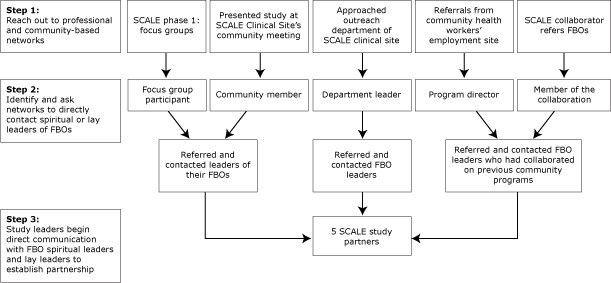
Faith-based organizations were identified primarily through direct referrals. Recruitment consisted of screening faith-based organizations, establishing a memorandum of understanding, and intervention modification. Partnership maintenance occurred primarily via progress meetings.
We identified processes that supported and impeded study recruitment and retention. Obtaining leadership support and using group orientation sessions were successful recruitment and retention processes. A balance must be found between leadership, advocacy, and causing members to feel pressured to participate in the study.
Behavioral health interventions implemented in faith-based organizations can reduce health disparities. However, researchers must determine whether faith-based organizations have the capacity to partner in intensive interventions. Focusing on the establishment of strong partnerships at the onset will help ensure that mutual objectives are achieved and sustained long-term.
宗教组织被认为是行为健康干预的一个有影响力的场所。然而,对于识别和招募这些组织的有效方法,以及使合作伙伴关系成功的过程,人们知之甚少。
2007 年,纽约市 66%的拉丁裔人和 70%的黑人报告体重超重或肥胖。SCALE 项目(Small Changes and Lasting Effects)是一项为期 5 年的随机行为减肥干预试验,旨在通过改变饮食行为和日常休闲体育活动,帮助黑人和拉丁裔成年人减肥。该研究与宗教组织合作。
宗教组织主要通过直接推荐来确定。招募包括筛选宗教组织、建立谅解备忘录和干预措施的修改。伙伴关系的维护主要通过进度会议进行。
我们确定了支持和阻碍研究招募和保留的过程。获得领导层的支持和使用团体定向会议是成功的招募和保留过程。必须在领导层、倡导和让成员感到有压力参与研究之间找到平衡。
在宗教组织中实施的行为健康干预措施可以减少健康差距。然而,研究人员必须确定宗教组织是否有能力参与强化干预。在开始时专注于建立强有力的伙伴关系将有助于确保实现共同目标并长期维持。