Swaroop Mamta, Straus David C, Agubuzu Ogo, Esposito Thomas J, Schermer Carol R, Crandall Marie L
Northwestern University Feinberg School of Medicine, University of Chicago Department of Neurosurgery, Loyola University Medical Center, University of California, Davis, USA.
J Emerg Trauma Shock. 2013 Jan;6(1):16-20. doi: 10.4103/0974-2700.106320.
Achieving definitive care within the "Golden Hour" by minimizing response times is a consistent goal of regional trauma systems. This study hypothesizes that in urban Level I Trauma Centers, shorter pre-hospital times would predict outcomes in penetrating thoracic injuries.
A retrospective cohort study was performed using a statewide trauma registry for the years 1999-2003. Total pre-hospital times were measured for urban victims of penetrating thoracic trauma. Crude and adjusted mortality rates were compared by pre-hospital time using STATA statistical software.
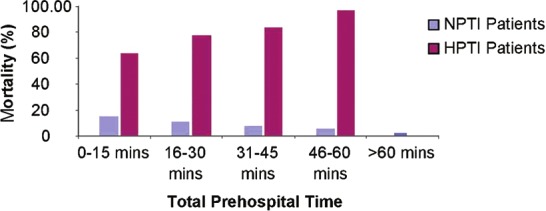
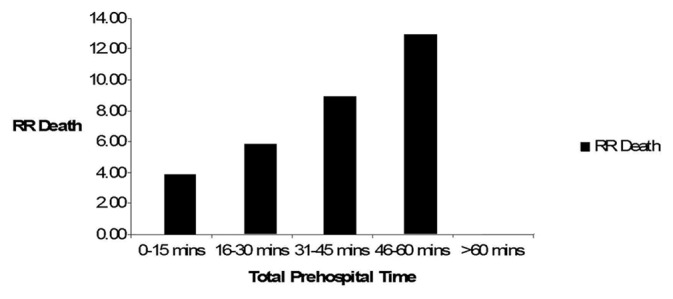
During the study period, 908 patients presented to the hospital after penetrating thoracic trauma, with 79% surviving. Patients with higher injury severity scores (ISS) were transported more quickly. Injury severity scores (ISS) ≥16 and emergency department (ED) hypotension (systolic blood pressure, SBP <90) strongly predicted mortality (P < 0.05 for each). In a logistic regression model including age, race, and ISS, longer transport times for hypotensive patients were associated with higher mortality rates (all P values <0.05). This was seen most significantly when comparing patient transport times 0-15 min and 46-60 min (P < 0.001).
In victims of penetrating thoracic trauma, more severely injured patients arrive at urban trauma centers sooner. Mortality is strongly predicted by injury severity, although shorter pre-hospital times are associated with improved survival. These results suggest that careful planning to optimize transport time-encompassing hospital capacity and existing resources, traffic patterns, and trauma incident densities may be beneficial in areas with a high burden of penetrating trauma.
通过尽量缩短反应时间在“黄金一小时”内实现确定性治疗是区域创伤系统的一个一致目标。本研究假设,在城市一级创伤中心,较短的院前时间可预测穿透性胸部损伤的预后。
利用1999 - 2003年全州创伤登记处进行了一项回顾性队列研究。对城市穿透性胸部创伤受害者的总院前时间进行了测量。使用STATA统计软件按院前时间比较了粗死亡率和调整后的死亡率。
在研究期间,908例穿透性胸部创伤患者被送往医院,79%存活。损伤严重程度评分(ISS)较高的患者转运速度更快。损伤严重程度评分(ISS)≥16以及急诊科(ED)低血压(收缩压,SBP <90)强烈预测死亡率(每项P <0.05)。在一个包括年龄种族和ISS的逻辑回归模型中,低血压患者较长的转运时间与较高的死亡率相关(所有P值<0.05)。在比较患者转运时间0 - 15分钟和46 - 60分钟时,这一点最为显著(P <0.001)。
在穿透性胸部创伤患者中,受伤更严重的患者更快到达城市创伤中心。死亡率强烈取决于损伤严重程度,尽管较短的院前时间与生存率提高相关。这些结果表明,对于穿透性创伤负担较高的地区,精心规划以优化转运时间(包括医院容量和现有资源、交通模式以及创伤事件密度)可能是有益的。