Panda Vandana, Ashar Hardik, Srinath Sudhamani
Department of Pharmacology & Toxicology, Prin. K. M. Kundnani College of Pharmacy, Rambhau Salgaonkar Marg, Cuffe Parade, Colaba, Mumbai, India.
Interdiscip Toxicol. 2012 Dec;5(4):207-13. doi: 10.2478/v10102-012-0034-1.
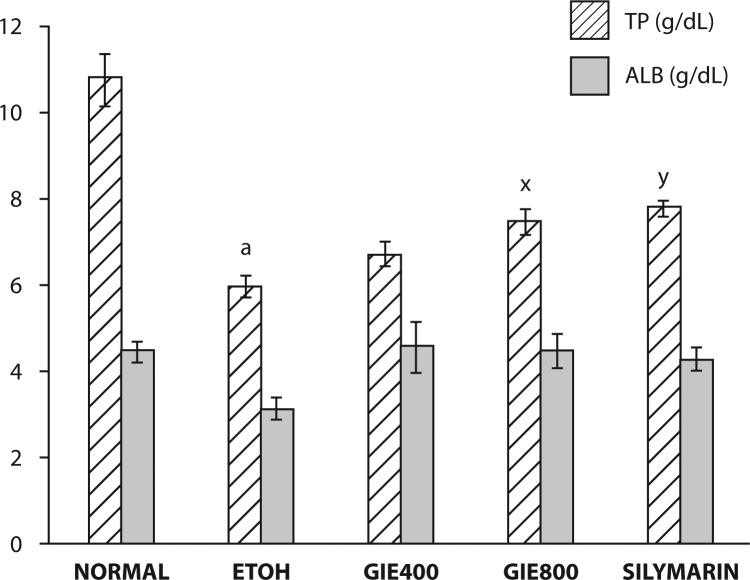
The protective effects of aqueous extracts of the fruit rind of Garcinia indica (GIE) on ethanol-induced hepatotoxicity and the probable mechanisms involved in this protection were investigated in rats. Liver damage was induced in rats by administering ethanol (5 g/kg, 20% w/v p.o.) once daily for 21 days. GIE at 400 mg/kg and 800 mg/kg and the reference drug silymarin (200 mg/kg) were administered orally for 28 days to ethanol treated rats, this treatment beginning 7 days prior to the commencement of ethanol administration. Levels of marker enzymes (aspartate aminotransferase (AST), alanine aminotransferase (ALT) and alkaline phosphatase (ALP)), triglyceride (sTG), albumin (Alb) and total protein (TP) were evaluated in serum. Antioxidant parameters (reduced glutathione (GSH), superoxide dismutase (SOD), catalase (CAT), glutathione peroxidase (GPx) and glutathione reductase (GR)), hepatic triglycerides (hTG) and the lipid peroxidation marker malondialdehyde (MDA) were determined in liver. GIE and silymarin elicited significant hepatoprotective activity by attenuating the ethanol-elevated levels of AST, ALT, ALP, sTG, hTG and MDA and restored the ethanol-depleted levels of GSH, SOD, CAT, GPx, GR, Alb and TP. GIE 800 mg/kg demonstrated greater hepatoprotection than GIE 400 mg/kg. The present findings indicate that hepatoprotective effects of GIE in ethanol-induced oxidative damage may be due to an augmentation of the endogenous antioxidants and inhibition of lipid peroxidation in liver.
研究了藤黄果果皮水提取物(GIE)对乙醇诱导的大鼠肝毒性的保护作用及其可能的保护机制。通过每天一次给予乙醇(5 g/kg,20% w/v,口服),持续21天,诱导大鼠肝损伤。对乙醇处理的大鼠口服给予400 mg/kg和800 mg/kg的GIE以及参比药物水飞蓟宾(200 mg/kg),持续28天,该处理在乙醇给药开始前7天开始。评估血清中标志物酶(天冬氨酸转氨酶(AST)、丙氨酸转氨酶(ALT)和碱性磷酸酶(ALP))、甘油三酯(sTG)、白蛋白(Alb)和总蛋白(TP)的水平。测定肝脏中的抗氧化参数(还原型谷胱甘肽(GSH)、超氧化物歧化酶(SOD)、过氧化氢酶(CAT)、谷胱甘肽过氧化物酶(GPx)和谷胱甘肽还原酶(GR))、肝脏甘油三酯(hTG)和脂质过氧化标志物丙二醛(MDA)。GIE和水飞蓟宾通过降低乙醇升高的AST、ALT、ALP、sTG、hTG和MDA水平,并恢复乙醇消耗的GSH、SOD、CAT、GPx、GR、Alb和TP水平,发挥了显著的肝保护活性。800 mg/kg的GIE比400 mg/kg的GIE表现出更强的肝保护作用。目前的研究结果表明,GIE对乙醇诱导的氧化损伤的肝保护作用可能是由于增强了内源性抗氧化剂并抑制了肝脏中的脂质过氧化。