Clinic of Preventive Dentistry, Periodontology and Cariology, Center of Dental Medicine, University of Zurich, Zurich, Switzerland.
J Appl Oral Sci. 2013 Jan-Feb;21(1):48-55. doi: 10.1590/1678-7757201302312.
To investigate the microbial adherence and colonization of a polyspecies biofilm on 7 differently processed titanium surfaces.
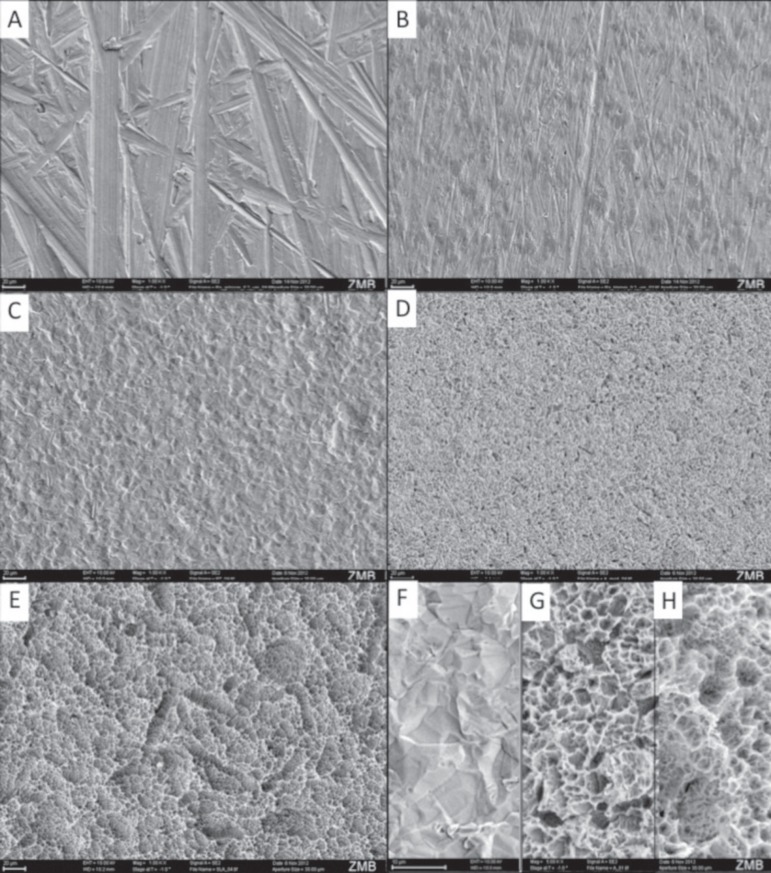
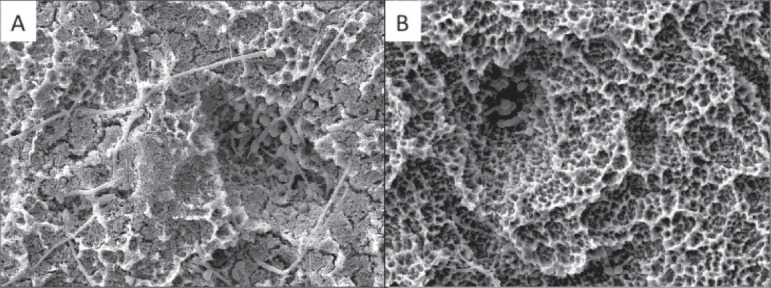
Six-species biofilms were formed anaerobically on 5-mm-diameter sterilized, saliva-preconditioned titanium discs. Material surfaces used were either machined, stained, acid-etched or sandblasted/acid-etched (SLA). Samples of the latter two materials were also provided in a chemically modified form, with increased wettability characteristics. Surface roughness and contact angles of all materials were determined. The discs were then incubated anaerobically for up to 16.5 h. Initial microbial adherence was evaluated after 20 min incubation and further colonization after 2, 4, 8, and 16.5 h using non-selective and selective culture techniques. Results at different time points were compared using ANOVA and Scheffé post hoc analysis.
The mean differences in microorganisms colonizing after the first 20 min were in a very narrow range (4.5 to 4.8 log CFU). At up to 16.5 h, the modified SLA surface exhibited the highest values for colonization (6.9±0.2 log CFU, p<0.05) but increasing growth was observed on all test surfaces over time. Discrepancies among bacterial strains on the differently crafted titanium surfaces were very similar to those described for total log CFU. F. nucleatum was below the detection limit on all surfaces after 4 h.
Within the limitations of this in vitro study, surface roughness had a moderate influence on biofilm formation, while wettability did not seem to influence biofilm formation under the experimental conditions described. The modified SLA surface showed the highest trend for bacterial colonization.
研究 7 种不同处理的钛表面多菌种生物膜的微生物黏附与定植。
在 5mm 直径的经消毒、唾液预处理的钛片上,无氧条件下形成六菌种生物膜。使用的材料表面分别为机械加工、染色、酸蚀或喷砂/酸蚀(SLA)。后两种材料的样品也以化学改性的形式提供,具有更高的润湿性。所有材料的表面粗糙度和接触角均进行了测定。然后将这些圆盘在无氧条件下孵育长达 16.5 小时。在孵育 20 分钟后评估初始微生物黏附,在孵育 2、4、8 和 16.5 小时后使用非选择性和选择性培养技术进一步评估定植情况。使用方差分析和 Scheffé 事后分析比较不同时间点的结果。
最初 20 分钟内定植的微生物的平均值差异非常小(4.5 至 4.8 log CFU)。在长达 16.5 小时的时间内,改性 SLA 表面的定植值最高(6.9±0.2 log CFU,p<0.05),但随着时间的推移,所有测试表面的生长都有所增加。不同钛表面上细菌菌株的差异与总 log CFU 的描述非常相似。在所有表面上,F. nucleatum 在 4 小时后均低于检测限。
在本体外研究的限制范围内,表面粗糙度对生物膜形成有中度影响,而润湿性在描述的实验条件下似乎不会影响生物膜形成。改性 SLA 表面显示出最高的细菌定植趋势。