Suffolk County Vector Control, Yaphank, New York, USA.
PLoS One. 2013;8(4):e60874. doi: 10.1371/journal.pone.0060874. Epub 2013 Apr 2.
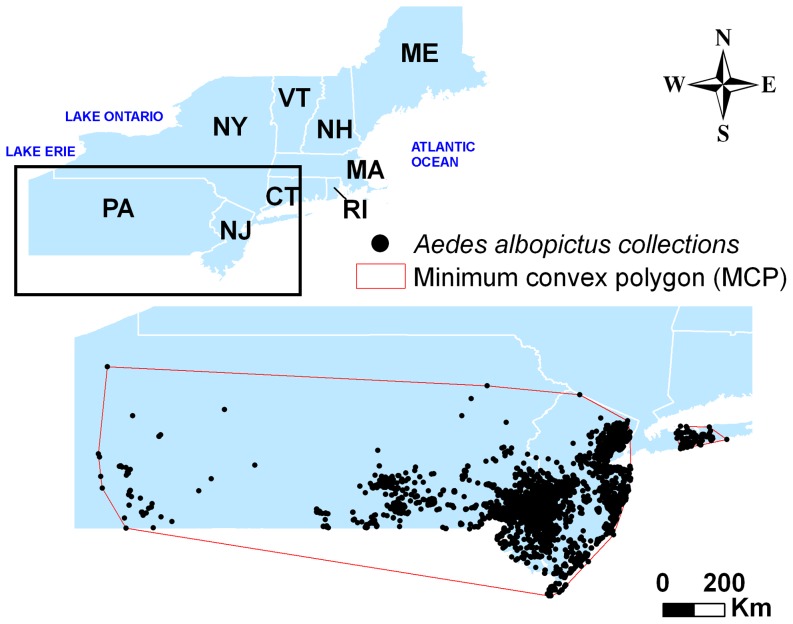
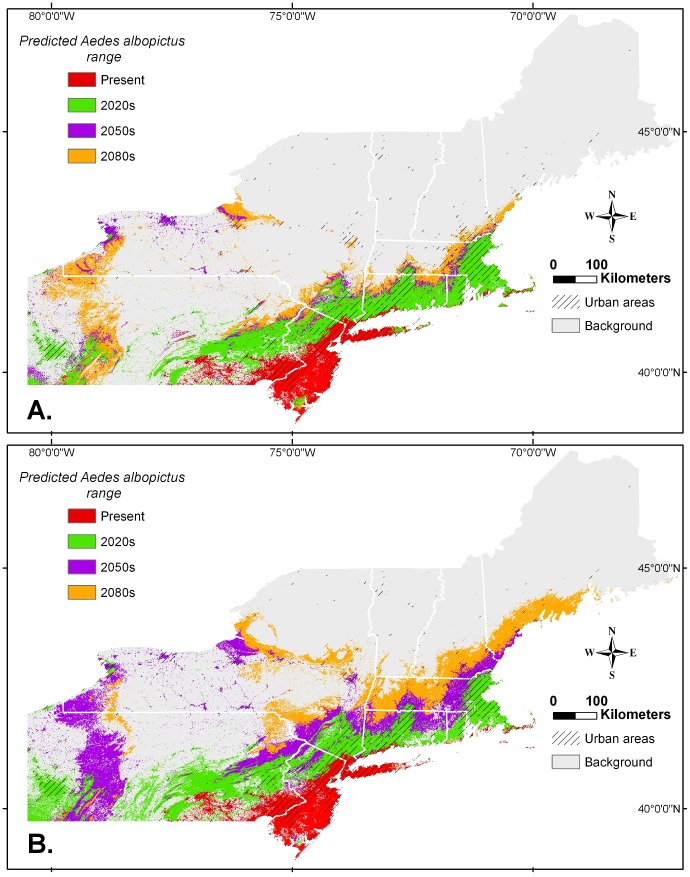
The Asian tiger mosquito, Aedes albopictus (Skuse), is an invasive species with substantial biting activity, high disease vector potential, and a global distribution that continues to expand. New Jersey, southern New York, and Pennsylvania are currently the northernmost boundary of established Ae. albopictus populations in the eastern United States. Using positive geographic locations from these areas, we modeled the potential future range expansion of Ae. albopictus in northeastern USA under two climate change scenarios. The land area with environmental conditions suitable for Ae. albopictus populations is expected to increase from the current 5% to 16% in the next two decades and to 43%-49% by the end of the century. Presently, about one-third of the total human population of 55 million in northeastern USA reside in urban areas where Ae. albopictus is present. This number is predicted to double to about 60% by the end of the century, encompassing all major urban centers and placing over 30 million people under the threat of dense Ae. albopictus infestations. This mosquito species presents unique challenges to public health agencies and has already strained the resources available to mosquito control programs within its current range. As it continues to expand into areas with fewer resources and limited organized mosquito control, these challenges will be further exacerbated. Anticipating areas of potential establishment, while planning ahead and gathering sufficient resources will be the key for successful public health campaigns. A broad effort in community sanitation and education at all levels of government and the private sector will be required until new control techniques are developed that can be applied efficiently and effectively at reasonable cost to very large areas.
亚洲虎蚊,白纹伊蚊(Skuse),是一种具有大量叮咬活动、高疾病传播潜力和全球分布范围不断扩大的入侵物种。新泽西州、纽约州南部和宾夕法尼亚州目前是美国东部已建立的白纹伊蚊种群的最北边界。利用这些地区的阳性地理位置,我们根据两种气候变化情景模拟了美国东北部白纹伊蚊未来的潜在范围扩展。在未来二十年,适合白纹伊蚊种群的环境条件的土地面积预计将从目前的 5%增加到 16%,到本世纪末将增加到 43%-49%。目前,美国东北部 5500 万总人口中有大约三分之一居住在有白纹伊蚊存在的城市地区。预计到本世纪末,这一数字将翻一番,达到 60%,涵盖所有主要城市中心,使超过 3000 万人面临密集的白纹伊蚊侵扰的威胁。这种蚊子给公共卫生机构带来了独特的挑战,并且已经使蚊子控制计划在其现有范围内可用的资源紧张。随着它继续扩展到资源较少且组织有限的蚊子控制地区,这些挑战将进一步加剧。预测潜在的建立区域,提前计划并收集足够的资源将是成功开展公共卫生运动的关键。需要在各级政府和私营部门开展广泛的社区卫生和教育工作,直到开发出能够以合理的成本在非常大的区域内高效、有效地应用的新控制技术。