Ogden Nicholas H, Milka Radojević, Caminade Cyril, Gachon Philippe
Zoonoses Division, Centre for Food-Borne, Environmental and Zoonotic Infectious Diseases, Public Health Agency of Canada, 3200 Rue Sicotte, Saint-Hyacinthe, J2S 7C6, Québec, Canada.
Centre Européen de Recherche et de Formation Avancée en Calcul Scientifique, 42 Av Coriolis, F-31057, Toulouse, Cedex 1, France.
Parasit Vectors. 2014 Dec 2;7:532. doi: 10.1186/s13071-014-0532-4.
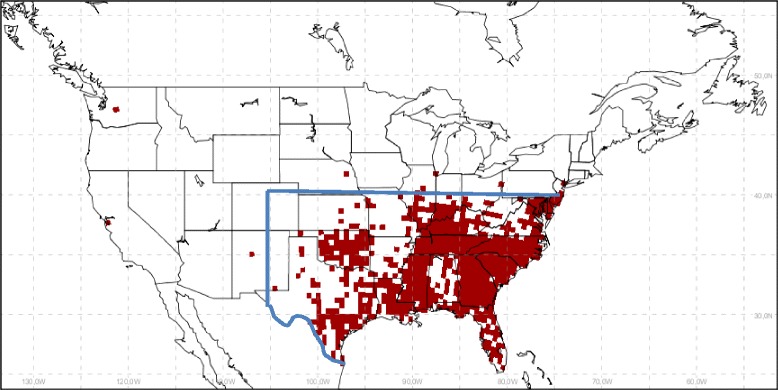
Since the 1980s, populations of the Asian tiger mosquito Aedes albopictus have become established in south-eastern, eastern and central United States, extending to approximately 40°N. Ae. albopictus is a vector of a wide range of human pathogens including dengue and chikungunya viruses, which are currently emerging in the Caribbean and Central America and posing a threat to North America.
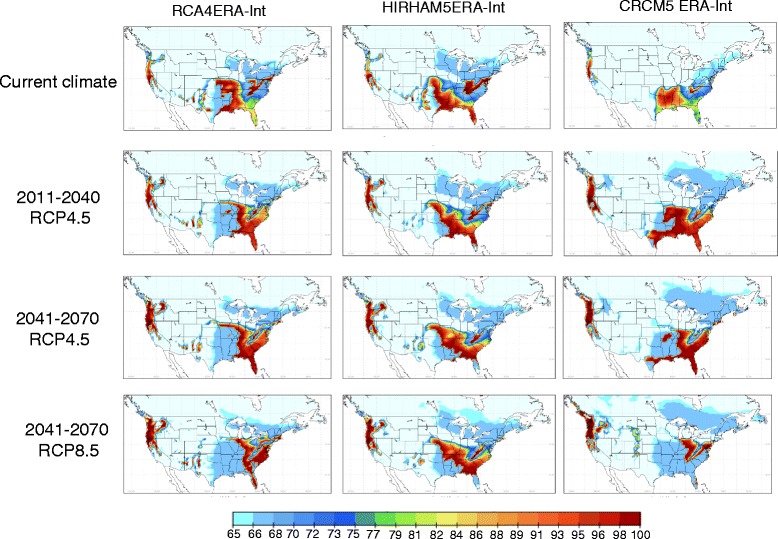
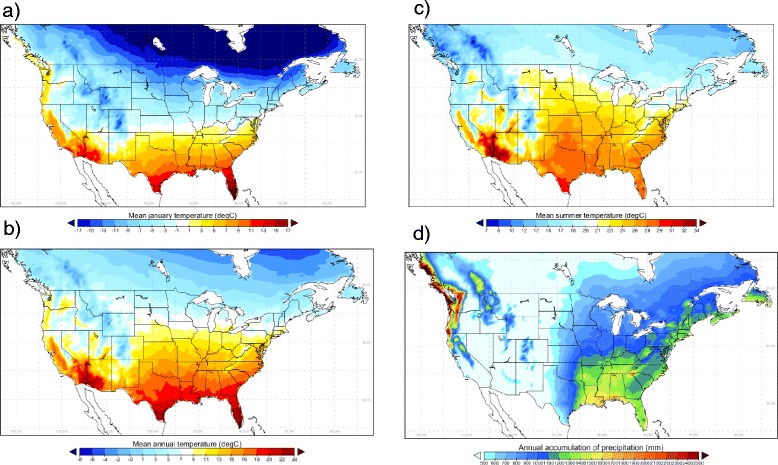
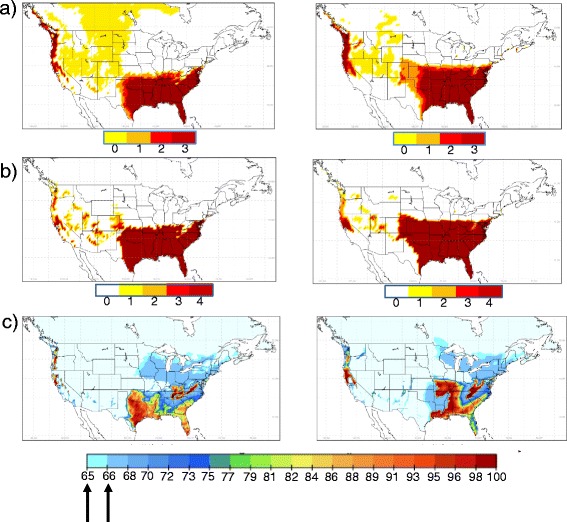
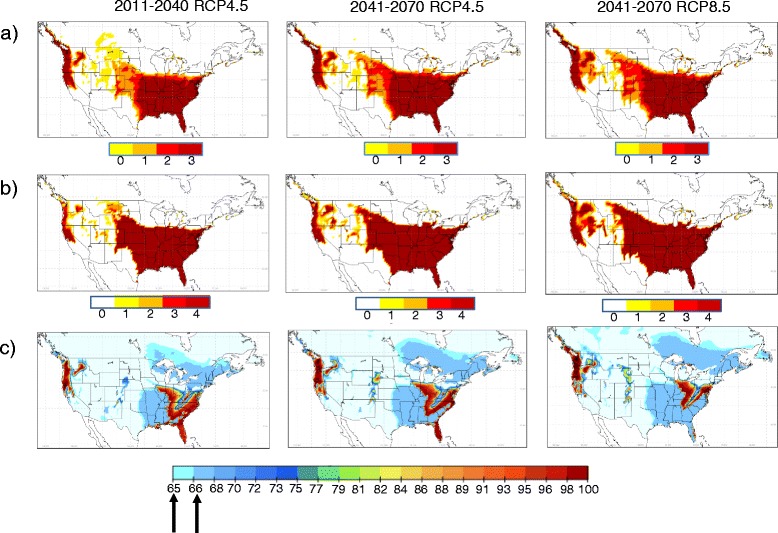
The risk of Ae. albopictus expanding its geographic range in North America under current and future climate was assessed using three climatic indicators of Ae. albopictus survival: overwintering conditions (OW), OW combined with annual air temperature (OWAT), and a linear index of precipitation and air temperature suitability expressed through a sigmoidal function (SIG). The capacity of these indicators to predict Ae. albopictus occurrence was evaluated using surveillance data from the United States. Projected future climatic suitability for Ae. albopictus was obtained using output of nine Regional Climate Model experiments (RCMs).
OW and OWAT showed >90% specificity and sensitivity in predicting observed Ae. albopictus occurrence and also predicted moderate to high risk of Ae. albopictus invasion in Pacific coastal areas of the Unites States and Canada under current climate. SIG also well predicted observed Ae. albopictus occurrence (ROC area under the curve was 0.92) but predicted wider current climatic suitability in the north-central and north-eastern United States and south-eastern Canada. RCM output projected modest (circa 500 km) future northward range expansion of Ae. albopictus by the 2050s when using OW and OWAT indicators, but greater (600-1000 km) range expansion, particularly in eastern and central Canada, when using the SIG indicator. Variation in future possible distributions of Ae. albopictus was greater amongst the climatic indicators used than amongst the RCM experiments.
Current Ae. albopictus distributions were well predicted by simple climatic indicators and northward range expansion was predicted for the future with climate change. However, current and future predicted geographic distributions of Ae. albopictus varied amongst the climatic indicators used. Further field studies are needed to assess which climatic indicator is the most accurate in predicting regions suitable for Ae. albopictus survival in North America.
自20世纪80年代以来,白纹伊蚊这一亚洲虎蚊种群已在美国东南部、东部和中部定居,向北延伸至约北纬40°。白纹伊蚊是多种人类病原体的传播媒介,包括登革热病毒和基孔肯雅病毒,这些病毒目前正在加勒比地区和中美洲出现,并对北美构成威胁。
利用白纹伊蚊生存的三个气候指标评估其在当前和未来气候条件下在北美扩大地理分布范围的风险:越冬条件(OW)、越冬条件与年气温相结合(OWAT),以及通过S形函数表示的降水和气温适宜性线性指数(SIG)。利用来自美国的监测数据评估这些指标预测白纹伊蚊出现情况的能力。利用九个区域气候模型实验(RCM)的输出结果获得未来白纹伊蚊的气候适宜性预测。
OW和OWAT在预测观察到的白纹伊蚊出现情况时显示出>90%的特异性和敏感性,并且还预测了在当前气候条件下美国和加拿大太平洋沿岸地区白纹伊蚊入侵的中到高风险。SIG也很好地预测了观察到的白纹伊蚊出现情况(曲线下面积为0.92),但预测美国中北部、东北部以及加拿大东南部目前的气候适宜性范围更广。当使用OW和OWAT指标时,RCM输出结果预测到2050年代白纹伊蚊未来向北的分布范围将适度(约500公里)扩大,但当使用SIG指标时,分布范围将扩大得更多(600 - 1000公里),特别是在加拿大东部和中部。在所使用的气候指标之间,白纹伊蚊未来可能分布的变化比在RCM实验之间更大。
简单的气候指标能很好地预测当前白纹伊蚊的分布情况,并且预测随着气候变化其未来分布范围将向北扩大。然而,在所使用的气候指标中,当前和未来预测的白纹伊蚊地理分布有所不同。需要进一步的实地研究来评估哪种气候指标在预测北美适合白纹伊蚊生存区域方面最准确。