Tumor Immunology and Gene Therapy Center, Eastern Hepatobiliary Surgery Hospital, The Second Military Medical University, Shanghai 200438, China.
Int J Biol Sci. 2013;9(4):322-30. doi: 10.7150/ijbs.5925. Epub 2013 Mar 28.
To investigate the efficacy of TACE combined with CQ, an autophagic inhibitor, in a rabbit VX2 liver tumor model.
Tumor size was measured. And tumor growth rate was calculated to examine the effect of the combined treatment. Apoptosis was detected by TUNEL assay. Meanwhile, autophagic activity was detected by immunohistochemistry and Western blotting to investigate the mechanism underlying. Liver function was also examined to assess feasibility and safety of the combined therapy.
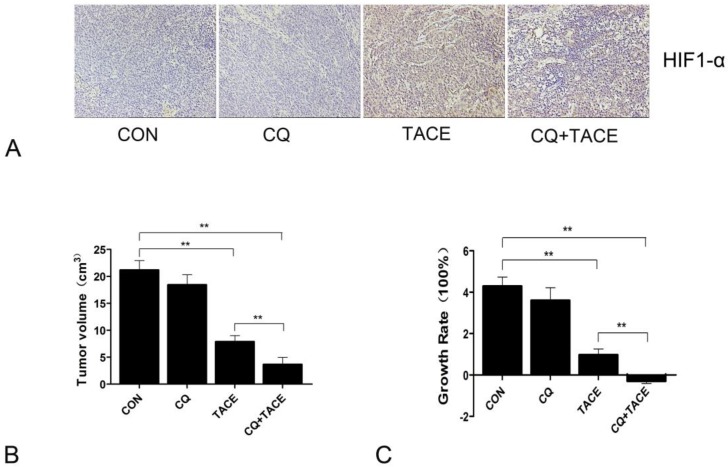
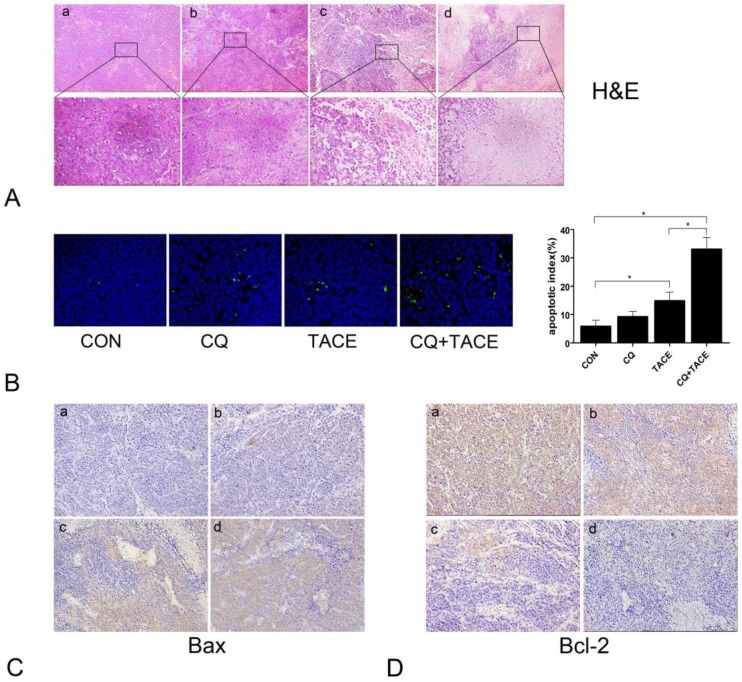
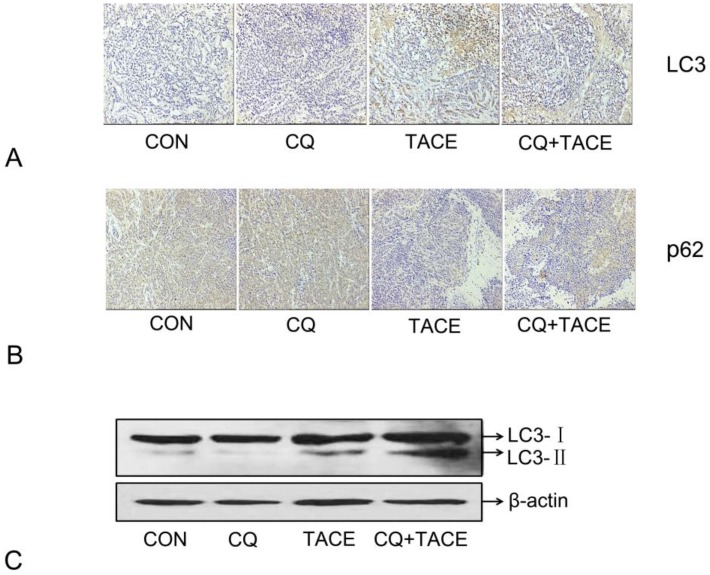
Tumors in the control grew more than 4 times bigger after 14 days, while that in the group of TACE alone just showed mild growth. But a slight shrinkage was shown after the treatment of CQ+TACE. Growth ratio of TACE alone was 96.45% ± 28.958% while that of CQ+TACE was -28.73% ± 12.265%. Compared with TACE alone, necrosis in CQ+TACE showed no significant difference, however, the apoptosis was much higher. There were only 14.8±3.11% apoptotic cells in TACE, but 33±4.18% in CQ+TACE, which suggests the increased apoptosis in CQ+TACE contributed to the decrease of tumor volume. In terms of autophagic activity, the result is negative when we immunostained sections of the control with LC3 antibody, but positive in TACE alone and CQ+TACE. And the result of Western blot showed that there was just a low level of LC3Ⅱexpressed in the control and CQ alone, but higher in TACE, and much higher in CQ+TACE because CQ inhibited its degradation in autophagy. Compared with control, p62 decreased in TACE, but the decrease was partially reversed in CQ+TACE. In addition, toxicity of CQ+TACE was assessed not higher than TACE alone, which supports the safety of CQ+TACE.
CQ+TACE works better than TACE alone in rabbit VX2 liver tumor model because CQ inhibits autophagy induced by TACE. The inhibited autophagy loses its resistance to apoptosis that apoptosis increased, which contributes to the inhibition of tumor growth. This study indicates CQ may be a promising adjuvant to promote the effect of TACE.
研究 TACE 联合自噬抑制剂 CQ 治疗兔 VX2 肝肿瘤模型的疗效。
测量肿瘤大小,并计算肿瘤生长率以检验联合治疗效果。TUNEL 法检测细胞凋亡,免疫组化和 Western blot 法检测自噬活性,以探讨其作用机制。同时检测肝功能,评估联合治疗的可行性和安全性。
对照组肿瘤 14 天后生长超过 4 倍,TACE 组仅轻度生长,但 CQ+TACE 组则略有缩小。TACE 组的生长率为 96.45%±28.958%,而 CQ+TACE 组为-28.73%±12.265%。与 TACE 组相比,CQ+TACE 组的坏死无明显差异,但凋亡明显增加。TACE 组的凋亡细胞为 14.8±3.11%,而 CQ+TACE 组为 33±4.18%,这表明 CQ+TACE 组肿瘤体积减小是由于凋亡增加所致。自噬活性方面,对照组 LC3 抗体免疫组化染色阴性,而 TACE 组和 CQ+TACE 组阳性。Western blot 结果显示,对照组和 CQ 组 LC3Ⅱ表达水平较低,TACE 组表达水平较高,CQ+TACE 组表达水平更高,因为 CQ 抑制了自噬中的降解。与对照组相比,TACE 组 p62 减少,但 CQ+TACE 组部分逆转。此外,CQ+TACE 的毒性并不高于 TACE 组,支持 CQ+TACE 的安全性。
与 TACE 组相比,CQ+TACE 在兔 VX2 肝肿瘤模型中疗效更好,因为 CQ 抑制了 TACE 诱导的自噬。抑制自噬后失去了对凋亡的抵抗能力,导致凋亡增加,从而抑制肿瘤生长。本研究表明 CQ 可能是一种有前途的辅助药物,可增强 TACE 的疗效。