Department of Physiological Sciences, Faculty of Veterinary Medicine, Warsaw University of Life Sciences-WULS, Nowoursynowska 159, Warsaw, 02-776, Poland.
BMC Vet Res. 2013 Apr 15;9:78. doi: 10.1186/1746-6148-9-78.
The frequency of mammary malignancies in canine patients is even three times over than in human. In various types of cancer different intracellular signalling pathways are perturbed, thus the patients with pathologically the same type of cancer often have dissimilar genetic defects in their tumours and respond in a heterogeneous manner to anticancer treatment. That is why the objective of the hereby study was to assess the gene expression profiles in canine mammary carcinomas (in unsupervised manner) classified by pathologists as grade 1 (well differentiated), grade 2 (moderately differentiated) and grade 3 (poorly differentiated) and compare their molecular and pathological classifications.
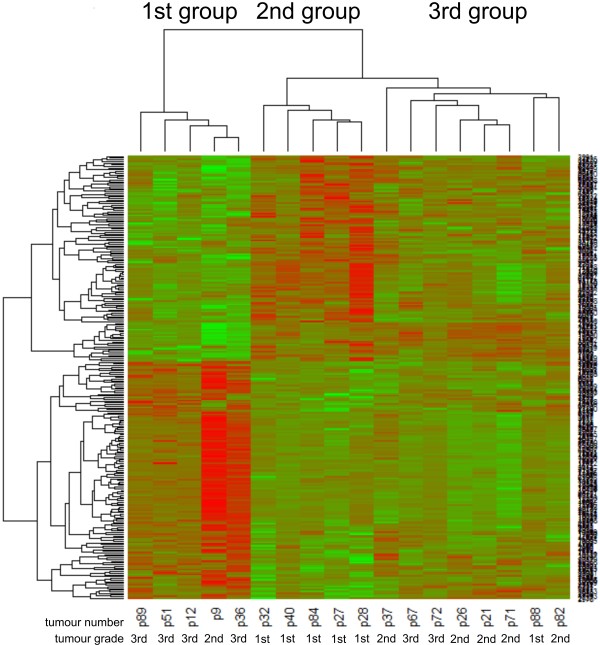
Our unsupervised analysis classified the examined tissues into three groups. The first one significantly differed from the others and consisted of four carcinomas of grade 3 and one carcinoma of grade 2. The second group consisted of four grade 1 carcinomas. The very heterogeneous (based on their pathological parameters) group was the last one which consisted of two grade 1 carcinomas, two grade 3 carcinomas and five grade 2 carcinomas. Hierarchical dendrogram showed that the most malignant tumour group had significantly distinct gene expression.
Molecular classification of canine mammary tumours is not identical with pathological classification. In our opinion molecular and pathological characterization of canine mammary malignancy can complement one another. However, furthers studies in this field are required.
犬科动物的乳腺恶性肿瘤发病率比人类高 3 倍。在不同类型的癌症中,不同的细胞内信号通路受到干扰,因此病理类型相同的患者肿瘤中的遗传缺陷往往不同,对癌症治疗的反应也存在异质性。这就是为什么本研究的目的是评估犬乳腺肿瘤(在无监督的情况下)的基因表达谱,这些肿瘤由病理学家分类为 1 级(高分化)、2 级(中分化)和 3 级(低分化),并比较它们的分子和病理分类。
我们的无监督分析将检查组织分为三组。第一组与其他组显著不同,由 4 个 3 级癌和 1 个 2 级癌组成。第二组由 4 个 1 级癌组成。非常异质(基于其病理参数)的组是最后一组,由 2 个 1 级癌、2 个 3 级癌和 5 个 2 级癌组成。层次聚类树状图显示,最恶性肿瘤组的基因表达明显不同。
犬乳腺肿瘤的分子分类与病理分类不一致。在我们看来,犬乳腺恶性肿瘤的分子和病理特征可以相互补充。然而,还需要在该领域进行进一步的研究。