School of Psychology, Flinders University, Adelaide, South Australia, Australia.
Nat Sci Sleep. 2009 Nov 4;1:1-8. doi: 10.2147/nss.s6234. Print 2009.
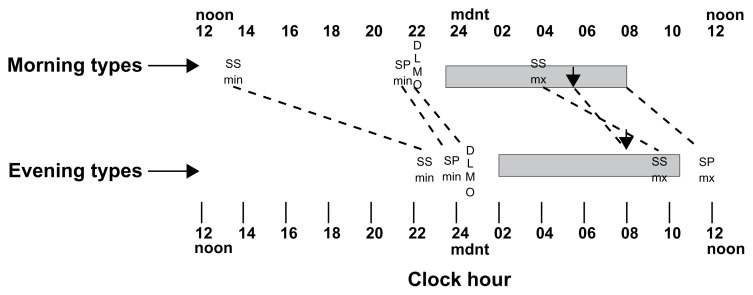
Evening chronotypes typically have sleep patterns timed 2-3 hours later than morning chronotypes. Ambulatory studies have suggested that differences in the timing of underlying circadian rhythms as a cause of the sleep period differences. However, differences in endogenous circadian rhythms are best explored in laboratory protocols such as the constant routine. We used a 27-hour modified constant routine to measure the endogenous core temperature and melatonin circadian rhythms as well as subjective and objective sleepiness from hourly 15-minute sleep opportunities. Ten (8f) morning type individuals were compared with 12 (8f) evening types. All were young, healthy, good sleepers. The typical sleep onset, arising times, circadian phase markers for temperature and melatonin and objective sleepiness were all 2-3 hours later for the evening types than morning types. However, consistent with past studies the differences for the subjective sleepiness rhythms were much greater (5-9 hours). Therefore, the present study supports the important role of subjective alertness/sleepiness in determining the sleep period differences between morning and evening types and the possible vulnerability of evening types to delayed sleep phase disorder.
夜间型通常比早晨型的睡眠模式晚 2-3 小时。动态研究表明,潜在的昼夜节律的时间差异是导致睡眠周期差异的原因。然而,内源性昼夜节律的差异最好在实验室方案中进行探索,例如恒常程序。我们使用了一个 27 小时的改良恒常程序来测量内源性核心体温和褪黑素的昼夜节律,以及每小时 15 分钟的睡眠机会的主观和客观困倦。将 10 名(8 名女性)早晨型个体与 12 名(8 名女性)夜间型个体进行比较。所有参与者都年轻、健康、睡眠质量良好。夜间型的典型入睡时间、起床时间、体温和褪黑素的昼夜节律标记以及客观困倦程度都比早晨型晚 2-3 小时。然而,与过去的研究一致,主观困倦节律的差异要大得多(5-9 小时)。因此,本研究支持主观警觉/困倦在确定晨型和夜型之间的睡眠周期差异以及夜型可能易患睡眠相位延迟障碍方面的重要作用。