Department of Oncology, the Second Affiliated Hospital of Xi'an Jiaotong University, Xi'an, 710004, China.
BMC Complement Altern Med. 2013 May 15;13:105. doi: 10.1186/1472-6882-13-105.
Radiation-induced skin injury is a common complication of radiotherapy. The RHIZOMA COPTIDIS and COPTIS CHINENSIS aqueous extract (RCE) can ameliorate radiation-induced skin injury in our clinical observation. But, the protective mechanism of RHIZOMA COPTIDIS and COPTIS CHINENSIS in radiation-induced skin injury remains unclear.
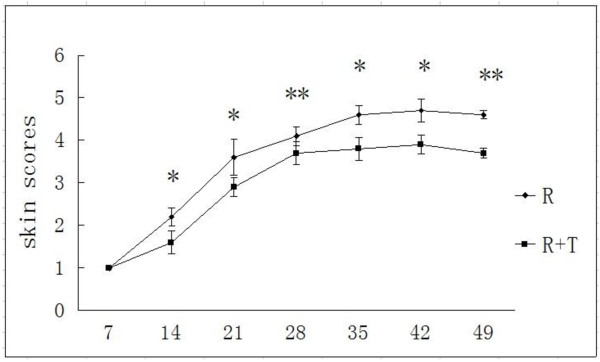
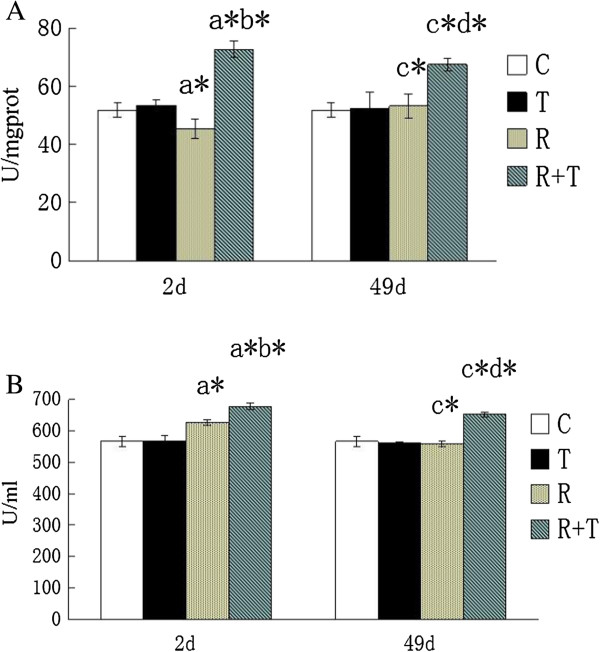
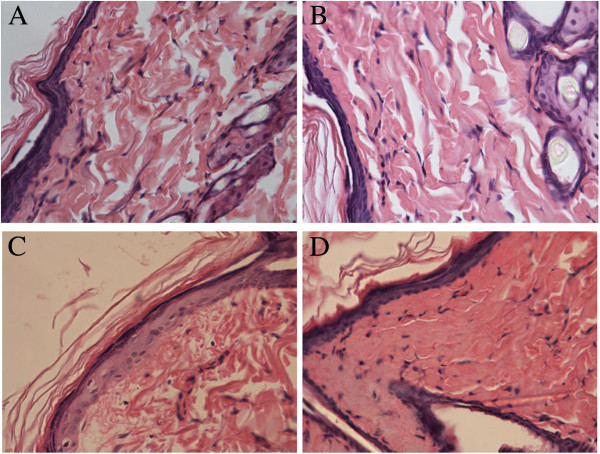
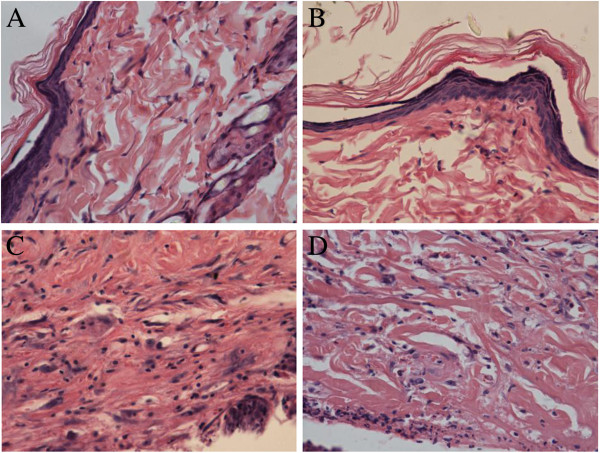
In this experiment, we developed a radiation-induced skin injury rat model to study the mechanism. The animals were randomly divided into control group, treatment group, radiation group, and treatment and radiation group. 5 rats in each group were separately executed on 2 d and 49 d post-radiation. The semi-quantitative skin injury score was used to measure skin reactions by unblinded observers, and hematoxylin and eosin staining was used to evaluate the damage areas by irradiation. The MDA content, SOD activity of skin and serum were measured to detect the oxidative stress.
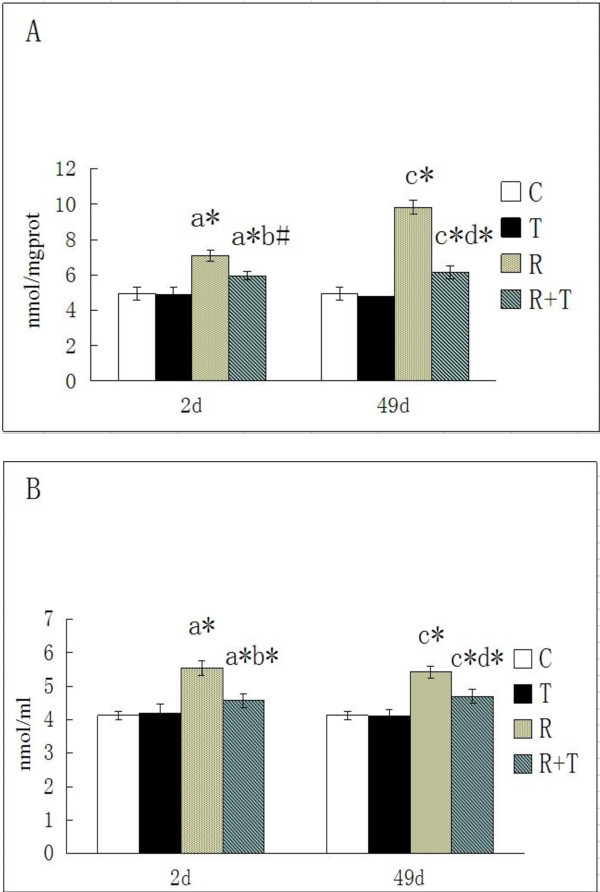
Acute skin reactions were caused by a single dose of 45 Gy of β-ray irradiation, and the skin injury could be found in all rats receiving irradiation based on the observation of HE staining of skin at different time-points, while RCE could significantly ameliorate those changes. The MDA content in serum and skin of control rats was 4.13±0.12 mmol/ml and 4.95±0.35 mmol/mgprot on 2 d post-radiation. The rats receiving radiation showed an increased content of MDA (5.54±0.21 mmol/ml and 7.10±0.32 mmol/mgprot), while it was 4.57±0.21 mmol/ml and 5.95±0.24 mmol/mgprot after treated with RCE (p<0.05). Similar changes of the MDA content could be seen on 49 d post-radiation. However, the SOD activity of rats receiving radiation decreased compared with control group on both time-points, which was inhibited by RCE (p<0.05). Meanwhile, no valuable changes could be found between control group and treatment group on 2 d and 49 d.
Our study provides evidences for the radioprotective role of RCE against radiation-induced skin damage in rats by modulating oxidative stress in skin, which may be a useful therapy for radiation-induced skin injury.
放射性皮肤损伤是放疗的常见并发症。在我们的临床观察中,黄连和黄连水提物(RCE)可改善放射性皮肤损伤。但是,黄连和黄连在放射性皮肤损伤中的保护机制尚不清楚。
本实验采用放射性皮肤损伤大鼠模型,研究其机制。动物随机分为对照组、治疗组、照射组和治疗照射组。每组 5 只大鼠分别于照射后 2d 和 49d 处死。采用半定量皮肤损伤评分法,由未设盲观察者测量皮肤反应,采用苏木精-伊红(HE)染色法评价照射损伤面积。检测皮肤和血清丙二醛(MDA)含量、超氧化物歧化酶(SOD)活性,以检测氧化应激。
单次 45Gyβ射线照射可引起急性皮肤反应,所有照射大鼠均可通过不同时间点皮肤 HE 染色观察到皮肤损伤,而 RCE 可明显改善这些变化。照射后 2d,对照组大鼠血清和皮肤 MDA 含量分别为 4.13±0.12mmol/ml 和 4.95±0.35mmol/mgprot。照射大鼠 MDA 含量增加(5.54±0.21mmol/ml 和 7.10±0.32mmol/mgprot),而 RCE 治疗组 MDA 含量为 4.57±0.21mmol/ml 和 5.95±0.24mmol/mgprot(p<0.05)。照射后 49d 时也可见到类似的 MDA 含量变化。然而,照射后大鼠血清和皮肤 SOD 活性均较对照组降低,RCE 抑制了这一降低(p<0.05)。同时,2d 和 49d 时对照组和治疗组之间未见有价值的变化。
本研究通过调节皮肤氧化应激,为 RCE 对大鼠放射性皮肤损伤的防护作用提供了证据,可能为放射性皮肤损伤提供一种有用的治疗方法。