School of Nursing, Midwifery & Health, University of Stirling, Stirling FK9 4LA, UK.
BMC Pregnancy Childbirth. 2013 May 16;13:114. doi: 10.1186/1471-2393-13-114.
Exclusive breastfeeding until six months followed by the introduction of solids and continued breastfeeding is recommended by the World Health Organisation. The dominant approach to achieving this has been to educate and support women to start and continue breastfeeding rather than understanding behaviour change processes from a broader perspective.
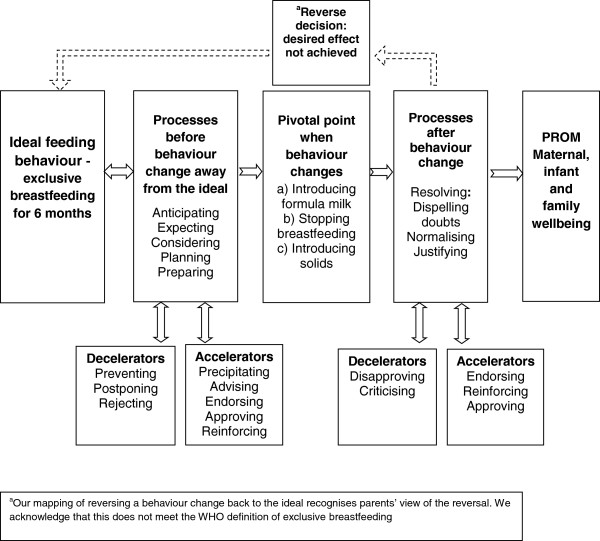
Serial qualitative interviews examined the influences of significant others on women's feeding behaviour. Thirty-six women and 37 nominated significant others participated in 220 interviews, conducted approximately four weekly from late pregnancy to six months after birth. Responses to summative structured questions at the end of each interview asking about significant influences on feeding decisions were compared and contrasted with formative semi-structured data within and between cases. Analysis focused on pivotal points where behaviour changed from exclusive breastfeeding to introducing formula, stopping breastfeeding or introducing solids. This enabled us to identify processes that decelerate or accelerate behaviour change and understand resolution processes afterwards.
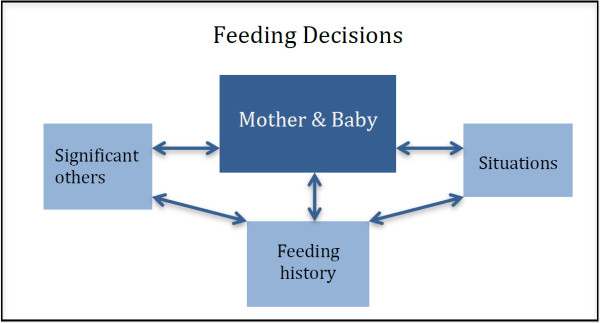
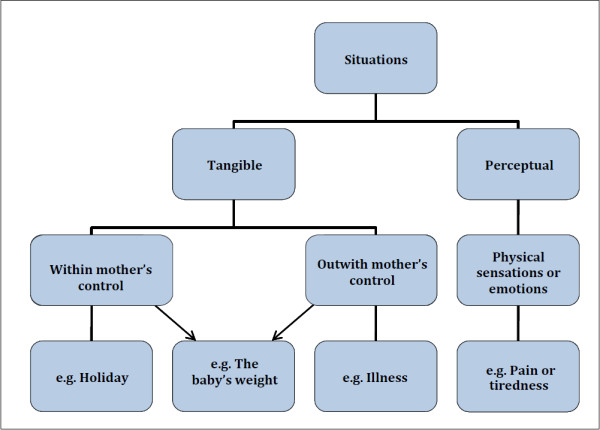
The dominant goal motivating behaviour change was family wellbeing, rather than exclusive breastfeeding. Rather than one type of significant other emerging as the key influence, there was a complex interplay between the self-baby dyad, significant others, situations and personal or vicarious feeding history. Following behaviour change women turned to those most likely to confirm or resolve their decisions and maintain their confidence as mothers.
Applying ecological models of behaviour would enable health service organisation, practice, policy and research to focus on enhancing family efficacy and wellbeing, improving family-centred communication and increasing opportunities for health professionals to be a constructive influence around pivotal points when feeding behaviour changes. A paradigm shift is recommended away from the dominant approach of support and education of individual women towards a more holistic, family-centred narrative approach, whilst acknowledging that breastfeeding is a practical skill that women and babies have to learn.
世界卫生组织建议纯母乳喂养至六个月,然后引入固体食物并继续母乳喂养。实现这一目标的主要方法是教育和支持妇女开始并继续母乳喂养,而不是从更广泛的角度理解行为改变过程。
连续的定性访谈研究了重要他人对妇女喂养行为的影响。36 名妇女和 37 名指定的重要他人参与了 220 次访谈,从妊娠晚期到产后六个月,大约每四周进行一次。在每次访谈结束时,对总结性结构问题的回答进行了比较和对比,这些问题询问了对喂养决策有重大影响的因素,并与案例内和案例间的形成性半结构化数据进行了对比。分析重点关注行为从纯母乳喂养转变为引入配方奶、停止母乳喂养或引入固体食物的关键点。这使我们能够识别出减缓或加速行为改变的过程,并了解之后的解决过程。
激励行为改变的主要目标是家庭幸福,而不是纯母乳喂养。并不是一种类型的重要他人成为关键影响,而是自我-婴儿对、重要他人、情况以及个人或间接喂养史之间存在着复杂的相互作用。行为改变后,妇女转向最有可能确认或解决她们决定并保持其作为母亲的信心的人。
应用行为的生态模型将使卫生服务组织、实践、政策和研究能够专注于增强家庭效能和幸福感,改善以家庭为中心的沟通,并增加卫生专业人员在喂养行为发生变化时发挥建设性影响的机会。建议从支持和教育个体妇女的主导方法向更全面、以家庭为中心的叙述方法转变,同时承认母乳喂养是妇女和婴儿必须学习的一项实际技能。