Harvard School of Public Health, Boston, Massachusetts, USA.
Prev Chronic Dis. 2013 May 23;10:E85. doi: 10.5888/pcd10.120198.
Although some US food manufacturers have reduced trans fatty acids (TFA) in their products, it is unknown how much TFA is being reduced, whether pace of reformulation has changed over time, or whether reformulations vary by food type or manufacturer.
In 2007, we identified 360 brand-name products in major US supermarkets that contained 0.5 g TFA or more per serving. In 2008, 2010, and 2011, product labels were re-examined to determine TFA content; ingredients lists were also examined in 2011 for partially hydrogenated vegetable oils (PHVO). We assessed changes in TFA content among the 270 products sold in all years between 2007 and 2011 and conducted sensitivity analyses on the 90 products discontinued after 2007.
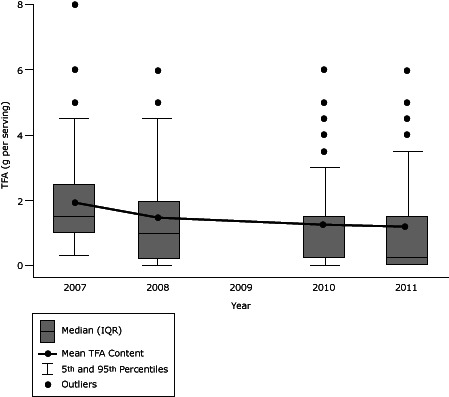
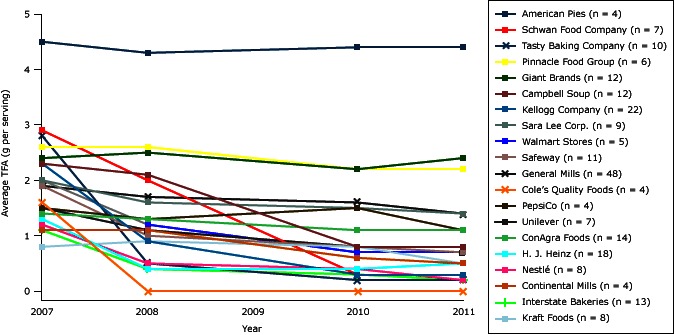
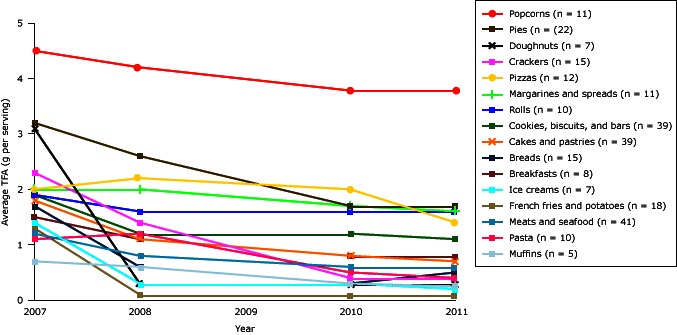
By 2011, 178 (66%) of the 270 products had reduced TFA content. Most reformulated products (146 of 178, 82%) reduced TFA to less than 0.5 g per serving, although half of these 146 still contained PHVO. Among all 270 products, mean TFA content decreased 49% between 2007 and 2011, from 1.9 to 0.9 g per serving. Yet, mean TFA reduction slowed over time, from 30.3% (2007-2008) to 12.1% (2008-2010) to 3.4% (2010-2011) (P value for trend < .001). This slowing pace was due to both fewer reformulations among TFA-containing products at start of each period and smaller TFA reductions among reformulated products. Reformulations also varied substantially by both food category and manufacturer, with some eliminating or nearly eliminating TFA and others showing no significant changes. Sensitivity analyses were similar to main findings.
Some US products and food manufacturers have made progress in reducing TFA, but substantial variation exists by food type and by parent company, and overall progress has significantly slowed over time. Because TFA consumption is harmful even at low levels, our results emphasize the need for continued efforts toward reformulating or discontinuing foods to eliminate PHVO.
尽管一些美国食品制造商已经减少了产品中的反式脂肪酸(TFA),但我们尚不清楚 TFA 的减少量是多少,也不知道配方改革的速度是否随时间而变化,或者配方是否因食品类型或制造商而异。
2007 年,我们在主要的美国超市中确定了 360 种品牌产品,这些产品每份含有 0.5 克或更多的 TFA。2008 年、2010 年和 2011 年,重新检查了产品标签以确定 TFA 含量;2011 年还检查了部分氢化植物油(PHVO)的成分清单。我们评估了 2007 年至 2011 年期间所有年份中 270 种在售产品的 TFA 含量变化,并对 2007 年后停产的 90 种产品进行了敏感性分析。
到 2011 年,270 种产品中有 178 种(66%)的 TFA 含量有所降低。大多数经过重新配方的产品(178 种中的 146 种,82%)将 TFA 减少到每份少于 0.5 克,尽管其中一半仍含有 PHVO。在所有 270 种产品中,TFA 的平均含量从 2007 年的 1.9 克/份下降到 2011 年的 0.9 克/份,降幅为 49%。然而,随着时间的推移,TFA 的减少速度逐渐放缓,从 2007-2008 年的 30.3%、2008-2010 年的 12.1%,到 2010-2011 年的 3.4%(趋势 P 值<.001)。这种放缓的速度是由于每个时间段开始时 TFA 含量产品的配方改革减少,以及经过重新配方的产品的 TFA 减少量减少。配方改革在食品类别和制造商方面也有很大差异,有些产品完全或几乎消除了 TFA,而有些产品则没有明显变化。敏感性分析与主要发现相似。
一些美国产品和食品制造商在减少 TFA 方面取得了进展,但按食品类型和母公司划分,仍存在很大差异,而且总体进展随着时间的推移明显放缓。由于 TFA 即使在低水平下也有害,因此我们的研究结果强调需要继续努力重新配方或停止使用含有 PHVO 的食品。