Division of General Medicine and Primary Care, Beth Israel Deaconess Medical Center, Harvard Medical School, Brookline, Massachusetts, USA.
Obesity (Silver Spring). 2013 Apr;21(4):681-9. doi: 10.1002/oby.20072.
Overweight and obesity are associated with increased high-sensitivity C-reactive protein (hsCRP) levels. The purpose of this study was to determine if weight loss diets differing in fat, protein, or carbohydrate composition differentially reduce hsCRP.
POUNDS (preventing overweight using novel dietary strategies) LOST was a 2-year trial of overweight and obese adults randomly allocated to one of four weight loss diets with targeted percentages of energy derived from fat, protein, and carbohydrates (20, 15, 65%; 20, 25, 55%; 40, 15, 45%; 40, 25, 35%, respectively). hsCRP was measured at baseline, 6, and 24 months among 710 participants, and adiposity as measured by dual X-ray absorptiometry (N = 340) or abdominal computed tomography (N = 126) was correlated with hsCRP change.
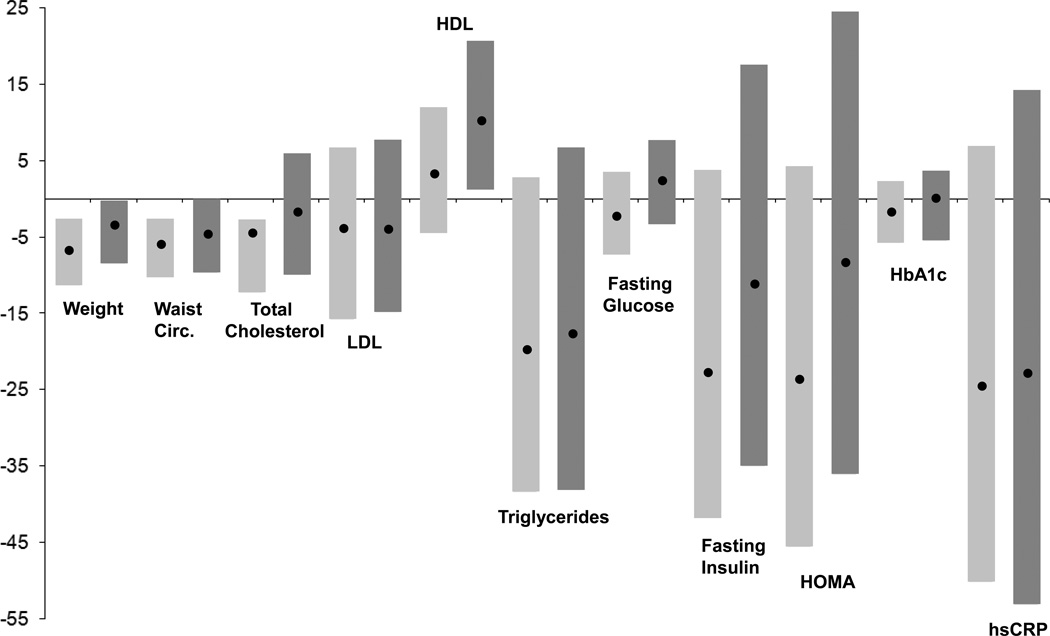
At 6 months, hsCRP was reduced in all trial participants by -24.7% (Interquartile range (IQR) +7%, -50%), weight by -6.7% (IQR -3%, -11%), and waist circumference by -6.0% (IQR -3%, -10%) (all P < 0.002), with no significant differences according to dietary composition. The percent change in hsCRP at 6 and 24 months correlated modestly with change in weight, waist circumference, fasting insulin, fasting glucose, HOMA, and most lipid levels. Reductions in hsCRP persisted despite ∼ 50% regain of weight by 24 months. The percent change in hsCRP at 24 months significantly correlated with changes in total body fat (r = 0.42), total abdominal adiposity (r = 0.52), subcutaneous abdominal adiposity (r = 0.52), visceral adiposity (r = 0.47), and hepatic tissue density (r = -0.34) (all P < 0.0006).
Weight loss decreased hsCRP by similar magnitude, irrespective of dietary composition. Clinicians concerned about inflammation and cardiovascular risk should recommend weight loss diets most likely to succeed for their patients.
超重和肥胖与高敏 C 反应蛋白(hsCRP)水平升高有关。本研究旨在确定不同脂肪、蛋白质或碳水化合物组成的减肥饮食是否能不同程度地降低 hsCRP。
POUNDS(通过新的饮食策略预防超重)是一项为期 2 年的超重和肥胖成年人试验,随机分配到四种减肥饮食中的一种,能量的目标百分比来自脂肪、蛋白质和碳水化合物(分别为 20%、15%、65%;20%、25%、55%;40%、15%、45%;40%、25%、35%)。710 名参与者中有 340 名接受了双能 X 线吸收法(DXA)和 126 名接受了腹部计算机断层扫描(CT)测量的体脂,在基线、6 个月和 24 个月时测量 hsCRP,并与 hsCRP 变化相关。
6 个月时,所有试验参与者的 hsCRP 降低了-24.7%(四分位距(IQR)+7%,-50%),体重降低了-6.7%(IQR-3%,-11%),腰围降低了-6.0%(IQR-3%,-10%)(均 P < 0.002),饮食组成无显著差异。6 个月和 24 个月时 hsCRP 的百分比变化与体重、腰围、空腹胰岛素、空腹血糖、HOMA 和大多数血脂水平的变化呈中度相关。尽管 24 个月时体重约有 50%的恢复,但 hsCRP 的降低仍持续存在。24 个月时 hsCRP 的百分比变化与全身脂肪总量(r = 0.42)、腹部总脂肪量(r = 0.52)、腹部皮下脂肪量(r = 0.52)、内脏脂肪量(r = 0.47)和肝组织密度(r = -0.34)的变化显著相关(均 P < 0.0006)。
体重减轻对 hsCRP 的降低作用相似,与饮食组成无关。关注炎症和心血管风险的临床医生应根据患者的具体情况,推荐最有可能成功的减肥饮食。