Department of Food and Biotechnology, Hankyong National University, Anseong 456-749, Korea.
J Ginseng Res. 2011 Jun;35(2):235-42. doi: 10.5142/jgr.2011.35.2.235.
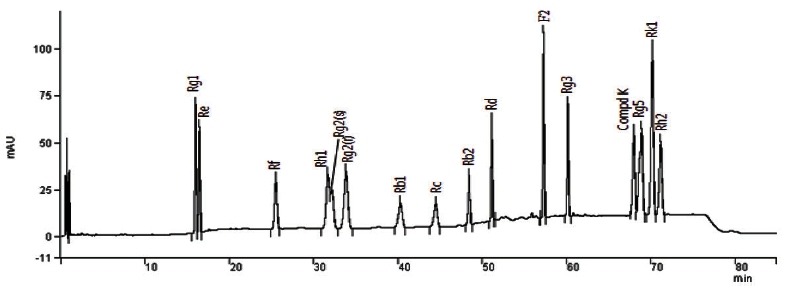
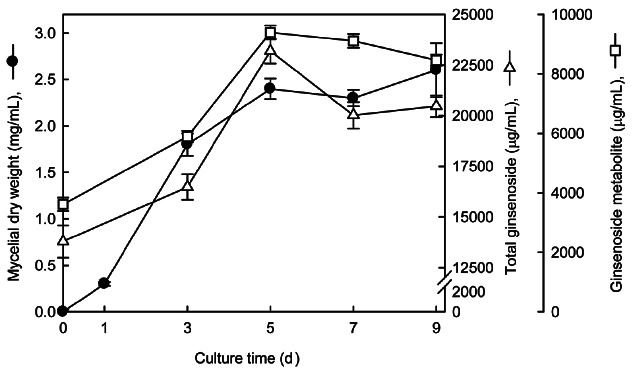
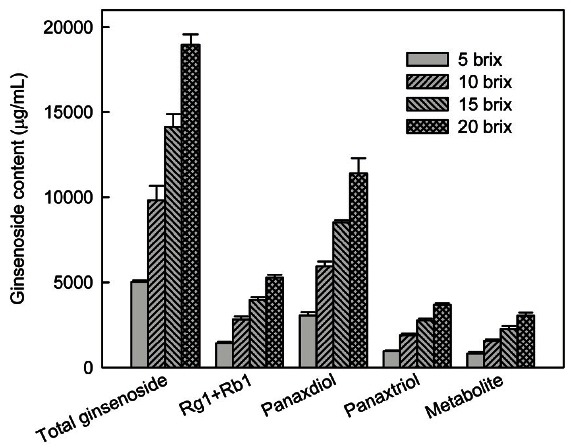
To obtain microorganisms for the microbial conversion of ginsenosides in red ginseng extract (RGE), mushroom mycelia were used for the fermentation of RGE. After fermentation, total sugar contents and polyohenol contents of the RGEs fermented with various mushrooms were not a significant increase between RGE and the ferments. But uronic acid content was relatively higher in the fermented RGEs cultured with Lentus edodes (2155.6 μg/mL), Phelllinus linteus (1690.9 μg/mL) and Inonotus obliquus 26137 and 26147 (1549.5 and 1670.7 μg/mL) compared to the RGE (1307.1 μg/mL). The RGEs fermented by Ph. linteus, Cordyceps militaris, and Grifola frondosa showed particularly high levels of total ginsenosides (20018.1, 17501.6, and 16267.0 μg/mL, respectively). The ferments with C. militaris (6974.2 μg/mL), Ph. linteus (9109.2 μg/mL), and G. frondosa (7023.0 μg/mL) also showed high levels of metabolites (sum of compound K, Rh1, Rg5, Rk1, Rg3, and Rg2) compared to RGE (3615.9 μg/mL). Among four different RGE concentrations examined, a 20 brix concentration of RGE was favorable for the fermentation of Ph. linteus. Maximum biotransformation of ginsneoside metabolites (9395.5 μg/mL) was obtained after 5 days fermentation with Ph. linteus. Maximum mycelial growth of 2.6 mg/mL was achieved at 9 days, in which growth was not significantly different during 5 to 9 days fermentation. During fermentation of RGE by Ph. linteus in a 7 L fermenter, Rg3, Rg5, and Rk1 contents showed maximum concentrations after 5 days similar to flask fermentation. These results confirm that fermentation with Ph. linteus is very useful for preparing minor ginsenoside metabolites while being safe for foods.
为了从红参提取物(RGE)中获得微生物来进行人参皂苷的微生物转化,使用蘑菇菌丝体对 RGE 进行发酵。发酵后,各种蘑菇发酵的 RGE 的总糖含量和多酚含量与 RGE 相比没有明显增加。但是,与 RGE(1307.1μg/mL)相比,香菇(Lentus edodes)(2155.6μg/mL)、黄伞(Phellinus linteus)(1690.9μg/mL)和 26137、26147 桦褐孔菌(Inonotus obliquus)发酵的 RGE 中的酸性糖含量相对较高(1549.5 和 1670.7μg/mL)。Ph. linteus、蛹虫草(Cordyceps militaris)和灰树花(Grifola frondosa)发酵的 RGE 总人参皂苷含量特别高(分别为 20018.1、17501.6 和 16267.0μg/mL)。C. militaris(6974.2μg/mL)、Ph. linteus(9109.2μg/mL)和 G. frondosa(7023.0μg/mL)的发酵物中的代谢产物(包括化合物 K、Rh1、Rg5、Rk1、Rg3 和 Rg2)含量也高于 RGE(3615.9μg/mL)。在所检查的四种不同 RGE 浓度中,20 度的 RGE 浓度有利于 Ph. linteus 的发酵。用 Ph. linteus 发酵 5 天后,可获得最高的人参皂苷代谢产物转化(9395.5μg/mL)。9 天时获得最大菌丝体生长量为 2.6mg/mL,5 至 9 天发酵期间生长无显著差异。在 7L 发酵罐中用 Ph. linteus 发酵 RGE 时,与摇瓶发酵相似,Rg3、Rg5 和 Rk1 的含量在 5 天后达到最大浓度。这些结果证实,用 Ph. linteus 发酵非常有助于制备少量的人参皂苷代谢产物,同时对食品也是安全的。