Xiao Rong, Miljkovic Nenad, Enright Ryan, Wang Evelyn N
Department of Mechanical Engineering, Massachusetts Institute of Technology, Cambridge, Massachusetts, USA.
Sci Rep. 2013;3:1988. doi: 10.1038/srep01988.
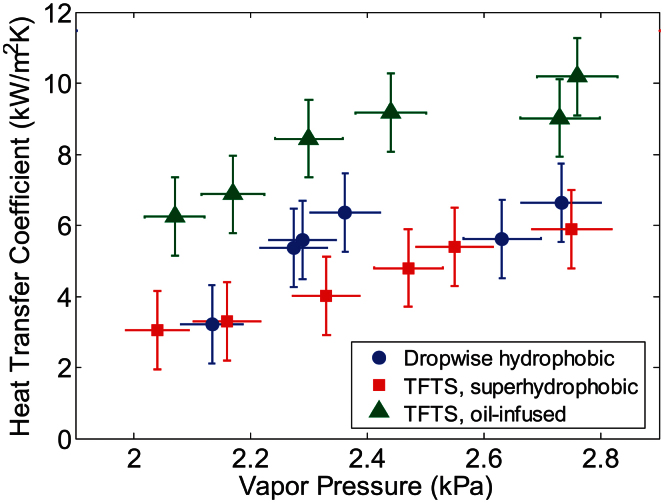
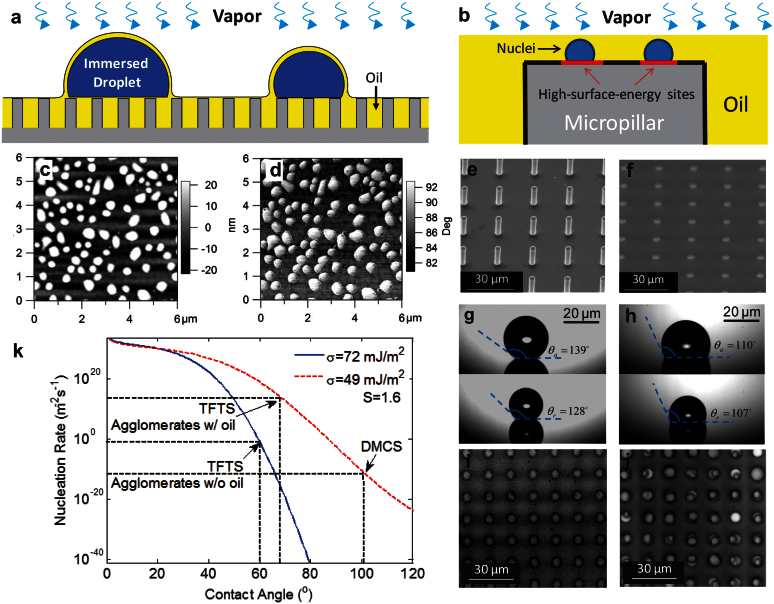
Enhancing condensation heat transfer is important for broad applications from power generation to water harvesting systems. Significant efforts have focused on easy removal of the condensate, yet the other desired properties of low contact angles and high nucleation densities for high heat transfer performance have been typically neglected. In this work, we demonstrate immersion condensation on oil-infused micro and nanostructured surfaces with heterogeneous coatings, where water droplets nucleate immersed within the oil. The combination of surface energy heterogeneity, reduced oil-water interfacial energy, and surface structuring enabled drastically increased nucleation densities while maintaining easy condensate removal and low contact angles. Accordingly, on oil-infused heterogeneous nanostructured copper oxide surfaces, we demonstrated approximately 100% increase in heat transfer coefficient compared to state-of-the-art dropwise condensation surfaces in the presence of non-condensable gases. This work offers a distinct approach utilizing surface chemistry and structuring together with liquid-infusion for enhanced condensation heat transfer.
强化冷凝传热对于从发电到集水系统等广泛应用而言至关重要。大量努力都集中在易于去除冷凝水方面,然而,对于实现高传热性能所需的低接触角和高形核密度等其他特性,通常却被忽视了。在这项工作中,我们展示了在具有异质涂层的注油微纳结构表面上的浸没冷凝现象,其中水滴在油中形核。表面能异质性、降低的油水界面能以及表面结构化的结合,在保持易于去除冷凝水和低接触角的同时,能够大幅提高形核密度。因此,在注油的异质纳米结构氧化铜表面上,我们证明,在存在不凝性气体的情况下,与最先进的滴状冷凝表面相比,传热系数提高了约100%。这项工作提供了一种独特的方法,利用表面化学、结构化以及液体注入来强化冷凝传热。