Institute of Chinese Materia Medica, China Academy of Chinese Medical Sciences, Beijing 100700, China.
Molecules. 2013 Jun 13;18(6):6919-35. doi: 10.3390/molecules18066919.
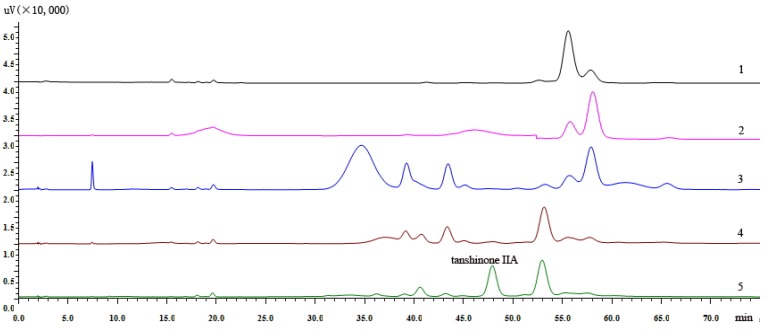
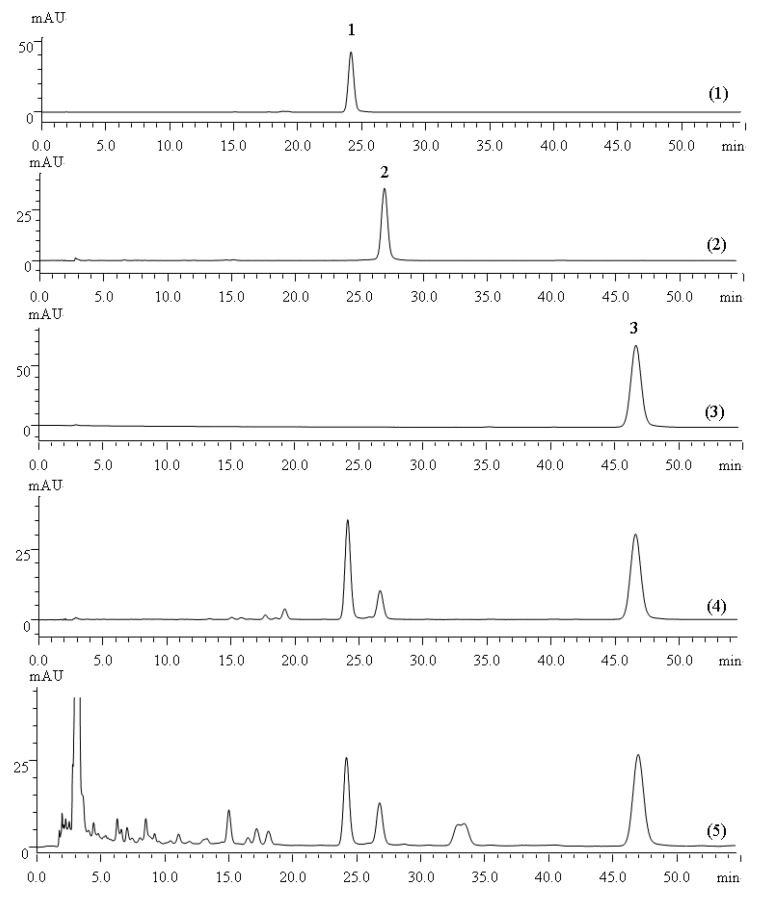
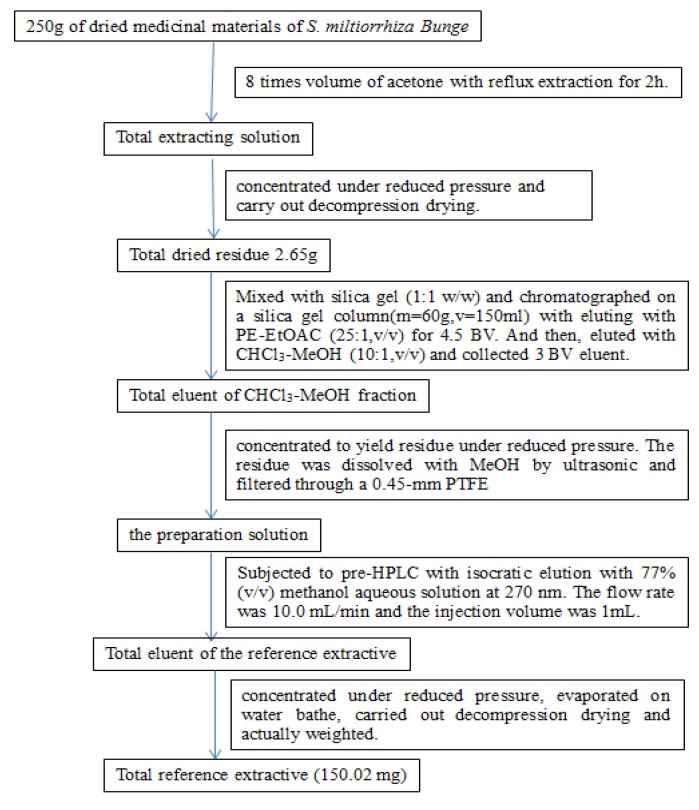
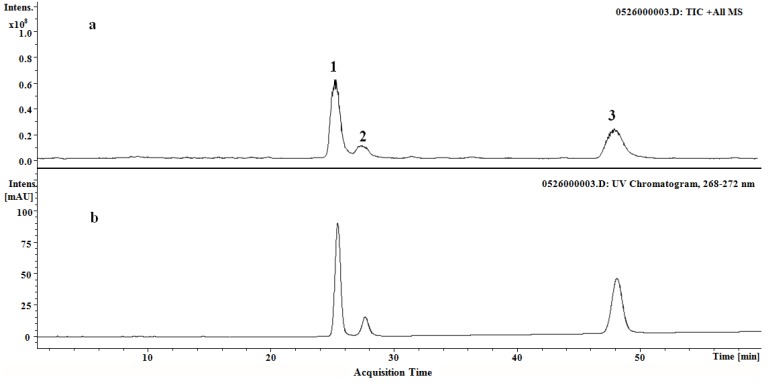
A reference extractive, containing multiple active known compounds, has been considered to be an alternative to individual reference standards. However, in the Chinese Pharmacopoeia (ChP) the great majority of reference extractives have been primarily used for qualitative identification by thin-layer chromatography (TLC) and few studies on the applicability of reference extractives for quantitative analysis have been presented. Using Salvia miltiorrhiza Bunge as an example in this paper, we first present a preliminary discussion on the feasibility and applicability of reference extractives for the quantitative analysis of TCMs. The reference extractive of S. miltiorrhiza Bunge, comprised of three pharmacological marker compounds, namely cryptotanshinone, tanshinone I and tanshinone IIA, was prepared from purchased Salvia miltiorrhiza Bunge by extraction with acetone under reflux, followed by silica gel column chromatography with stepwise elution with petroleum ether-ethyl acetate (25:1, v/v, 4.5 BV) to remove the non-target components and chloroform-methanol (10:1, v/v; 3 BV) to yield a crude reference extractive solution. After concentration, the solution was further purified by preparative reversed-phase HPLC on a C18 column with isocratic elution with 77% methanol aqueous solution to yield the total reference extractive of S. miltiorrhiza Bunge. Thereafter, the reference extractive was applied to the quality assessment of S. miltiorrhiza Bunge using high-performance liquid chromatography (HPLC) coupled with diode array detection (DAD). The validation of the method, including linearity, sensitivity, repeatability, stability and recovery testing, indicated that this method was valid, reliable and sensitive, with good reproducibility. The developed method was successfully applied to quantify seven batches of samples collected from different regions in China and the results were also similar to those obtained using reference standards, with relative standard deviation (RSD) <3%. Preparation of a reference extractive of S. miltiorrhiza Bunge was significantly less expensive and time consuming than preparation of a corresponding reference standard. Quantitative analysis using a reference extractive was shown to be simple, low-cost, time-saving and practical, with high sensitivity and good stability; and is, therefore, a strong alternative to the use of reference standards.
一种包含多种已知活性化合物的对照提取物已被认为是替代个别对照品的一种选择。然而,在中国药典(ChP)中,绝大多数对照提取物主要用于薄层色谱(TLC)的定性鉴别,很少有研究报道对照提取物在定量分析中的适用性。本文以丹参为例,初步探讨了对照提取物用于中药定量分析的可行性和适用性。丹参对照提取物由三个药理标志物化合物,即隐丹参酮、丹参酮 I 和丹参酮 IIA 组成,由市售丹参用丙酮回流提取,然后用硅胶柱层析,用石油醚-乙酸乙酯(25:1,v/v,4.5BV)洗脱去除非目标成分,用氯仿-甲醇(10:1,v/v;3BV)洗脱得到粗对照提取物溶液。浓缩后,溶液进一步用 C18 柱制备型反相高效液相色谱法以等度洗脱 77%甲醇水溶液,得到丹参总对照提取物。此后,该对照提取物被应用于丹参的质量评估,采用高效液相色谱(HPLC)-二极管阵列检测(DAD)联用。方法验证包括线性、灵敏度、重复性、稳定性和回收率试验,结果表明该方法有效、可靠、灵敏,重现性好。该方法成功应用于定量分析来自中国不同地区的七批样品,结果与对照品法相似,相对标准偏差(RSD)<3%。与对照品相比,丹参对照提取物的制备成本显著降低,耗时更少。使用对照提取物进行定量分析简单、成本低、耗时短、实用,具有高灵敏度和良好的稳定性;因此,是替代对照品的有力选择。