Division of Nutrition, National Food Institute, Technical University of Denmark, Søborg, DK, Denmark.
Food Nutr Res. 2013 Jun 11;57. doi: 10.3402/fnr.v57i0.19805. Print 2013.
Dietary intakes of plant lignans have been hypothesized to be inversely associated with the risk of developing cardiovascular disease and cancer. Earlier studies were based on a Finnish lignan database (Fineli(®)) with two lignan precursors, secoisolariciresinol (SECO) and matairesinol (MAT). More recently, a Dutch database, including SECO and MAT and the newly recognized lignan precursors lariciresinol (LARI) and pinoresinol (PINO), was compiled. The objective was to re-estimate and re-evaluate plant lignan intakes and to identify the main sources of plant lignans in five European countries using the Finnish and Dutch lignan databases, respectively.
Forty-two food groups known to contribute to the total lignan intake were selected and attributed a value for SECO and MAT from the Finnish lignan database (Fineli(®)) or for SECO, MAT, LARI, and PINO from the Dutch database. Total intake of lignans was estimated from food consumption data for adult men and women (19-79 years) from Denmark, Finland, Italy, Sweden, United Kingdom, and the contribution of aggregated food groups calculated using the Dutch lignin database.
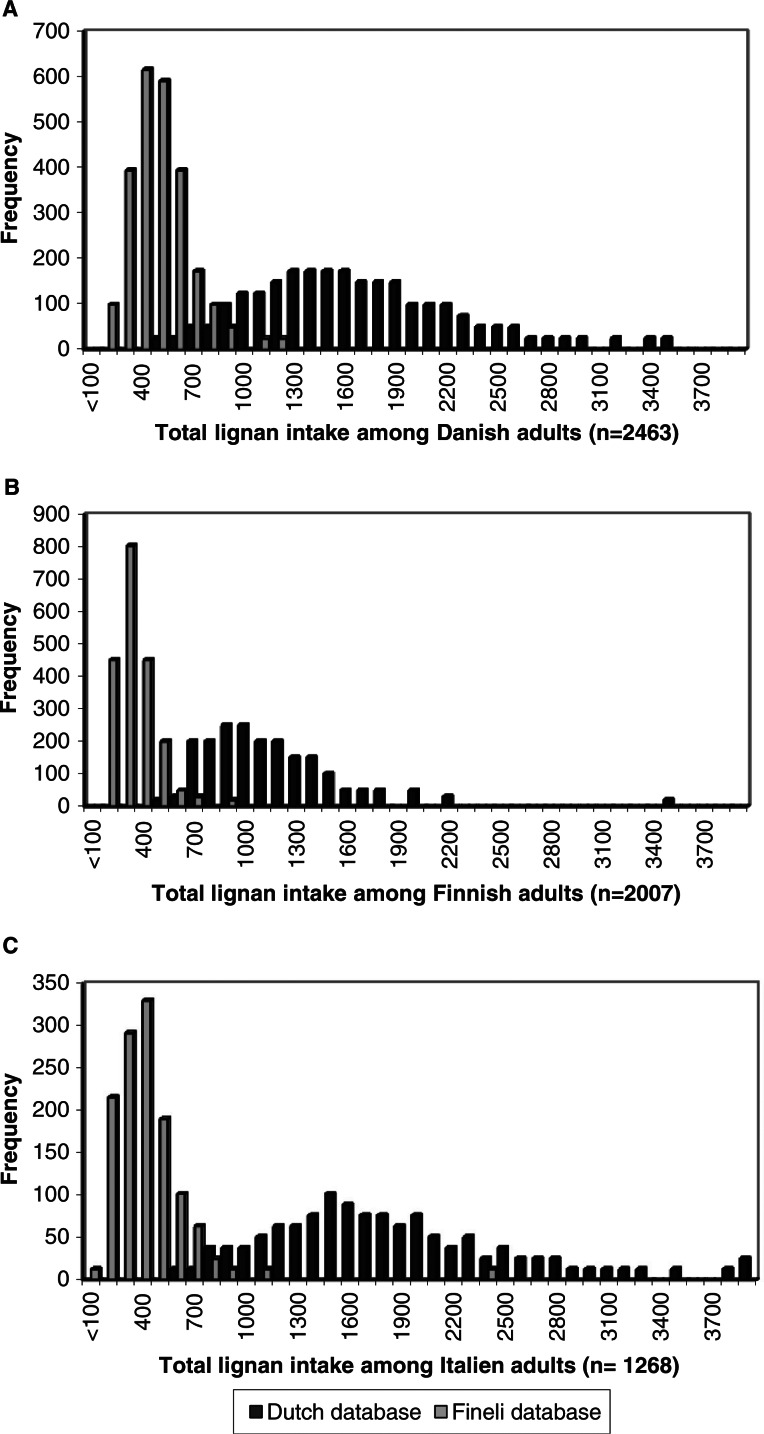
Mean dietary lignan intakes estimated using the Dutch database ranged from 1 to 2 mg/day, which was approximately four-fold higher than the intakes estimated from the Fineli(®) database. When LARI and PINO were included in the estimation of the total lignan intakes, cereals, grain products, vegetables, fruit and berries were the most important dietary sources of lignans.
Total lignin intake was approximately four-fold higher in the Dutch lignin database, which includes the lignin precursors LARI and PINO, compared to estimates based on the Finnish database based only on SECO and MAT. The main sources of lignans according to the Dutch database in the five countries studied were cereals and grain products, vegetables, fruit, berries, and beverages.
植物木脂素的饮食摄入量与心血管疾病和癌症风险呈负相关。早期的研究基于芬兰木脂素数据库(Fineli(®)),其中包含两种木脂素前体,开环异落叶松树脂酚(SECO)和马太树脂酚(MAT)。最近,一个包括 SECO 和 MAT 以及新识别的木脂素前体落叶松脂醇(LARI)和松脂醇(PINO)的荷兰数据库被编译。目的是使用芬兰和荷兰的木脂素数据库分别重新估算和评估植物木脂素的摄入量,并确定五个欧洲国家植物木脂素的主要来源。
选择了 42 种已知对总木脂素摄入量有贡献的食物组,并从芬兰木脂素数据库(Fineli(®))中为 SECO 和 MAT 赋值,或从荷兰数据库中为 SECO、MAT、LARI 和 PINO 赋值。从丹麦、芬兰、意大利、瑞典、英国的成年人(19-79 岁)的食物消费数据中估算总木脂素摄入量,并使用荷兰木脂素数据库计算汇总食物组的贡献。
使用荷兰数据库估算的平均膳食木脂素摄入量在 1 至 2 毫克/天之间,这大约是从 Fineli(®)数据库估算的摄入量的四倍。当 LARI 和 PINO 被纳入总木脂素摄入量的估算时,谷物、谷物制品、蔬菜、水果和浆果是木脂素的最重要膳食来源。
与仅基于 SECO 和 MAT 的芬兰数据库的估计相比,包含 LARI 和 PINO 木脂素前体的荷兰木脂素数据库中,总木脂素摄入量大约高出四倍。根据荷兰数据库,在研究的五个国家中,谷物和谷物制品、蔬菜、水果、浆果和饮料是木脂素的主要来源。