Department of Neurosurgery, Academic Medical Center, Neurosurgical Center Amsterdam, Amsterdam, The Netherlands.
BMJ Open. 2013 May 28;3(5):e002534. doi: 10.1136/bmjopen-2012-002534.
This study describes the 5 years' results of the Sciatica trial focused on pain, disability, (un)satisfactory recovery and predictors for unsatisfactory recovery.
A randomised controlled trial.
Nine Dutch hospitals.
Five years' follow-up data from 231 of 283 patients (82%) were collected.
Early surgery or an intended 6 months of conservative treatment.
Scores from Roland disability questionnaire, visual analogue scale (VAS) for leg and back pain and a Likert self-rating scale of global perceived recovery were analysed.
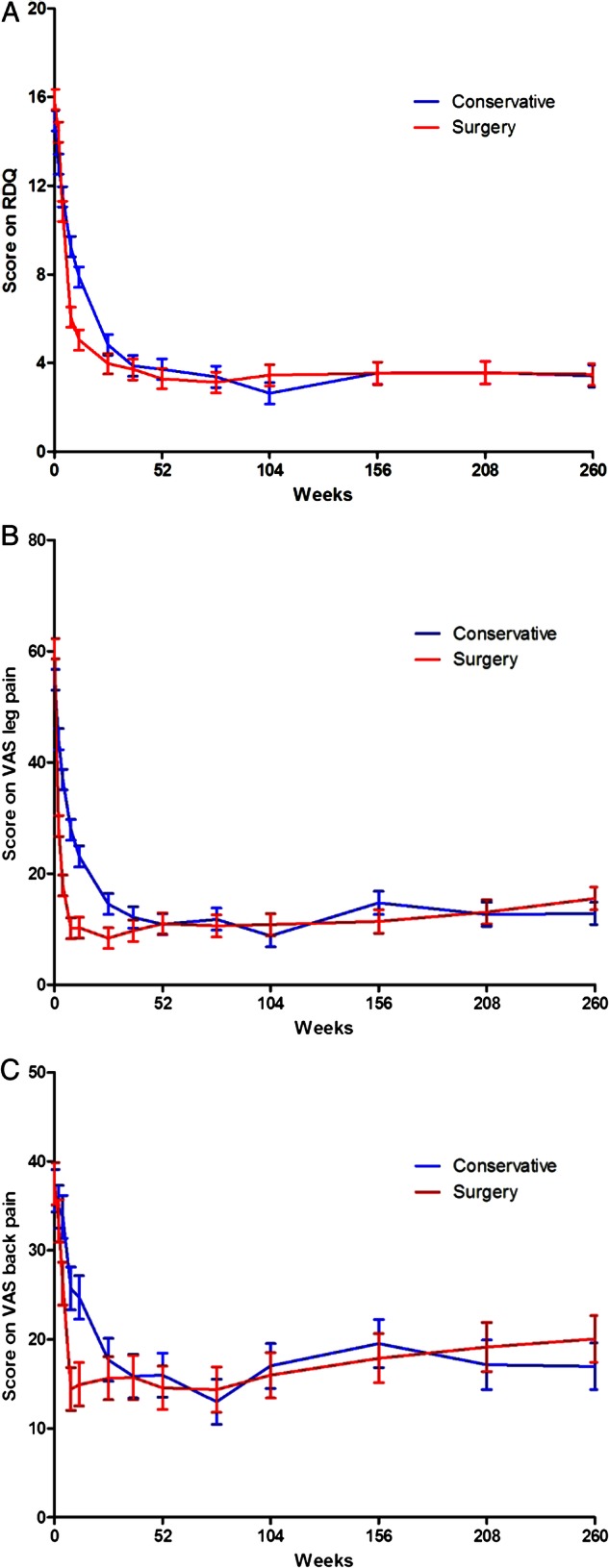
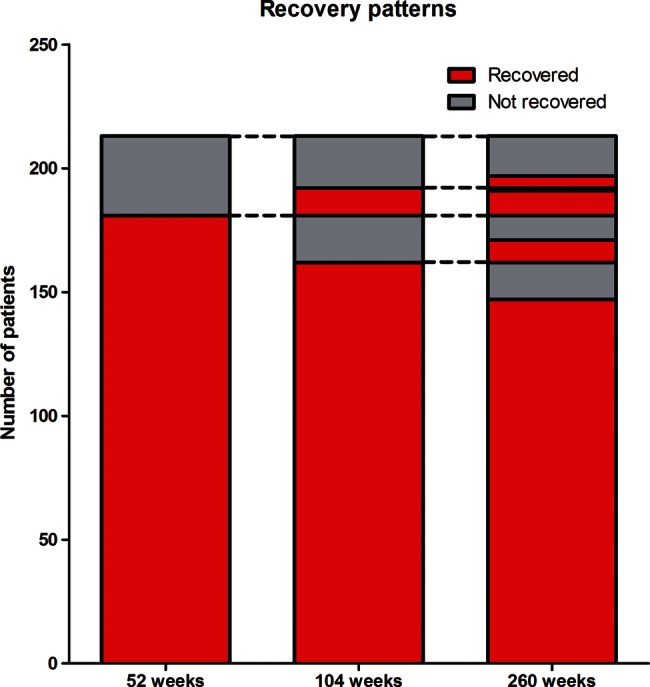
There were no significant differences between groups on the 5 years' primary outcome scores. Despite at least 6 months of conservative treatment 46% of the conservatively allocated patients were treated surgically because of severe leg pain and disability. Forty-nine (21%) patients had an unsatisfactory recovery at 5 years and the recovery pattern showed that there was a variable group of 66 patients (31%) with at least one unsatisfactory outcome at 1, 2 or 5 years of follow-up. Multivariate logistic regression showed that age (>40; OR 2.42 (95% CI 1.16 to 5.02)), severity of leg pain (VAS >70; OR 3.32 (95% CI 1.69 to 6.54)) and the Mc Gill affective score (score >3; OR 6.23 (95% CI 2.23 to 17.38)) were the only significant predictors for an unsatisfactory outcome at 5 years.
In the long term, 8% of the patients with sciatica never showed any recovery and in at least 23%, sciatica appears to result in ongoing complaints, which fluctuate over time, irrespective of treatment. Prolonged conservative care might give patients a fair chance for pain and disability to resolve without surgery, but with the risk to receive delayed surgery after prolonged suffering of sciatica. Age above 40 years, severe leg pain at baseline and a higher affective Mc Gill pain score were predictors for unsatisfactory recovery. Trial Registry ISRCT No 26872154.
本研究描述了坐骨神经痛试验的 5 年结果,重点关注疼痛、残疾、(不满意)康复以及对不满意康复的预测因素。
一项随机对照试验。
9 家荷兰医院。
共收集了 283 名患者中的 231 名(82%)的 5 年随访数据。
早期手术或计划的 6 个月保守治疗。
罗尔登残疾问卷评分、腿部和背部疼痛视觉模拟量表(VAS)评分以及整体感知恢复的李克特自我评分量表进行分析。
两组在 5 年主要结局评分上无显著差异。尽管接受了至少 6 个月的保守治疗,但由于严重腿部疼痛和残疾,仍有 46%的保守治疗组患者接受了手术治疗。5 年后有 49 名(21%)患者康复不满意,且康复模式表明,有 66 名(31%)患者在 1、2 或 5 年随访中有至少 1 项不满意的结果,存在变异性。多变量逻辑回归显示,年龄(>40 岁;OR 2.42(95%CI 1.16 至 5.02))、腿部疼痛严重程度(VAS >70;OR 3.32(95%CI 1.69 至 6.54))和麦吉尔情感评分(评分>3;OR 6.23(95%CI 2.23 至 17.38))是 5 年时不满意结局的唯一显著预测因素。
在长期随访中,8%的坐骨神经痛患者从未出现任何恢复,而在至少 23%的患者中,坐骨神经痛似乎导致持续的疼痛和残疾,这些症状随时间波动,与治疗无关。长期保守治疗可能使患者有机会在不进行手术的情况下缓解疼痛和残疾,但存在因长期坐骨神经痛而接受延迟手术的风险。年龄>40 岁、基线时腿部疼痛严重以及较高的麦吉尔情感疼痛评分是不满意康复的预测因素。试验注册号:ISRCTN26872154。