Infectious Disease Epidemiology Group, School of Public Health, Li Ka Shing Faculty of Medicine, University of Hong Kong, Hong Kong Special Administrative Region, China.
BMJ. 2013 Jun 24;346:f3693. doi: 10.1136/bmj.f3693.
To characterise the complete case series of influenza A/H7N9 infections as of 27 May 2013, detected by China's national sentinel surveillance system for influenza-like illness.
Case series.
Outpatient clinics and emergency departments of 554 sentinel hospitals across 31 provinces in mainland China.
Infected individuals were identified through cross-referencing people who had laboratory confirmed A/H7N9 infection with people detected by the sentinel surveillance system for influenza-like illness, where patients meeting the World Health Organization's definition of influenza-like illness undergo weekly surveillance, and 10-15 nasopharyngeal swabs are collected each week from a subset of patients with influenza-like illness in each hospital for virological testing. We extracted relevant epidemiological data from public health investigations by the Centers for Disease Control and Prevention at the local, provincial, and national level; and clinical and laboratory data from chart review.
Epidemiological, clinical, and laboratory profiles of the case series.
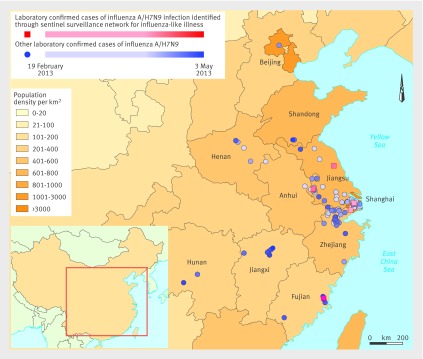
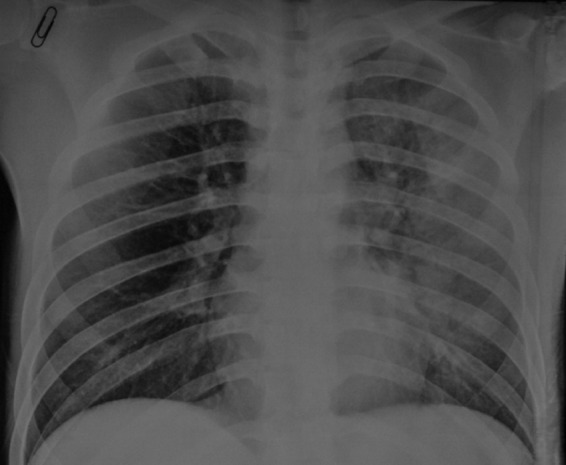
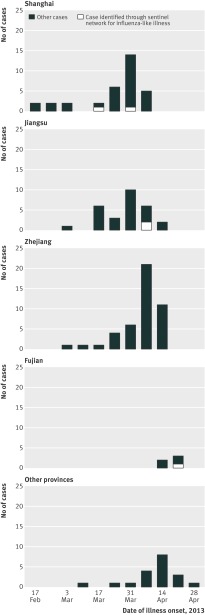
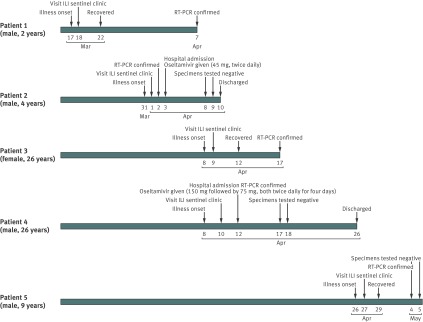
Of 130 people with laboratory confirmed A/H7N9 infection as of 27 May 2013, five (4%) were detected through the sentinel surveillance system for influenza-like illness. Mean age was 13 years (range 2-26), and none had any underlying medical conditions. Exposure history, geographical location, and timing of symptom onset of these five patients were otherwise similar to the general cohort of laboratory confirmed cases so far. Only two of the five patients needed hospitalisation, and all five had mild or moderate disease with an uneventful course of recovery.
Our findings support the existence of a "clinical iceberg" phenomenon in influenza A/H7N9 infections, and reinforce the need for vigilance to the diverse presentation that can be associated with A/H7N9 infection. At the public health level, indirect evidence suggests a substantial proportion of mild disease in A/H7N9 infections.
描述截至 2013 年 5 月 27 日中国流感样病例国家级监测系统所检测到的甲型 H7N9 流感的完整病例系列。
病例系列。
中国大陆 31 个省的 554 家哨点医院的门诊和急诊。
通过将实验室确诊的 A/H7N9 感染病例与流感样病例国家级监测系统所检测到的病例进行交叉参照,从而确定感染个体。在流感样病例国家级监测系统中,符合世界卫生组织流感样疾病定义的患者每周进行监测,每家医院每周从流感样疾病患者中抽取 10-15 份鼻咽拭子进行病毒学检测。我们从地方、省和国家疾病预防控制中心的公共卫生调查中提取了相关的流行病学数据;并从病历回顾中提取了临床和实验室数据。
病例系列的流行病学、临床和实验室特征。
截至 2013 年 5 月 27 日,实验室确诊的 130 例 A/H7N9 感染患者中,有 5 例(4%)通过流感样病例国家级监测系统发现。平均年龄为 13 岁(范围 2-26 岁),均无基础疾病。这 5 例患者的暴露史、地理位置和症状出现时间与迄今为止实验室确诊的一般病例群相似。只有 2 例患者需要住院治疗,所有 5 例患者的病情均为轻度或中度,康复过程顺利。
我们的研究结果支持甲型 H7N9 流感感染存在“临床冰山”现象,并强化了对甲型 H7N9 感染相关多种表现的警惕。在公共卫生层面,间接证据表明甲型 H7N9 流感感染中存在大量轻症病例。