State Key Laboratory of Cardiovascular Disease, China Oxford Centre for International Health Research, Fuwai Hospital, National Center for Cardiovascular Diseases, Chinese Academy of Medical Sciences and Peking Union Medical College, Beijing, PR China.
PLoS One. 2013 Jun 20;8(6):e66479. doi: 10.1371/journal.pone.0066479. Print 2013.
To determine whether educational level and overweight/obesity was associated with the development of diabetes among Chinese adult men and women.
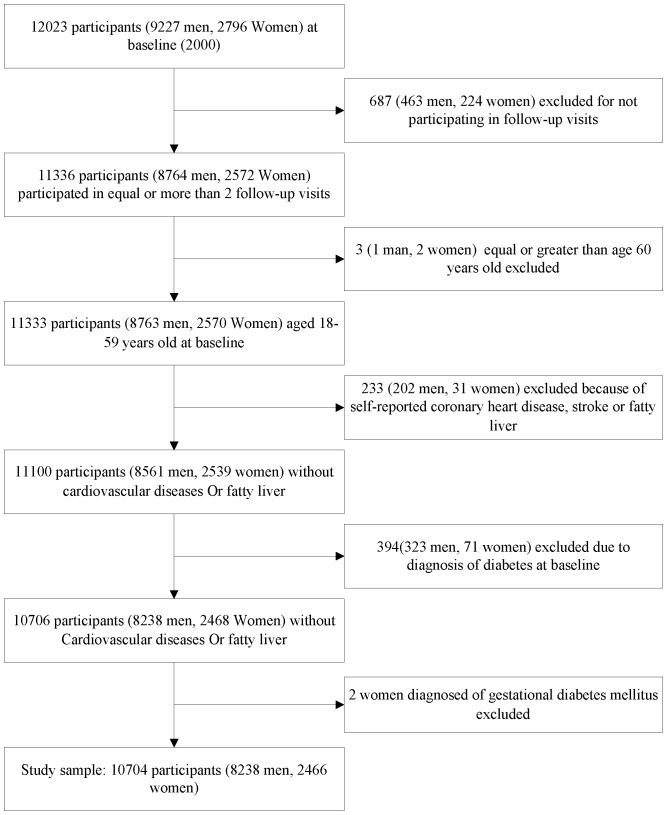
A cohort (2000-2011) of 10 704 participants aged 18-59 years (8 238 men, 2 466 women) in Qingdao Port Health Study (QPHS) were recruited in this study. The personal lifestyle, height, weight, waist circumference, resting heart rate, blood pressure, fasting blood glucose, total cholesterol, triglycerides and plasma uric acid were collected annually in a comprehensive health checkup program. Cox proportional hazards regression models were used to estimate the association of factors and incidence of diabetes.
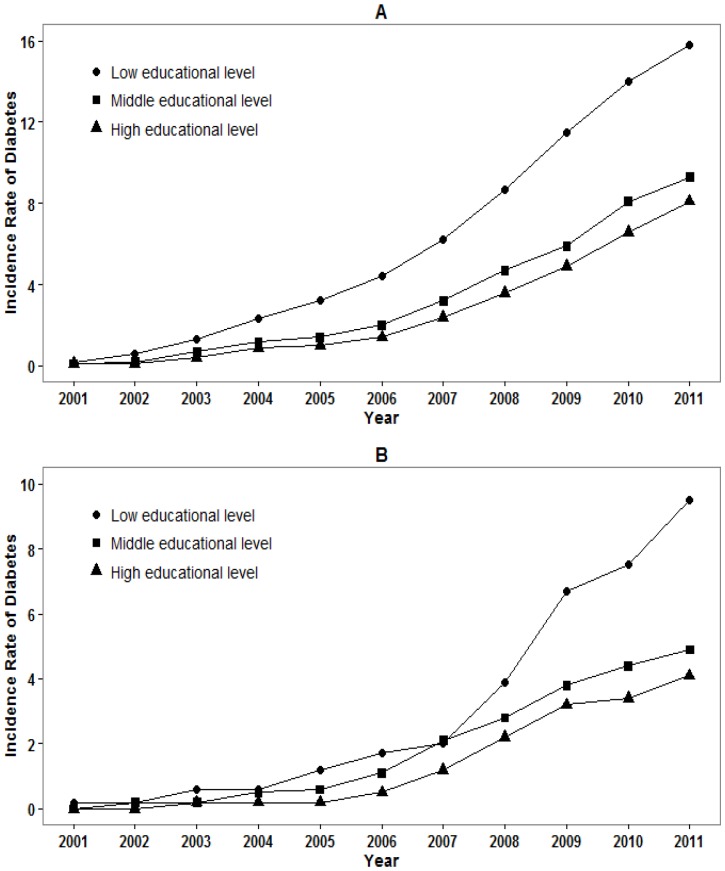
During 110 825 person-years of follow-up, 1 056 new onset cases (9.5 per 1 000 person-years) of diabetes were identified. With normal weight as reference, the multiple-adjusted hazard ratio (HR) (95%CI) of diabetes was 1.69(1.38-2.09) for overweight and 2.24(1.66-3.02) for obesity among men, which was 1.81(1.12-2.92) and 2.58(1.37-4.86) among women, respectively. Compared with the participants with high educational level, those with low educational level had a higher risk of diabetes (multiple-adjusted HR (95%CI): 1.43(1.11-1.86)) among men. The association was not found among women and the adjusted HR (95%CI) of diabetes was 1.56(0.89-2.76). The increased risks of low educational level were independent of mediators among men, through normal weight (P for trend = 0.0313) and overweight (P for trend = 0.0212) group but not obesity group (P for trend = 0.0957).
Baseline overweight/obesity was an independent risk factor for diabetes for both men and women. Low educational level was adversely associated with incidence of diabetes through normal weight, overweight and obesity groups, with the association being substantially attenuated by mediating factors only in the obesity group among men. The association was not found among women.
确定教育水平和超重/肥胖与中国成年男女糖尿病的发生是否有关。
本研究纳入了青岛港健康研究(QPHS)中的一个队列(2000-2011 年)共 10704 名 18-59 岁的参与者(8238 名男性,2466 名女性)。在全面健康体检项目中,每年收集个人生活方式、身高、体重、腰围、静息心率、血压、空腹血糖、总胆固醇、甘油三酯和血尿酸等数据。采用 Cox 比例风险回归模型来估计各因素与糖尿病发病的相关性。
在 110825 人年的随访期间,共发现 1056 例新发糖尿病病例(9.5/1000 人年)。与正常体重者相比,男性超重者的糖尿病多因素调整后风险比(HR)(95%CI)为 1.69(1.38-2.09),肥胖者为 2.24(1.66-3.02);女性分别为 1.81(1.12-2.92)和 2.58(1.37-4.86)。与高学历者相比,低学历者患糖尿病的风险更高(多因素调整后 HR(95%CI):1.43(1.11-1.86)),但在女性中并未发现这种关联,糖尿病的调整后 HR(95%CI)为 1.56(0.89-2.76)。在男性中,这种与低学历相关的糖尿病风险升高与正常体重(P 趋势=0.0313)和超重(P 趋势=0.0212)组而非肥胖组(P 趋势=0.0957)的中介因素无关。
基线超重/肥胖是男性和女性糖尿病的独立危险因素。低学历与糖尿病的发生呈负相关,通过正常体重、超重和肥胖组,仅在男性肥胖组中,这种关联被中介因素显著减弱。在女性中未发现这种关联。