National Institute of Parasitic Disease, Chinese Center for Disease Control and Prevention, WHO Collaborating Centre on Malaria, Schisostomiasis and Filariasis, Key Laboratory of Parasite and Vector Biology, Ministry of Health, 207 Rui Jin Er Rd, Shanghai, 200025, People's Republic of China.
Infect Dis Poverty. 2012 Nov 1;1(1):7. doi: 10.1186/2049-9957-1-7.
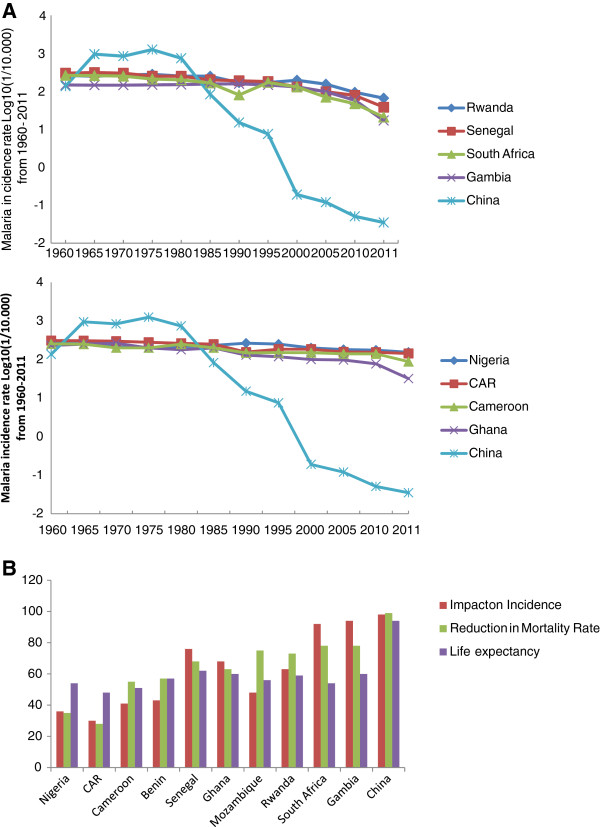
This review aims at providing synthetic information with scientific evidence on the trends in the malaria events from 1960 to 2011, with the hope that it will help policy makers to take informed decisions on public health issues and intervention designs on malaria control towards elimination in both Sub-Sahara Africa and in the People's Republic of China by highlighting the achievements, progress and challenges in research on moving malaria from epidemic status towards elimination. Our findings showed that since 1960, malaria control programmes in most countries have been disjointed and not harmonized. Interestingly, during the last decade, the causal factors of the unprecedented and substantial decline in malaria morbidity and mortality rates in most vulnerable groups in these endemic areas are multifaceted, including not only the spread of malaria and its related effects but also political and financial willingness, commitment and funding by governments and international donors. The benefits of scaling up the impact of malaria coverage interventions, improvement of health system approaches and sustained commitment of stakeholders are highlighted, although considerable efforts are still necessary in Sub-Sahara Africa. Furthermore, novel integrated control strategies aiming at moving malaria from epidemic status to control towards elimination, require solid research priorities both for sustainability of the most efficient existing tools and intervention coverage, and in gaining more insights in the understanding of the epidemiology, pathogenesis, vector dynamics, and socioeconomic aspects of the disease. In conclusion, political commitment and financial investment of stakeholders in sustaining the scaling up impact of malaria control interventions, networking between African and Chinese scientists, and their Western partners are urgently needed in upholding the recent gains, and in translating lessons learnt from the Chinese malaria control achievements and successes into practical interventions in malaria endemic countries in Africa and elsewhere.
本文旨在提供综合信息和科学依据,介绍 1960 年至 2011 年疟疾事件的趋势,希望能帮助决策者在公共卫生问题上做出明智的决策,并为撒哈拉以南非洲和中华人民共和国的疟疾控制干预设计提供参考,突出在将疟疾从流行状态推向消除的研究方面所取得的成就、进展和挑战。我们的研究结果表明,自 1960 年以来,大多数国家的疟疾控制计划都缺乏协调性和统一性。有趣的是,在过去十年中,大多数流行地区最脆弱群体疟疾发病率和死亡率大幅下降的原因是多方面的,不仅包括疟疾的传播及其相关影响,还包括政府和国际捐助者的政治意愿、承诺和资金投入。扩大疟疾防治干预措施的影响、改善卫生系统方法以及利益相关者的持续承诺所带来的好处得到了强调,尽管撒哈拉以南非洲仍需要做出相当大的努力。此外,新型综合控制策略旨在将疟疾从流行状态推向控制和消除,这需要明确的研究重点,既要保持现有最有效工具和干预措施的覆盖范围的可持续性,又要深入了解疾病的流行病学、发病机制、病媒动力学和社会经济方面。总之,利益相关者需要在政治承诺和财政投资方面保持疟疾控制干预措施的扩大影响,加强非洲和中国科学家之间的网络联系,以及与西方合作伙伴的联系,以维持最近取得的成果,并将从中国疟疾控制成就和成功中吸取的经验教训转化为非洲和其他疟疾流行国家的实际干预措施。